
Living in Jackson Hole with tourism means your kid’s soccer game might get delayed because a bison is blocking the road to the field. Again.
It means explaining to your kindergartener why she can’t use the bathroom at her favorite coffee shop because there’s a 45-minute line of tourists ordering lattes. It means teaching your teenagers the art of the “local bypass” route, the unspoken knowledge of which dirt roads still flow when Highway 22 is gridlocked with rental cars.
This is the texture of daily life here. Beautiful, frustrating, and unlike anywhere else.
Raising a family in Jackson Hole means developing strategies to navigate year-round tourism while protecting your quality of life. Success requires mastering seasonal rhythms, building strong local networks, teaching children to distinguish tourist spaces from local haunts, and accepting that flexibility is non-negotiable. The trade-off for stunning landscapes and tight community bonds is learning to share your home with millions of visitors annually.
The seasonal calendar that governs everything
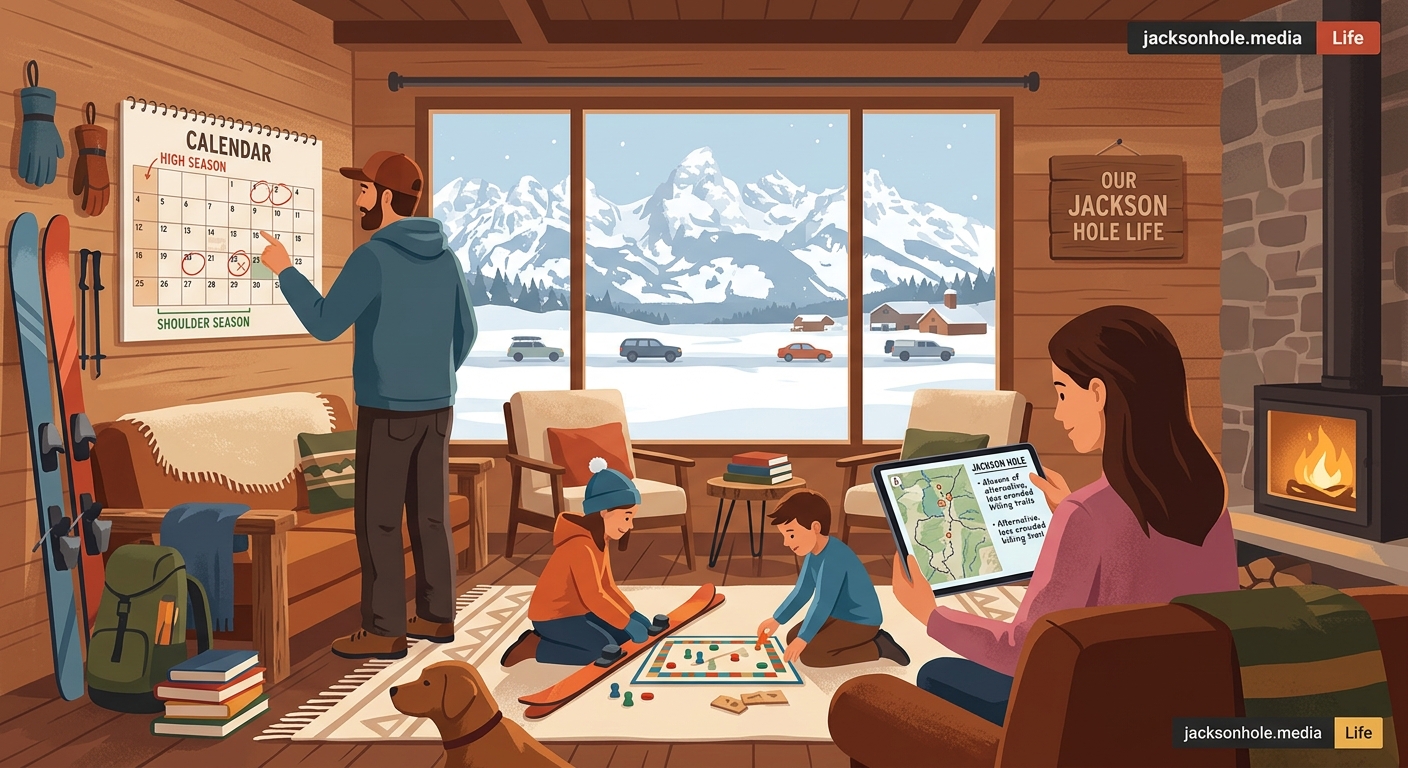
Most places have four seasons. Jackson Hole has eight.
There’s ski season (December through early April), mud season (late April through May), early summer (June), peak summer chaos (July through August), shoulder fall (September), elk rut season (late September through October), leaf peeper season (overlapping with rut), and the blessed quiet of November before it all starts again.
Your family calendar bends around these rhythms whether you want it to or not.
School schedules already account for this. Teton County School District builds in strategic breaks that don’t align with most of the country because they know half the parents work in hospitality and can’t take time off during peak seasons. Spring break often falls during mud season, not the traditional March window.
Doctor appointments? Book them for November or May. Trying to see a dentist in February means competing with ski patrol members getting their teeth fixed between powder days. Summer dental appointments are booked solid with seasonal workers finally using their insurance before they leave town.
Seasonal planning for families:
- Schedule annual physicals and dental cleanings during shoulder seasons (May or November)
- Book summer camps by January or accept the waitlist
- Plan family vacations for September or late April when you can actually afford local hotels
- Stock up on groceries midweek, never on Saturdays in summer
- Get car maintenance done in November before winter rush begins
The rhythm becomes second nature after a year or two. You stop fighting it and start flowing with it.
Teaching kids the invisible boundary between tourist town and local life
Your children will grow up bilingual in a way most Americans don’t understand. They’ll speak tourist and they’ll speak local.
Tourist means the Town Square, the elk antler arches, and anywhere on Broadway between the hours of 10 a.m. and 8 p.m. Local means the community center, the skate park behind the rec center, the actual good playground at Mike Yokel Park that tourists never find.
One Jackson Hole mother describes teaching her seven-year-old daughter the “local test” for restaurants. If you can see the Tetons from the window and the menu has a cocktail over $18, it’s a tourist spot. Save it for when grandparents visit and insist on paying.
The real local spots? They’re the ones working three jobs in town actually eat at. No mountain views. No valet parking. Just good food and familiar faces.
“We taught our kids early: if someone asks you for directions and they’re wearing brand-new Patagonia head to toe, give them the scenic route. If they’re wearing Carhartts with actual dirt on them, give them the real way.” — Local parent of three, 12-year Jackson Hole resident
This isn’t mean-spirited. It’s survival. Your kids learn which bathrooms have shorter lines (the library, always the library). Which parks empty out after 4 p.m. when tour buses head back to hotels. Which trails stay quiet even in July because they’re too short for serious hikers and too long for casual tourists.
The real cost beyond the price tag
Everyone knows Jackson Hole is expensive. What it really costs goes beyond rent and groceries.
The hidden cost is time. Everything takes longer during peak season.
A grocery run that takes 20 minutes in November takes 90 minutes in July. Not because the store is farther away, but because parking is impossible, the aisles are clogged with tourists buying snacks for their Yellowstone trip, and the checkout lines stretch to the frozen food section.
Families develop elaborate workarounds. One father does all grocery shopping at 6 a.m. on weekdays before his kids wake up. Another family uses grocery delivery year-round, considering the markup cheaper than the childcare they’d need to wrangle two toddlers through Smith’s on a Saturday in August.
Medical care requires even more creativity. The local urgent care can have three-hour waits in summer when tourists need stitches after hiking accidents. Smart locals know which doctors in Idaho Falls take their insurance and are worth the 90-minute drive for non-emergency appointments.
| Challenge | Tourist Season Reality | Local Workaround |
|---|---|---|
| Grocery shopping | 90-minute ordeal, crowded aisles | 6 a.m. weekday runs or delivery service |
| Dining out | Two-hour waits, inflated prices | Early dinners (5 p.m.) or November reservations |
| Trail access | Packed parking lots by 7 a.m. | Locals-only trailheads or post-work hikes |
| Medical appointments | Long waits, booked months ahead | Idaho Falls providers or November scheduling |
| School pickup | Traffic gridlock on highways | Backroad routes, carpools, bike commutes |
How families actually make it work financially
Very few families survive here on a single income unless that income is substantial.
The math is brutal. Median home prices hover around $2.5 million. Rentals that accept families start at $3,500 monthly for something small. A gallon of milk costs $6. Youth sports registration fees match what you’d pay in major cities, but for a town of 10,000 people.
Most families piece together multiple income streams. One parent might work for the school district (stable income, benefits, summers off). The other works hospitality or recreation (higher hourly wages, tips, seasonal flexibility). Many add a side hustle: guiding, photography, vacation rental management, freelance work that can happen after kids are in bed.
Employee housing makes the difference for many families. Positions with St. John’s Health, the school district, or Teton County government often come with housing assistance or access to deed-restricted properties. These aren’t luxurious, but they’re affordable and stable.
Some families accept a longer commute. Living in Victor, Driggs, or Alpine means housing costs drop by half or more. The trade-off is 45 to 90 minutes of driving daily and being even more strategic about when you come into town.
Common family income combinations:
- Teacher + ski instructor/summer guide + vacation rental income
- Healthcare worker + restaurant server + freelance remote work
- County employee (with housing assistance) + retail manager + side photography business
- Construction + hospitality + short-term rental management
- Remote tech job + part-time local work for community connection
The families who last aren’t necessarily the wealthiest. They’re the most flexible and creative about income.
What your kids gain that money can’t buy
The trade-offs are real, but so are the benefits that don’t show up on a balance sheet.
Children here grow up with a different relationship to nature. Not nature as a weekend destination, but as their backyard. They learn to read weather patterns because their safety sometimes depends on it. They know the difference between a black bear and a grizzly by second grade.
The community is tight in ways that surprise newcomers. When a family loses their housing, the community fundraises and finds solutions. When a parent gets injured and can’t work, meal trains organize within hours. Everyone knows the school nurse, the youth soccer coaches, and the librarians by name.
Kids here participate in activities that simply don’t exist elsewhere. Where else do elementary schoolers learn backcountry skiing, wildlife tracking, and fly fishing as part of normal childhood? Where else is the high school rodeo team as prominent as the football team?
The downside is the fishbowl effect. Everyone knows everyone. Your teenager can’t make a mistake without half the town hearing about it. Privacy is a luxury that doesn’t exist here.
Navigating the shoulder season scramble
April and November are when locals reclaim their town, but they’re also when anxiety spikes.
These are the months when seasonal workers leave, businesses close for renovation, and families wonder if they can make it through another year. Tourism slows, which means tips dry up, hours get cut, and that second or third job might pause until the next season ramps up.
Smart families build financial buffers during peak season to cover the slower months. Others pick up contract work, tackle home projects they’ve been putting off, or use the time for professional development that positions them better for the next busy season.
Shoulder seasons are also when locals actually use the amenities tourists come for. Families ski without lift lines in April. They hike popular trails without seeing another soul in November. Restaurants offer local appreciation discounts. Hidden gem spots become accessible again.
This is when community events flourish. Potlucks, craft nights, book clubs, and volunteer projects fill the social calendar because people finally have time and energy.
The school experience in a resort town
Teton County schools serve an unusual mix of students. There are kids whose families have ranched here for generations, kids of billionaires, kids of seasonal workers living three families to a house, and everything in between.
The schools handle this diversity better than you might expect. There’s an unspoken agreement that what happens outside school stays outside school. The kid whose family owns a private jet sits next to the kid whose parent cleans vacation homes, and they’re just classmates.
Class sizes are small. Teachers know every student personally. The student-to-teacher ratio allows for individualized attention that larger districts can’t match.
But there are challenges. Teacher retention is difficult because teachers face the same housing costs as everyone else. The district offers housing assistance, but it’s not always enough. Talented educators sometimes leave for places where their salary goes further.
Extracurricular activities require significant parent involvement because the school district can’t fund everything. Sports teams fundraise constantly. Music and arts programs depend on parent volunteers and community donations.
Field trips take advantage of the location. Students visit Grand Teton for science class, not as a special treat. They learn local history from people who lived it. Environmental education is woven through the curriculum in ways that feel organic because the environment is right there.
Building your local network before you need it
The families who thrive here are the ones who invest in community before crisis hits.
That means showing up. Volunteer at school events even when you’re exhausted. Attend town council meetings occasionally. Join a rec league, a book club, or a trail maintenance crew. The relationships you build during these low-stakes interactions become your safety net later.
One family learned this the hard way. They kept to themselves for two years, then faced a medical emergency that required frequent trips to Salt Lake City. They had no one to help with childcare, no meal train, no support system. They ended up leaving town.
Another family made community building a priority from day one. They hosted potlucks, joined the search and rescue volunteer team, and coached youth soccer. When they faced a similar medical crisis three years later, the community surrounded them with support. Meals appeared. Childcare was covered. Someone even organized a fundraiser for travel expenses.
The difference wasn’t the crisis. It was the groundwork laid before the crisis hit.
Ways to build local connections:
- Volunteer with Teton County Search and Rescue or Community Safety Network
- Join a rec sports league (adult soccer, volleyball, hockey)
- Attend free community events at the Center for the Arts
- Participate in trail maintenance days with local conservation groups
- Shop at the farmers market and actually talk to vendors
- Become a regular at one local coffee shop or breakfast spot
Managing the mental load of constant adaptation
Living in Jackson Hole with tourism means your family operates in constant adaptation mode.
Plans change because Highway 22 is closed due to an accident involving a tourist who’d never driven in snow. Your favorite restaurant is booked solid for the next six weeks. The trailhead you planned to hike is full by 6:30 a.m. The grocery store is out of basics because a tour bus stopped and cleaned out the produce section.
This requires a mental flexibility that wears on some people. Type-A personalities who thrive on predictability and control often struggle here. Those who can roll with chaos and find humor in absurdity tend to last longer.
Parents report teaching their kids radical flexibility as a core life skill. Backup plans have backup plans. If the original activity doesn’t work out, there are always alternatives. This adaptability serves children well later in life, but it’s exhausting to model and maintain.
The families who manage this best build in regular escape valves. They take trips to places with less natural beauty but more convenience. They visit family in towns where you can get a restaurant reservation the same day and parking lots aren’t full by dawn.
Some families leave for a few weeks each summer, renting out their home to tourists at rates that cover several months of mortgage. They use that income and time away to reset before returning for fall.
What nobody tells you about the social dynamics
Jackson Hole has an unusual social structure that affects family life in unexpected ways.
There’s old money and new money. There are multi-generational ranching families and tech executives who arrived last year. There are seasonal workers living in vans and second-homeowners who visit twice annually. Everyone shops at the same grocery store.
This creates interesting dynamics at school events and community gatherings. Wealth disparities are visible but rarely discussed directly. Kids are generally shielded from this, but parents navigate it constantly.
Some families feel pressure to keep up appearances, to have the right gear, to ski the right terrain. Others reject that entirely and embrace a simpler lifestyle focused on community over consumption.
The healthiest approach seems to be finding your people and ignoring the rest. There are enough families here with similar values that you can build a friend group that feels authentic, whether that’s artists redefining western culture, outdoor enthusiasts, service workers, or remote professionals.
When to visit family versus when to avoid visitors
Managing visiting family and friends is its own skill set here.
Everyone wants to visit Jackson Hole. Your calendar will fill with requests from relatives and college friends who haven’t called in years but suddenly want to reconnect during peak season.
Experienced locals set firm boundaries. Some families designate one week in summer and one week in winter for visitors, making it clear that other times don’t work. Others embrace a steady stream of guests, using it as an excuse to play tourist in their own town and offset costs by charging for accommodations.
The worst time for visitors, according to most locals, is late June through early August. This is when tourism peaks, prices soar, and locals are most stretched thin with work obligations. It’s also when everyone wants to come.
The best times for visitors are September (gorgeous weather, smaller crowds, wildlife active) and January (great skiing, lower prices than holidays, locals have more availability).
Visitor management strategies:
- Set a yearly limit on hosting weeks and communicate it early
- Charge family market rate for stays (or close to it) to offset the disruption
- Plan visits during shoulder seasons when you can actually spend time together
- Create a standard “things to do” list so you’re not planning from scratch each visit
- Be honest about your availability during peak work seasons
The question every family eventually faces
At some point, usually around year three or four, every family living in Jackson Hole with tourism asks the same question.
Is this sustainable long-term?
Can we keep juggling multiple jobs? Can we accept that our kids share a bedroom because that’s all we can afford? Can we handle another summer of traffic and another winter of tourists asking if we “actually live here” with barely concealed envy?
Some families answer no. They leave for places with lower costs, easier logistics, and less competition for basic resources. There’s no shame in this. Jackson Hole isn’t for everyone, and recognizing that is wisdom, not failure.
Other families double down. They buy into deed-restricted housing, commit to the community for the long haul, and accept the trade-offs as the price of admission to something special.
The families who stay long-term share certain characteristics. They’re deeply connected to the outdoor lifestyle. They value community over convenience. They’ve built strong enough social networks that they feel rooted. They’ve found work that’s meaningful beyond just a paycheck. And they’ve made peace with the fact that life here will never be easy, but it will be distinctive.
Finding your rhythm in the chaos
Living in Jackson Hole with tourism isn’t about eliminating the challenges. It’s about developing systems that let you thrive despite them.
You’ll learn which coffee shop has the shortest lines (it’s never the one with the best Instagram presence). You’ll memorize the back roads that bypass tourist traffic. You’ll know which weeks to stock up on groceries and which weeks to eat down your pantry because the stores are too chaotic to navigate.
Your family will develop its own rituals that mark the seasons. Maybe it’s the first ski day of winter, or the annual float down the Snake River in September, or the November potluck where locals collectively exhale after summer chaos ends.
These rhythms become the structure that holds everything together. They’re what your kids will remember years later, not the frustrations of tourist traffic or expensive groceries. They’ll remember the community that showed up when it mattered, the landscape that shaped their childhood, and the resilience they developed navigating a life unlike anything their peers experienced elsewhere.
That’s the real answer to whether raising a family here is worth it. Not whether it’s easy (it’s not), or affordable (it’s not), or convenient (definitely not). But whether it gives your family something meaningful that you couldn’t find anywhere else. For those who stay, the answer is yes.