
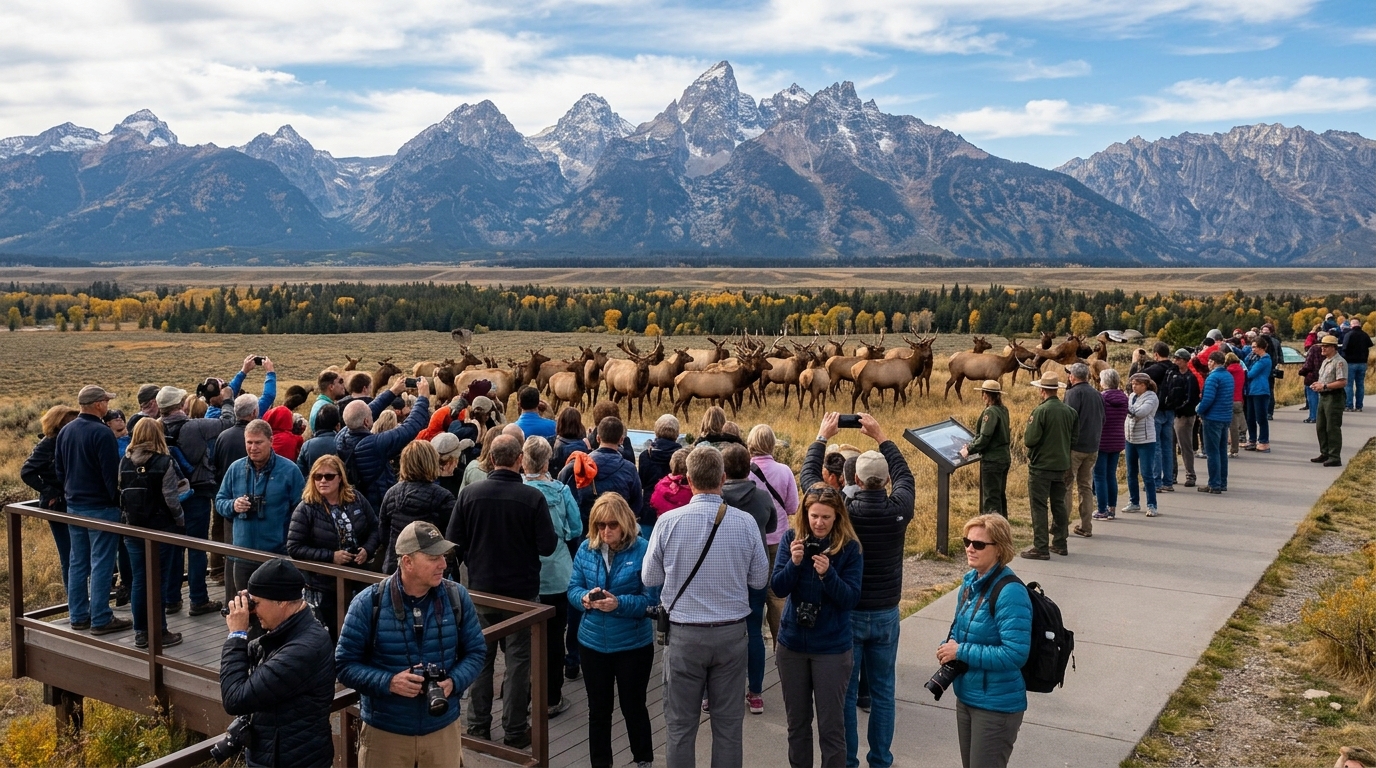
The grizzly bear stepped onto Highway 191 at 6:47 a.m. on a Tuesday in June. A line of rental cars braked hard. Phones came out. Visitors left their vehicles. Within eight minutes, a wildlife biologist was redirecting traffic while the bear retreated into the willows, visibly stressed. This scene plays out dozens of times each summer across Jackson Hole, where the collision between wildlife and tourism creates ripples that affect every species from moose to pika.
Tourism fundamentally alters wildlife behavior in Jackson Hole through habitat displacement, stress-induced changes in feeding patterns, and disrupted migration corridors. While visitor dollars fund conservation, the physical presence of three million annual tourists forces animals to adapt their routines, abandon traditional ranges, and expend critical energy avoiding humans during seasons when survival margins are already thin.
How visitor numbers reshape animal behavior
Jackson Hole hosts roughly 3.3 million visitors annually between Grand Teton National Park and the surrounding areas. That’s about 9,000 people per day during peak summer months, concentrated along a handful of roads and trails that bisect critical wildlife habitat.
The math matters. A single elk herd historically used the area around Jenny Lake for summer grazing. As foot traffic increased by 40% between 2015 and 2023, the herd shifted its core range two miles north, adding energy expenditure during a season when they should be building fat reserves for winter.
Grizzly bears show even more dramatic responses. Research from the Interagency Grizzly Bear Study Team found that bears within 400 meters of hiking trails altered their activity patterns, becoming more nocturnal and spending less time foraging in prime habitat. A female grizzly needs to consume roughly 20,000 calories per day in late summer to prepare for denning. When human presence cuts her foraging time by even two hours, she loses critical weight that affects cub survival.
The changes cascade through entire ecosystems. When large predators avoid areas with heavy human use, prey species like elk and deer recognize these zones as refuges. This creates unnatural concentrations of herbivores, which overgraze vegetation and alter plant communities. Willows along Cottonwood Creek, for example, show 60% less regeneration in high-traffic areas compared to sections where visitor access is restricted.
The infrastructure footprint nobody photographs
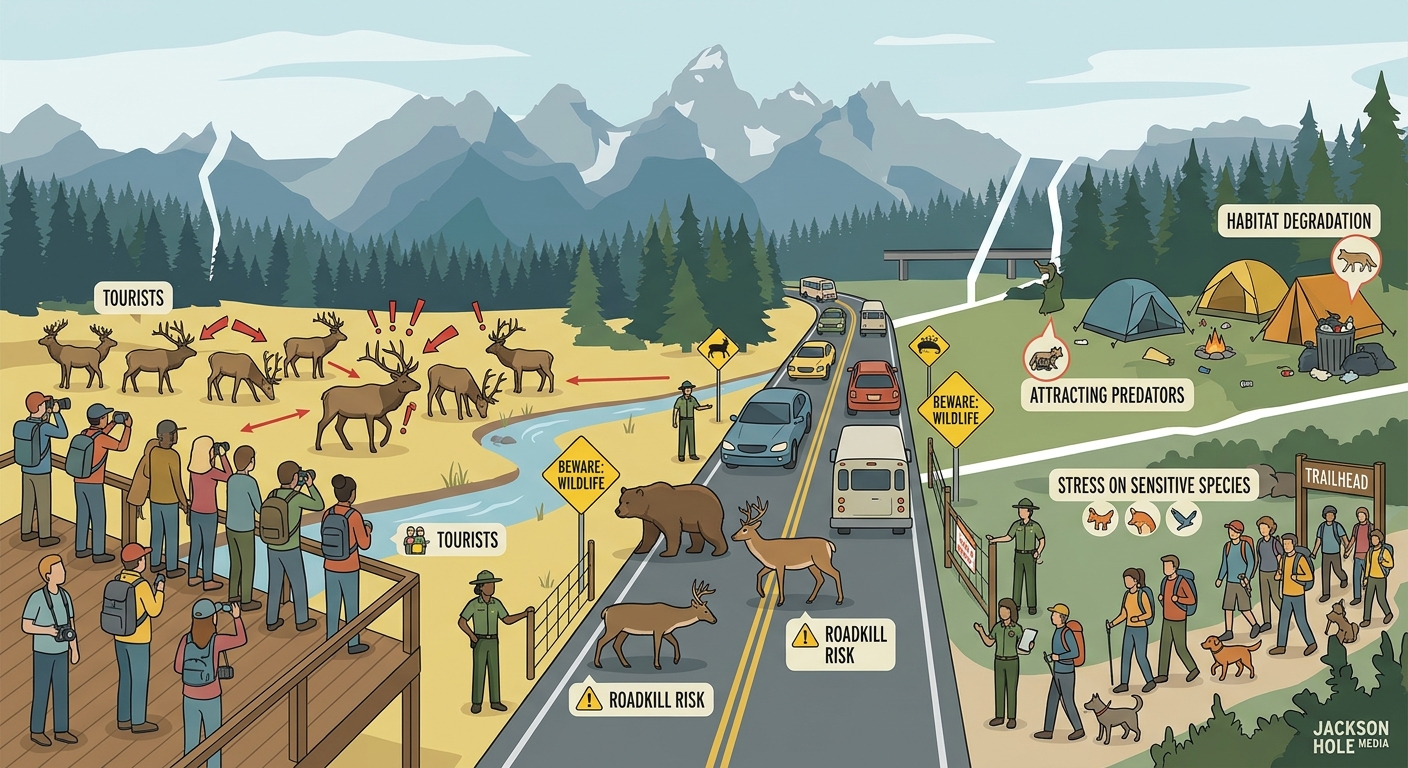
Roads tell a harder story than most visitors realize. The 42 miles of paved roads through Grand Teton create barriers that fragment habitat for species ranging from grizzlies to salamanders. Researchers documented 74 wildlife-vehicle collisions in 2023 alone, with moose and mule deer accounting for the majority of strikes.
But the visible roads are just the beginning. Service roads, parking lots, and pullouts add another 18 miles of pavement. Cell towers require access roads. Utility corridors cut through winter range. Each piece of infrastructure creates what biologists call an “edge effect,” where the altered habitat extends well beyond the physical footprint.
Consider the parking lot at Schwabacher Landing. The lot itself covers 0.8 acres. But the zone where wildlife behavior changes extends roughly 200 meters in all directions, creating a 30-acre bubble where animals modify their patterns. Multiply that across dozens of trailheads and pullouts, and you begin to understand how infrastructure affects wildlife at a landscape scale.
Nighttime lighting presents another challenge. Jackson Hole has made progress with dark sky initiatives, but hotels, parking lots, and streetlights still create artificial daylight that disrupts nocturnal species. Bats, owls, and small mammals evolved to hunt and forage in darkness. Light pollution reduces their effective hunting time and exposes them to predators during hours when they should have cover.
Three ways tourism money actually helps wildlife
The relationship between tourism and conservation isn’t purely negative. Visitor spending generates resources that directly support wildlife protection.
-
Entrance fees fund habitat restoration. Grand Teton collected $12.8 million in entrance fees in 2023. Roughly 80% of that money stays within the park system, funding projects like sage grouse habitat improvement, invasive species removal, and stream restoration. The Spread Creek restoration project, completed in 2022, reopened 4 miles of spawning habitat for native cutthroat trout using funds derived partly from visitor fees.
-
Tourism employment creates conservation advocates. When locals earn their living from wildlife-related tourism, they have economic incentives to protect animal populations. The 2,400 people employed in Jackson Hole’s outdoor recreation sector represent a political constituency that supports conservation policy. This matters during debates about development, grazing permits, and land use planning.
-
Visitor interest drives research funding. Universities and conservation groups find it easier to secure grants for wildlife research in high-profile areas like Jackson Hole. The charismatic megafauna that draw tourists also attract scientific attention. Studies on grizzly bear genetics, wolf pack dynamics, and pronghorn migration have all benefited from the visibility that tourism brings to the region.
What responsible wildlife viewing actually looks like
Most visitors genuinely want to minimize their effect on animals. But good intentions without knowledge still create problems. Here’s what makes the difference between observation and disturbance.
Distance matters more than duration. A person standing 200 meters away for an hour causes less stress than someone approaching to 50 meters for five minutes. The National Park Service recommends 100 yards for bears and 25 yards for other wildlife, but these are legal minimums, not biological ideals. If an animal changes its behavior because of your presence, you’re too close. Period.
Timing affects vulnerability. Spring brings newborn elk calves, bear cubs, and nesting birds. All are especially sensitive to disturbance. A cow elk will abandon a calf if repeatedly stressed by approaching humans. Ground-nesting birds like sage grouse will flush from nests, leaving eggs exposed to predators and temperature extremes. Why spring bear watching in Grand Teton beats any wildlife documentary explores the balance between observation and impact during this critical season.
Group size amplifies impact. One person on a trail creates a certain level of disturbance. Ten people create more than ten times that effect. Large groups generate more noise, take up more visual space, and move less predictably. Wildlife perceives them as greater threats.
“We see the same pattern every year. Memorial Day weekend hits, and within 48 hours, the moose that were feeding along Moose-Wilson Road have moved into heavier cover. They don’t leave the area entirely, but they shift to places where they’re harder to see and harder to reach. That behavioral change has an energy cost that shows up later in calf survival rates.” — Wildlife biologist, Grand Teton National Park
The hidden costs animals pay for our presence
Energy budgets determine survival for most wildlife species. Animals must balance calories consumed against calories burned, with enough surplus to survive lean periods. Human disturbance tips these equations in ways that don’t show up in visitor photos.
When a grizzly bear detects humans, it faces a choice. It can continue foraging and risk an encounter, or it can leave and find food elsewhere. If it leaves, it burns calories moving and loses foraging time in proven habitat. Over a season, these small losses accumulate. Research suggests that bears in high-use areas may need to extend their active season by up to two weeks to compensate for lost foraging opportunities, which means later denning and reduced cub survival.
Elk and bison show stress responses even without direct approaches. Elevated cortisol levels appear in animals that live near high-traffic roads compared to those in backcountry areas. Chronic stress suppresses immune function, reduces reproductive success, and shortens lifespans. The effects are subtle but measurable across populations.
Birds face different challenges. Raptors like bald eagles and ospreys abandon nests if disturbed during critical periods. A single drone flight or climbing attempt near an active nest can cause permanent abandonment. Songbirds in campgrounds show altered singing patterns and reduced nesting success compared to birds in undisturbed habitat.
How different seasons create different pressures
Winter concentrates both wildlife and impact. Animals move to lower elevations where snow is shallower and forage is accessible. These same areas attract snowmobilers, cross-country skiers, and fat-tire bikers. The National Elk Refuge hosts up to 7,000 elk each winter, along with thousands of visitors who come to see them.
Deep snow creates energy crises for large mammals. A moose burns roughly 30% more calories moving through snow deeper than 18 inches. When snowmobiles or skiers push animals off packed trails into deep powder, the energy cost can be severe. For pregnant cows carrying calves, repeated disturbances can mean the difference between a successful birth and a stillborn fawn.
Spring brings a different set of challenges. Newborns are vulnerable, and mothers are protective. A cow moose with a calf is one of the most dangerous animals in North America. When hikers or dogs surprise a cow with calf, the results can be fatal for humans. But the stress also affects the animals. Repeated defensive behaviors burn energy that should go toward lactation.
Summer sees peak visitor numbers but also peak food availability. Animals can usually compensate for human disturbance by shifting feeding times or locations. But this is also when young animals are learning survival skills. A grizzly cub learning to dig for roots or catch cutthroat trout needs uninterrupted practice time. Human presence can disrupt this education.
Fall brings hunters, hikers, and wildlife in motion. Elk are bugling and moving to rutting areas. Moose are in rut and aggressive. Bears are hyperphagic, eating 20 hours per day to build fat reserves. This is the worst time to interrupt their routines, yet it’s also when autumn colors draw huge crowds to trails and roads.
Comparing visitor behavior and wildlife outcomes
Different types of recreation create different impacts. Understanding these patterns helps both managers and visitors make better choices.
| Activity Type | Primary Impact | Affected Species | Mitigation Strategy |
|---|---|---|---|
| Road-based viewing | Habituation, vehicle strikes | Moose, bears, bison | Enforce parking rules, add wildlife crossings |
| Trail hiking | Displacement, den abandonment | Bears, wolves, nesting birds | Seasonal closures, permit systems |
| Photography | Close approaches, baiting | All large mammals | Enforce distance rules, ban baiting |
| Camping | Food conditioning, habitat loss | Bears, small mammals, birds | Bear boxes, designated sites only |
| Winter sports | Energy expenditure, displacement | Elk, moose, bighorn sheep | Trail designations, seasonal restrictions |
The table reveals patterns. Activities that allow controlled distances cause less harm than those that bring people into close contact with animals. Seasonal timing matters as much as activity type. And enforcement makes the difference between policy and practice.
What local guides know about minimizing harm
Professional wildlife guides in Jackson Hole have learned through thousands of hours in the field what actually works to reduce impact while still providing meaningful experiences.
They arrive early or stay late, avoiding midday peak hours when both crowds and animal stress are highest. Dawn and dusk offer better wildlife viewing anyway, as most species are crepuscular.
They use optics instead of approaches. A quality spotting scope at 400 meters provides better views than a phone camera at 40 meters, without the disturbance. Why a former Wall Street trader now guides fly fishing trips on the Snake River captures this philosophy of patient observation over aggressive pursuit.
They read animal body language. Ear position, tail movement, and feeding behavior all signal stress levels. A bear that stops feeding and looks toward you is showing early warning signs. A moose that raises its hackles is preparing to charge. Guides know these signals and adjust accordingly.
They share knowledge with clients. Education reduces impact. When visitors understand why distance matters, most comply willingly. The minority who don’t respond to education respond to peer pressure from informed group members.
The development pressure nobody wants to discuss
Tourism doesn’t just bring visitors. It brings infrastructure to serve them. Hotels, restaurants, shops, and employee housing all require land. Jackson Hole has added roughly 800 housing units since 2015, each one converting habitat or agricultural land that previously provided wildlife value.
The town of Jackson sits in a bottleneck that pronghorn have used for 6,000 years during their annual migration between Grand Teton and the Upper Green River Basin. This migration, at 150 miles, is the longest remaining land mammal migration in the lower 48 states. Development has already constricted the corridor. Further growth could sever it entirely.
Water use presents another challenge. Jackson Hole’s aquifer supports both human development and riparian habitat that wildlife depends on. As tourism grows, water demand increases. Wells draw down water tables. Streams that once flowed year-round now go dry in late summer. Fish die. Willows wither. Moose and beaver lose habitat.
The tension between economic growth and wildlife conservation defines Jackson Hole’s future. Tourism provides the economic base that allows the region to resist extractive industries like mining and logging. But tourism itself becomes extractive when it consumes the very resources that give the place value.
Practical steps for visitors who actually care
If you’re reading this, you probably fall into the category of travelers who want to minimize harm. Here’s what actually makes a difference.
- Visit during shoulder seasons when wildlife faces less pressure and you’ll encounter smaller crowds
- Stay on designated trails and roads to concentrate human impact in already-disturbed areas
- Invest in quality optics rather than close approaches for photography
- Keep dogs leashed always, as free-roaming dogs trigger prey responses in wildlife
- Pack out all food waste, including apple cores and orange peels that can condition animals to human food
- Report violations you witness to rangers, as enforcement depends on documentation
- Support local conservation groups financially, as they do the on-ground work that protects habitat
- Choose accommodations and tour operators with documented conservation commitments
These aren’t radical actions. They’re basic practices that compound across millions of visitors to create meaningful differences in wildlife outcomes.
The measurement problem in wildlife tourism
Scientists struggle to quantify exactly how much tourism affects wildlife populations. Correlation is clear. Causation is harder to prove. Does reduced elk calf survival in high-use areas result from human disturbance, or from habitat quality, predation pressure, or weather patterns?
Long-term studies provide the best data, but they require decades of consistent funding and methodology. The elk study on the National Elk Refuge has run since 1912, making it one of the longest continuous wildlife studies in North America. That dataset shows clear population trends, but isolating tourism impact from other variables remains challenging.
Newer technologies help. GPS collars track animal movements in relation to human activity. Remote cameras document behavior changes. Hormone analysis from fecal samples reveals stress levels. But these tools are expensive and labor-intensive. Most wildlife populations in Jackson Hole lack this level of monitoring.
The absence of perfect data doesn’t mean we should ignore obvious patterns. When animals consistently avoid areas after human use increases, we don’t need a peer-reviewed study to recognize cause and effect. Precautionary principles suggest we should err on the side of protecting wildlife when uncertainty exists.
What happens when tourism becomes the primary economy
Jackson Hole provides a preview of what full tourism conversion looks like. The valley’s economy runs almost entirely on visitor spending. Agriculture, once the economic base, now occupies a tiny fraction of employment and revenue.
This shift affects conservation in complex ways. Ranches that once provided winter range for elk now face pressure to sell for development. But some ranchers have found conservation easements that protect land while providing income. Tourism dollars fund these easements through philanthropic giving and public programs.
The workforce challenge grows more acute each year. Service industry wages can’t cover Jackson Hole housing costs. Workers commute from Idaho, living 40 to 60 miles away. This creates traffic, emissions, and infrastructure needs that ripple through the ecosystem. What it really costs to live in Jackson Hole in 2026 breaks down these economic pressures that indirectly affect wildlife through development patterns.
Where wildlife tourism gets the balance right
Not all tourism is created equal. Some models demonstrate how visitor experiences and wildlife protection can coexist.
Yellowstone’s road closure policy protects denning areas and calving grounds during critical seasons. Visitors accept these restrictions because the park clearly communicates the reasons. Wildlife benefits from undisturbed habitat during vulnerable periods.
The National Elk Refuge manages winter viewing through guided sleigh rides that follow designated routes. This concentrates human presence in a controlled zone, leaving the majority of the refuge as undisturbed habitat. The program generates revenue that funds habitat management while providing close wildlife encounters.
Private ranches that offer wildlife viewing under strict protocols show another path forward. Small groups, mandatory guides, and enforced distances create premium experiences that generate high revenue per visitor while minimizing impact per encounter.
These models share common elements. They limit numbers, control access, enforce standards, and reinvest revenue in conservation. They recognize that quality of experience matters more than quantity of visitors.
The next decade of wildlife and visitors
Current trends suggest Jackson Hole will see continued growth in visitor numbers. Climate change will alter wildlife patterns, potentially creating new conflicts. Technology will enable both better monitoring and new forms of disturbance.
The decisions made in the next few years will determine whether Jackson Hole maintains viable wildlife populations or becomes a place where animals exist primarily in protected enclaves, visible only through managed viewing programs.
Some changes are already underway. Grand Teton is experimenting with timed entry permits for certain trails. The town of Jackson is strengthening wildlife-resistant trash container requirements. Conservation groups are securing easements on critical migration corridors.
But the fundamental tension remains. Three million visitors create economic benefits and conservation challenges that can’t be fully separated. Managing this balance requires constant adjustment based on monitoring, research, and willingness to prioritize long-term wildlife survival over short-term visitor convenience.
Living with the consequences of loving a place
Jackson Hole’s wildlife tourism impact reflects a broader challenge facing wild places across North America. We love these landscapes and their animals. That love brings us here. Our presence changes what we came to see.
The grizzly bear that stepped onto Highway 191 survived that morning encounter. But she’ll face similar situations dozens more times this year. Each one burns energy, creates stress, and teaches her that roads mean danger. Eventually, she’ll shift her range to avoid peak traffic times, leaving prime habitat unused during hours when she should be foraging.
This is the hidden cost of our visits. Not dramatic die-offs or species extinctions, but subtle shifts in behavior and habitat use that compound across populations and generations. These changes are harder to see than a traffic jam or a crowded trailhead, but they’re more consequential for wildlife survival.
Your choices matter. Distance, timing, and awareness create ripples through the ecosystem just as surely as roads and development. The animals you came to see are watching you, adjusting their lives around your presence. The question isn’t whether you’ll have an impact, but whether that impact pushes them toward survival or stress.
Choose carefully. The wildlife of Jackson Hole depends on millions of individual decisions made by visitors who care enough to get it right.