
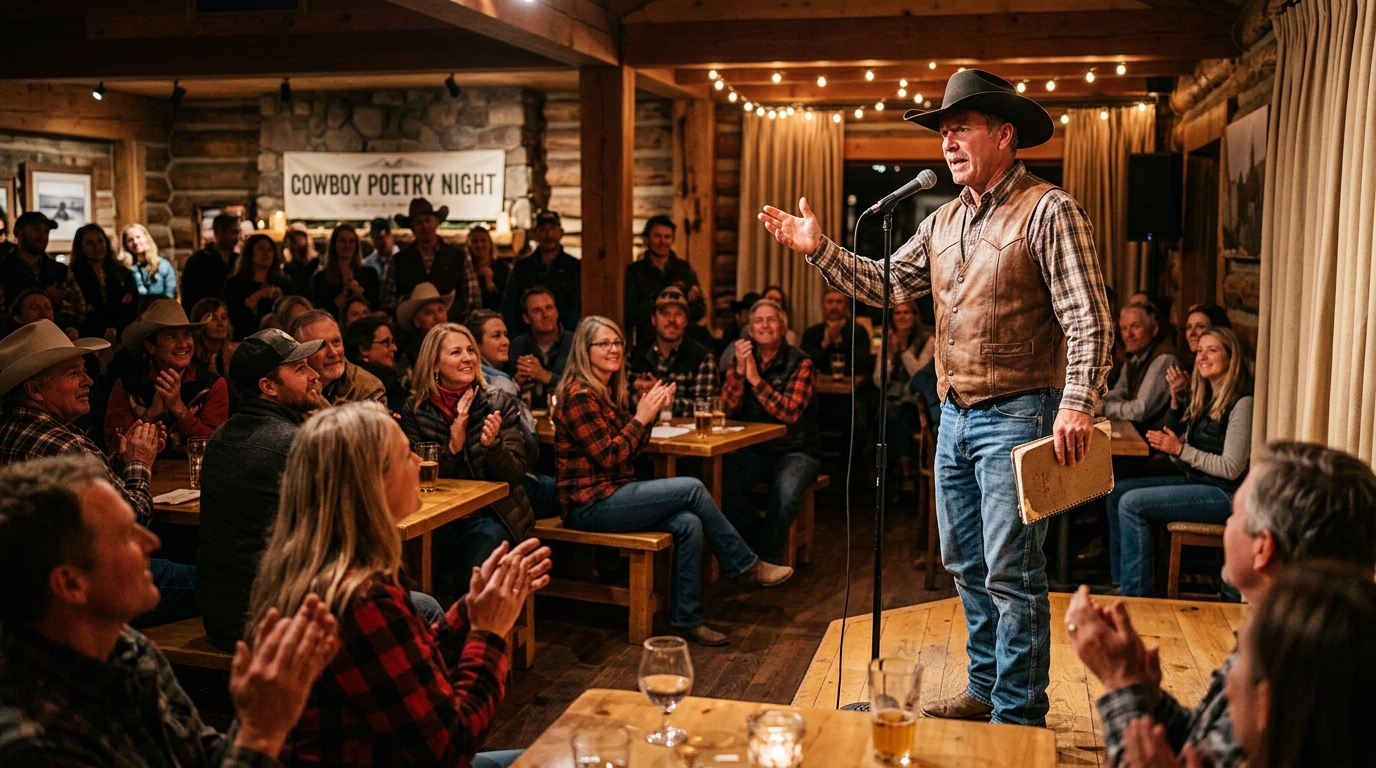
The smell of leather and sagebrush mingles with the sound of boots on wooden floors as ranchers, writers, and tourists gather in Jackson Hole for something unexpected: poetry. Not the kind you studied in high school, but verses about branding cattle at dawn, losing a good horse, and watching storms roll across the Tetons. This isn’t a museum piece. It’s a living, breathing art form that’s finding new audiences and younger voices right now.
Jackson Hole cowboy poetry blends authentic ranch life with artistic expression through regular gatherings, open mics, and workshops. The scene welcomes everyone from fourth-generation ranchers to curious visitors, preserving Western heritage while adapting to modern audiences. Performances happen year-round at local venues, combining traditional recitations with contemporary themes that reflect today’s changing West.
What Makes Cowboy Poetry Different
Cowboy poetry follows its own rules. The rhythm matches the cadence of hoofbeats. The rhyme schemes stay simple because they were meant to be memorized around campfires, not written in journals. These poems tell stories about real work: fixing fence in February, pulling calves in the mud, riding night watch during thunderstorms.
The form emerged in the 1800s when cowboys spent months on cattle drives with nothing but their voices for entertainment. They borrowed structures from Scottish ballads and Irish drinking songs, then filled them with sagebrush and cattle brands. What survived were the poems that worked out loud, that could be remembered after one hearing, that made other cowboys nod in recognition.
Jackson Hole’s version carries that DNA but adds local flavor. You’ll hear verses about elk migrations interfering with cattle rotations, about the tension between conservation and ranching, about what it means to work land that tourists photograph. The best poems here don’t romanticize ranch life. They show the broken fingernails and frozen water pipes alongside the sunrises.
Where the Scene Comes Together
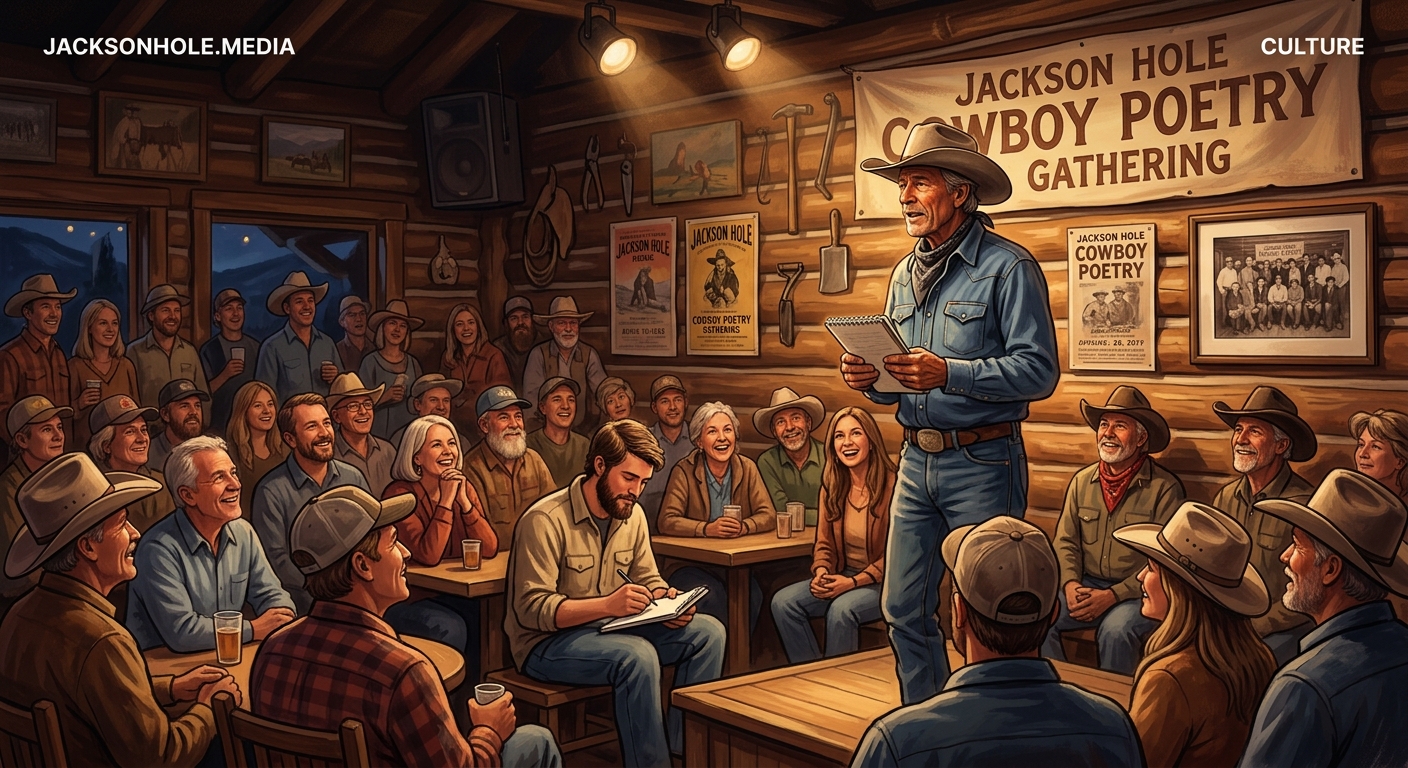
Three main venues anchor Jackson Hole cowboy poetry. The Center for the Arts hosts quarterly gatherings with featured poets and open mic slots. These evening events draw 50 to 100 people, mixing locals who’ve been coming for decades with tourists who stumbled onto something authentic.
The Million Dollar Cowboy Bar runs a monthly poetry night on the second Tuesday. The setting matters. Sitting on saddle barstools while a rancher recites verses about losing cattle to wolves creates a specific kind of magic. The bar keeps the music off and the lights up. Everyone listens.
The Jackson Hole Historical Society organizes summer workshops where working poets teach the craft. These three-hour sessions cover meter, rhyme, storytelling structure, and performance techniques. Attendees range from teenagers to retirees, from active ranchers to writers who’ve never touched a horse.
Private ranches occasionally host gatherings too. These invite-only events happen around branding or shipping times, when crews gather anyway. The poetry here skews more traditional, more insider, more likely to reference specific local geography that only valley residents would recognize.
The Poets Keeping It Alive
Jackson Hole cowboy poetry doesn’t have celebrities in the traditional sense, but it has respected voices. Some have published books. Others have never written a word down but can recite 30 poems from memory.
The scene includes fourth-generation ranchers who learned verses from their grandparents. It includes newcomers who moved here for other work but fell into the culture. It includes women writing about perspectives that early cowboy poetry ignored. It includes younger poets addressing climate change, land prices, and what happens when your family ranch becomes unaffordable.
One regular performer spent 40 years working cattle on the National Elk Refuge. His poems sound like weather reports until the last line hits you. Another writes exclusively about horses she’s lost, each poem a specific animal with a specific personality. A third performs only humorous pieces about the gap between how tourists imagine ranch life and how it actually works.
The community respects authenticity above all. You can be a beginner, you can be rough around the edges, but your material needs to come from real experience or real research. Fake cowboy poetry gets spotted immediately and politely ignored.
How to Experience It Yourself
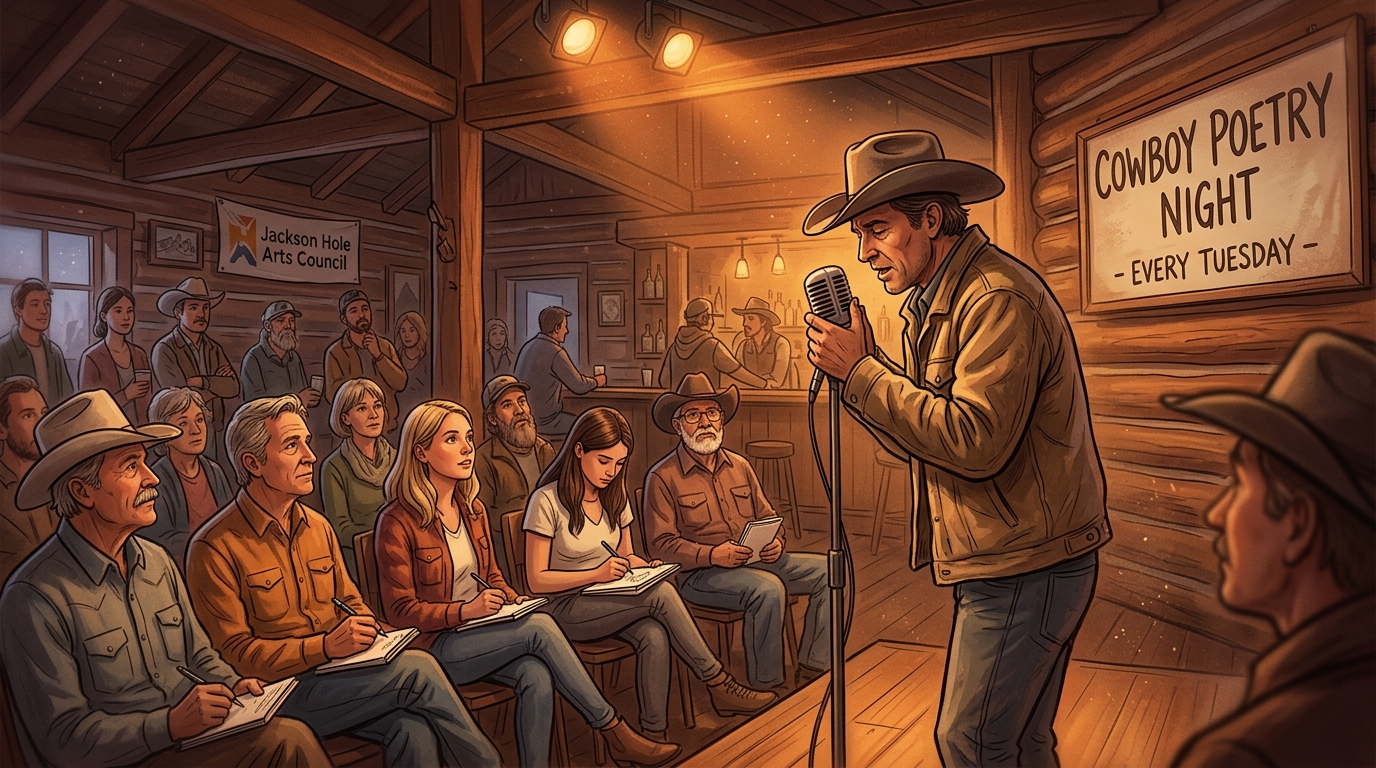
Attending a Jackson Hole cowboy poetry event requires minimal preparation but rewards some planning.
- Check the Center for the Arts calendar two weeks before your visit to catch scheduled gatherings.
- Arrive 20 minutes early because seating fills up and standing room gets uncomfortable during 90-minute programs.
- Silence your phone completely because any interruption in these quiet rooms feels massive.
- Stay for the open mic even if you won’t perform because that’s where you hear the most diverse voices.
- Talk to people during the intermission because the community welcomes genuine questions.
- Buy the chapbooks that poets sell at the back table because that’s how most of them make anything from this work.
For the Million Dollar Cowboy Bar events, different rules apply. Show up right at start time, order a drink to support the venue, and expect a louder, looser atmosphere. These nights feel more like a party where poetry happens than a formal reading.
The summer workshops require registration and fill up fast. They cost $75 to $125 and run from 1 PM to 4 PM on Saturdays. Bring a notebook, bring something you’ve written if you have it, and be ready to read your work out loud.
Common Mistakes Visitors Make
| Mistake | Why It Matters | Better Approach |
|---|---|---|
| Treating it like a tourist attraction | Poets can tell when audiences aren’t really listening | Engage genuinely or don’t come |
| Recording without asking | Many poems are unpublished intellectual property | Request permission first |
| Wearing obviously new Western gear | It signals you’re playing dress-up | Wear normal clothes |
| Interrupting poems with reactions | Breaks the performance rhythm | Save responses for between pieces |
| Asking if poems are “real” | Implies distrust of the art form | Assume authenticity unless proven otherwise |
| Leaving before open mic | Misses the community heart of the event | Plan for the full program |
The biggest mistake is assuming this is a show put on for tourists. These gatherings happened before Jackson Hole became a destination and they’ll continue if tourism disappeared tomorrow. You’re being allowed to observe and participate in something that exists for its own reasons.
The Themes You’ll Hear
Certain subjects appear repeatedly in Jackson Hole cowboy poetry. Loss runs through everything: lost cattle, lost land, lost ways of life, lost people. But the treatment avoids sentimentality. These poems acknowledge what’s gone and keep working anyway.
Weather gets constant attention. Not as backdrop but as a character that determines whether you succeed or fail. A late spring storm can kill calves. An early fall freeze can trap cattle in high country. Drought can break a ranch. Poets here track weather with the intensity of people whose income depends on it.
The relationship between humans and animals provides endless material. Not cute animal stories but complicated partnerships. The horse that saves your life one day and nearly kills you the next. The cattle that somehow find every weak spot in your fence. The dogs that understand your hand signals better than some people understand your words.
Land use conflicts show up increasingly in contemporary work. Poems address wolves, grizzlies, development pressure, conservation easements, and the economics that make ranching nearly impossible for anyone without family land. These pieces can get political but usually stay grounded in specific experiences rather than abstract arguments.
“The best cowboy poetry makes you smell the dust and feel the cold. It doesn’t tell you ranching is hard. It shows you the exact moment the calf won’t stand up and you realize you’re going to lose it anyway.” – Local poetry workshop instructor
Why the Renaissance Is Happening Now
Several forces converged to revitalize Jackson Hole cowboy poetry over the past decade. First, enough time passed that younger people could approach it fresh, without the baggage of it being their parents’ thing. Second, the broader culture developed new appreciation for regional art forms and authentic voices. Third, social media gave poets ways to share work beyond live performances.
But the main driver is simpler: people here want to preserve something real. As Jackson Hole becomes more expensive, more developed, more oriented toward wealthy part-time residents, cowboy poetry represents a connection to the valley’s working heritage. Attending these events, learning to write this way, supporting these poets becomes a form of cultural preservation.
The renaissance also benefits from institutional support. The historical society, the arts center, and several local businesses actively promote cowboy poetry. Grants fund workshops. Venues provide free space. Local media covers events. This infrastructure didn’t exist 20 years ago.
New voices matter too. Women poets, younger poets, and poets addressing contemporary issues bring fresh energy while respecting traditional forms. The scene hasn’t calcified into nostalgia. It’s adapting while maintaining its core identity.
Learning to Write It Yourself
Writing cowboy poetry requires understanding both the technical requirements and the cultural expectations. The technical side involves meter and rhyme. Most cowboy poetry uses regular meter, often iambic tetrameter or a galloping rhythm that mimics horse gaits. Rhyme schemes stay simple: AABB, ABAB, or ABCB.
The cultural side demands authenticity. You need to write from experience or deep knowledge. Surface-level observations about Western life won’t work. The audience includes people who’ve lived this material their entire lives. They’ll spot fakery instantly.
Start by listening to lots of cowboy poetry. Notice how the good ones build to a final line that reframes everything before it. Notice how they use specific details rather than general descriptions. Notice how they avoid explaining the emotion and instead show the moment that created it.
Try writing about small, specific experiences first. Not “my love of horses” but “the morning my mare stepped on my foot and I couldn’t work for a week.” Not “ranch life is hard” but “the sound fence wire makes when it snaps at 20 below.”
Read your work out loud constantly. Cowboy poetry lives in performance. If it doesn’t sound right spoken, rewrite it. If you can’t remember it after reading it three times, it’s probably too complicated.
The Jackson Hole workshops provide the best learning environment. Experienced poets will tell you exactly what works and what doesn’t. The feedback can be blunt but it’s never mean. Everyone there wants the art form to continue.
What to Read and Listen To
Building familiarity with cowboy poetry helps you appreciate Jackson Hole’s scene. Several anthologies collect classic and contemporary work. “Cowboy Poetry Matters” provides good historical context. “Songs of the Saddlemen” focuses on traditional pieces. “New Cowboy Poetry” shows how the form is evolving.
Many Jackson Hole poets have self-published chapbooks sold at local bookstores and events. These slim volumes cost $10 to $20 and represent the actual local voice better than any national anthology. Buy them directly from poets when possible.
Online resources include the Western Folklife Center’s archives, which contain thousands of recorded performances. YouTube has channels dedicated to cowboy poetry, though quality varies wildly. The best recordings capture live performances with audience reactions rather than studio readings.
Local radio station KHOL occasionally airs cowboy poetry segments, especially during summer tourist season. These 15-minute features typically include one or two poems plus brief interviews with the poets.
The Jackson Hole Historical Society library maintains a collection of cowboy poetry books, recordings, and manuscripts. You can access it during regular hours without charge.
The Economic Reality
Nobody makes a living writing cowboy poetry. Even respected poets with published books earn maybe a few hundred dollars a year from their work. Most have day jobs ranching, guiding, teaching, or working in town.
Performance fees at Jackson Hole venues typically run $50 to $200 for featured poets. Open mic participants perform for free. Workshop instructors might earn $300 for a three-hour session. Chapbook sales at events might generate $50 to $100.
This economic reality shapes the scene. It keeps out people motivated purely by money or fame. It means poets do this because they genuinely care about the art form and the culture it represents. It also means the scene depends on volunteer labor and institutional support to survive.
Some poets view this as appropriate. Cowboy poetry emerged from working people sharing stories, not from professional artists seeking audiences. The lack of money keeps it honest, keeps it connected to its roots, keeps it from becoming a commercial product.
Others worry that without some economic support, the form will struggle to attract younger voices who face higher costs of living in Jackson Hole. Finding ways to compensate poets fairly while maintaining authenticity remains an ongoing conversation.
Planning Your Visit Around Poetry Events
If cowboy poetry interests you enough to plan travel around it, certain times offer more opportunities. Summer brings the most events: weekly open mics, monthly featured readings, and the intensive workshops. June through August provides the densest schedule.
Fall shipping season (September and October) sometimes includes ranch gatherings, though these are harder for visitors to access. The Center for the Arts typically hosts a major event in October as tourist season winds down but before winter truly arrives.
Winter slows the schedule but doesn’t stop it. The Million Dollar Cowboy Bar continues monthly events. The historical society might host a January or February gathering focused on historical poems about winter ranch work.
Spring is the quietest season. Calving keeps ranchers too busy to attend events. The venues focus on other programming. If you visit in April or May, check schedules carefully.
Major Western events like the Jackson Hole Rendezvous sometimes include cowboy poetry components. The Old West Days celebration in May usually features at least one poetry session. These festival settings offer a different energy than dedicated poetry nights.
Book accommodations early if you’re visiting specifically for a workshop or major event. Jackson Hole fills up fast during peak seasons, and last-minute lodging gets expensive.
How This Fits Into Broader Western Culture
Jackson Hole cowboy poetry connects to a larger network of Western cultural preservation. Similar scenes exist in Elko, Nevada (home to the National Cowboy Poetry Gathering), Prescott, Arizona, and scattered throughout ranch country. These communities share poets, swap techniques, and support each other’s events.
But Jackson Hole’s scene has distinct characteristics. The proximity to wilderness areas and national parks creates unique tensions between conservation and traditional land use that appear in the poetry. The extreme wealth inequality in the valley produces verses about being priced out of your hometown. The collision between working ranches and luxury development generates material you won’t hear in more purely rural areas.
The scene also connects to Jackson Hole’s broader arts community. Some cowboy poets also paint, sculpt, or play music. Cross-pollination happens. A photographer might collaborate with a poet on a project about ranch life. A musician might set cowboy poems to original melodies.
This integration into the wider cultural landscape helps cowboy poetry avoid becoming a curiosity or a nostalgic sideshow. It’s treated as legitimate art alongside any other form, judged by its quality and authenticity rather than dismissed as regional kitsch.
Stories the Poems Tell
Certain narratives recur in Jackson Hole cowboy poetry, forming a collective story about life in this specific place. One common thread follows the seasonal rhythm of ranch work: calving in spring, moving cattle to high country in summer, shipping in fall, feeding through brutal winters.
Another thread addresses the relationship with predators. Wolves returned to the ecosystem in the 1990s, creating conflicts that appear throughout contemporary poetry. These pieces rarely take simple pro or anti positions. Instead, they capture the complexity of losing cattle to predators while understanding the ecological arguments for wolf recovery.
Generational transition stories appear frequently. Poems about whether children will take over the family ranch, about selling land that’s been in the family for a century, about watching the last working ranch in a valley convert to trophy homes. These pieces carry grief but also resilience.
Weather disasters provide dramatic material. The poem about the 1997 blizzard that killed thousands of cattle. Verses about drought years when you sell breeding stock just to survive. Pieces about floods washing out irrigation systems that took decades to build.
Relationship poems show up too, though they approach love and loss through the lens of ranch partnership. The poem about a spouse who died during calving season and how you still set two coffee cups out every morning. Verses about teaching a child to ride and realizing they’ve surpassed you.
Keeping the Tradition Alive
Preserving cowboy poetry requires active effort. The Jackson Hole Historical Society documents contemporary poets through audio and video recordings. These archives ensure that even unwritten poems survive for future study.
The workshops focus heavily on bringing in younger participants. Offering student discounts, partnering with local schools, and creating youth performance opportunities all aim to pass the tradition forward.
Some ranches include cowboy poetry in their agritourism offerings. Guests might attend a small evening gathering as part of their stay. This introduces the art form to people who’d never seek it out otherwise, potentially creating new audiences and participants.
Publishing remains important. Even small print runs of chapbooks create physical artifacts that libraries can collect and scholars can study. Several Jackson Hole poets have worked with university presses to publish more formal collections.
Digital preservation presents challenges. Video recordings capture performances but lose the specific energy of being in the room. Transcriptions preserve words but not delivery. The best documentation combines multiple approaches: written text, audio, video, and contextual notes about the setting and audience.
The Role of Authenticity
Authenticity functions as the ultimate value in Jackson Hole cowboy poetry. But what counts as authentic keeps evolving. Early cowboy poetry was written and performed exclusively by working cowboys. Today’s scene includes people with various connections to ranch life.
The community generally accepts that you don’t need to currently work on a ranch to write cowboy poetry. But you need some genuine connection to the culture. Maybe you grew up on a ranch but moved to town for work. Maybe you guide pack trips into the backcountry. Maybe you’re a large animal vet who spends time on ranches professionally.
What doesn’t work is pure imagination or research. Writing cowboy poetry after reading books and watching movies will produce hollow work that insiders immediately recognize. The details will be wrong, the emotional truth will be missing, the rhythm will feel imposed rather than natural.
This emphasis on authenticity can create barriers. It makes the scene less accessible to outsiders, less diverse in some ways. But it also protects the integrity of the art form and ensures it remains connected to the culture that created it.
Younger poets sometimes push against these boundaries, arguing that lived experience can come from different angles. A poem about working in a Jackson Hole restaurant that serves ranch tourists might count as authentic cowboy poetry if it captures real observations about the culture. The conversation continues.
Connecting Poetry to Place
Geography shapes Jackson Hole cowboy poetry in specific ways. The Tetons appear constantly, not as scenic backdrop but as weather makers, landmarks for navigation, and symbols of the region’s character. Poets reference specific peaks, passes, and drainages that locals recognize immediately.
The National Elk Refuge generates its own subset of poems. The winter gathering of thousands of elk creates both spectacle and management challenges. Poems address feeding programs, hunting politics, and the strangeness of wild animals on managed land.
The Snake River runs through many pieces, sometimes literally (poems about irrigating with river water) and sometimes metaphorically (the river as a symbol of change, of things flowing away, of the valley’s lifeblood).
Specific ranches appear in poems, usually without being named directly but described in ways that locals recognize. The ranch at the base of Blacktail Butte. The place where the Gros Ventre River meets the Snake. The high meadow below the Sleeping Indian.
This geographic specificity grounds the poetry in reality. It also creates layers of meaning. A tourist might enjoy a poem about moving cattle across a river. A local recognizes which river, which crossing, and knows that spot is treacherous in spring runoff, adding tension the poet never has to explain.
Where the Art Form Goes Next
Jackson Hole cowboy poetry faces questions about its future. Will enough younger people learn the craft to replace aging poets? Will the economic pressures that make ranching difficult also erode the culture that produces this art? Will the form evolve in ways that maintain its essence or dilute it beyond recognition?
Current trends suggest cautious optimism. Workshop attendance includes people in their 20s and 30s. New poems address contemporary issues while respecting traditional forms. Venues continue supporting events. Audiences show up.
The integration of women’s voices represents significant evolution. Early cowboy poetry was almost exclusively male. Today’s Jackson Hole scene includes many women poets writing from their own ranch experiences, not as wives or daughters but as workers and owners in their own right.
Environmental themes will likely grow. Climate change affects ranch operations directly through shifting weather patterns, longer droughts, and changing growing seasons. Expect more poems grappling with these realities.
The tension between preservation and evolution will continue. Some poets want to maintain strict adherence to traditional forms and subjects. Others push for expansion while staying rooted in authentic experience. This creative tension might actually strengthen the scene by preventing both stagnation and dilution.
Why It Resonates Beyond the Ranch
People with no connection to ranch life attend Jackson Hole cowboy poetry events and find themselves moved. The appeal reaches beyond nostalgia or Western romanticism to something more fundamental.
These poems speak to the experience of physical work in a world increasingly dominated by screens and abstraction. They honor skill, endurance, and direct engagement with animals and land. That resonates even with urban professionals who’ve never touched a cow.
The poems address loss, change, and persistence in ways that translate across cultures. Losing your family’s way of life to economic forces beyond your control isn’t unique to ranchers. The emotional truth carries.
The performance aspect matters too. Hearing someone recite a memorized poem in their own voice, about their own experience, creates intimacy that reading on a page can’t match. You’re not consuming content. You’re receiving a story directly from the person who lived it.
The humor helps. Cowboy poetry includes plenty of funny pieces about the gap between expectation and reality, about mishaps and absurdities, about the ways animals outsmart humans. These lighter poems make the art form accessible and enjoyable even when you don’t understand every reference.
Finding Your Way Into the Scene
If you want to move beyond observing and actually participate in Jackson Hole cowboy poetry, several paths exist. The most obvious is attending events regularly. Becoming a familiar face helps. People will start conversations. You’ll learn the unwritten rules and the community dynamics.
Volunteering helps too. The Center for the Arts and the historical society need people to set up chairs, sell tickets, manage sound systems. Helping out demonstrates genuine interest and puts you in contact with poets and organizers.
Taking a workshop provides the most direct entry point. You’ll learn the craft, meet other students, and connect with an instructor who can guide your development. The workshop environment explicitly welcomes beginners.
If you have relevant experience, consider sharing it. Even if you’ve never written poetry, you might have stories worth telling. A workshop instructor or experienced poet might help you shape those stories into verses.
Reading your work at open mics requires courage but creates instant community. The audience supports nervous beginners. Other poets will often offer encouragement and suggestions afterward. Start with one short piece and see how it feels.
Buying chapbooks, attending events, and talking genuinely with poets all contribute. This scene values people who show up, listen carefully, and engage authentically. Do that consistently and you’ll find your place.
The Sound of a Living Tradition
Stand in the back of the Center for the Arts on a Thursday evening when a rancher who’s worked the same land for 50 years recites a poem about watching his grandson learn to rope. Listen to the silence in the room, broken only by the poet’s voice and the creak of wooden chairs. Watch people nod at lines that capture something they’ve lived but never articulated.
That’s Jackson Hole cowboy poetry. Not a museum exhibit or a tourist show, but a living tradition that adapts while staying true to its roots. It preserves a way of life even as that way of life changes. It gives voice to experiences that mainstream culture often ignores. It creates community among people who might otherwise feel isolated in their work and their values.
Whether you attend one event out of curiosity or become a regular participant, you’re witnessing something rare: an authentic regional art form that emerged from working people and remains in their hands. The poems you’ll hear were written by the people who lived them, performed in their own voices, shared with audiences who understand the references because they share the landscape.
Show up with genuine interest. Listen carefully. Ask respectful questions. You might discover that poetry about branding cattle and fixing fence speaks to something universal about work, land, loss, and persistence. You might find yourself returning, not as a tourist collecting experiences, but as someone drawn to voices telling truths you won’t hear anywhere else.