
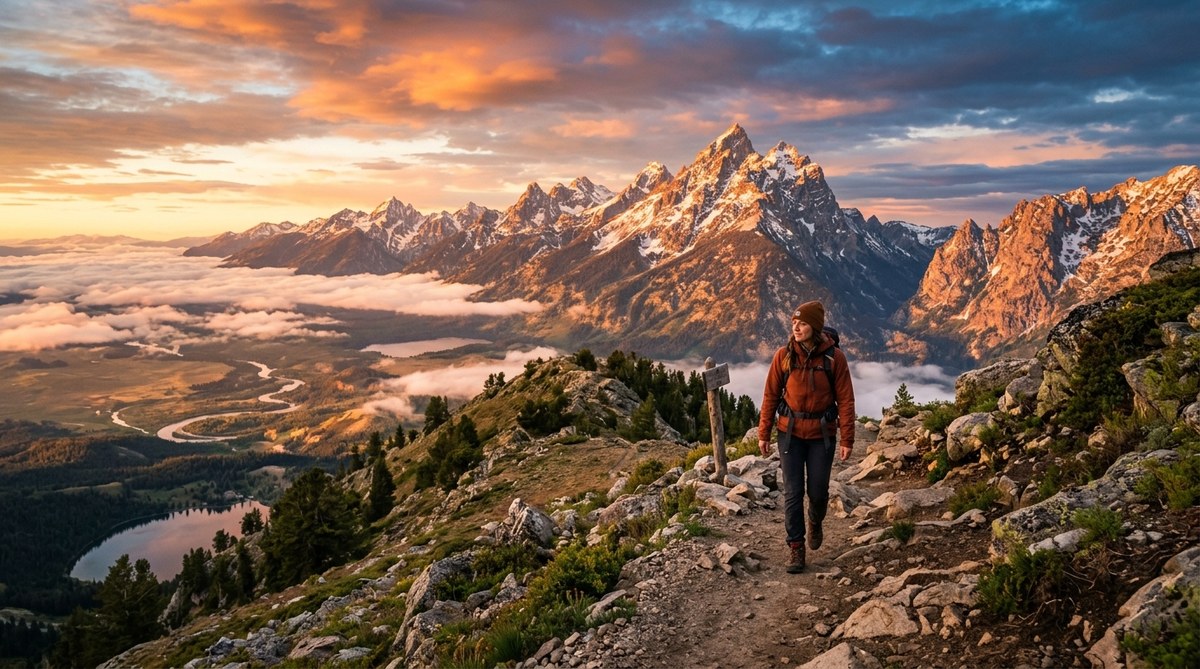
The first glow hits the Grand Tetons long before the sun clears the horizon. The sky shifts from black to deep violet, then to a band of orange that seems to hover just behind the peaks. If you are standing on a trail at that moment, the whole valley feels like it is waking up with you. This is why people come here. This is why locals set their alarms for 4 a.m. even in summer.
Getting the perfect sunrise view in Grand Teton takes more than luck. It takes planning, the right trail, and a willingness to roll out of bed when the rest of the world is still asleep. Whether you are a first time visitor or a seasoned photographer, these are the best sunrise hikes in Grand Teton National Park for 2026. We have walked every mile, tested every vantage point, and talked to the rangers who watch the light change every single day.
The best sunrise hikes in Grand Teton National Park reward early risers with alpenglow on the peaks and quiet wildlife encounters. Our top picks include the easy Schwabacher Landing trail for reflections, the moderate Signal Mountain summit loop, and the strenuous Paintbrush Canyon route for the ambitious. Always arrive at the trailhead 45 minutes before sunrise to secure parking and set up.
Why Sunrise makes Grand Teton Unforgettable
There is a reason the phrase “alpenglow” was invented for places like this. When the first rays hit the granite faces of the Tetons, the mountains seem to burn with a soft pink and gold light. That glow lasts maybe fifteen minutes. Then the sun rises higher, the shadows shrink, and the moment is gone.
Sunrise also means fewer people. On the most popular trails like Taggart Lake or Delta Lake, the midday crowds can be intense. But at 5:30 a.m., you might have the trail to yourself. Wildlife is more active too. Deer, moose, and even bears tend to feed in the cooler morning hours. A sunrise hike is your best chance to see them without a traffic jam of other visitors.
The weather plays a role as well. Afternoon thunderstorms are common in the Tetons during July and August. Starting early lets you finish before the clouds build up. For a deeper look at how locals plan around the mountain weather, check out our piece on how to read weather in the Tetons when your life depends on it.
The Top Sunrise Hikes in Grand Teton for 2026
We have ranked these hikes by accessibility, wow factor, and reliability of sunrise views. Some are short walks. Others require a real commitment. Every one of them delivers.
1. Schwabacher Landing Trail
This is the classic sunrise spot for photographers, and for good reason. The trail is a flat 1.4 mile loop that follows the Snake River. At sunrise the water becomes a perfect mirror, reflecting the entire Cathedral Group of peaks. You do not need to hike far. Most people walk just a few hundred feet from the parking area to the main beaver pond.
Difficulty: Easy.
Distance: 1.4 miles round trip.
Time needed: 30 minutes to 1 hour.
Sunrise tip: Arrive 50 minutes before sunrise to claim a spot along the riverbank.
Parking: Small lot that fills by 5:30 a.m. in summer. No overflow.
The reflection works best on calm mornings. If there is wind, the ripples break the mirror effect. Check the forecast the night before. For a less crowded alternative with similar views, walk upstream along the gravel bar instead of staying at the main pond.
2. Signal Mountain Summit
Signal Mountain rises 800 feet above Jackson Lake and offers a 360 degree view of the Tetons, the valley, and the Absaroka Range. The trail is a moderate 3.4 mile round trip with steady switchbacks. The summit is wide open, giving you plenty of room to spread out.
Difficulty: Moderate.
Distance: 3.4 miles round trip.
Time needed: 90 minutes to 2 hours.
Sunrise tip: Start hiking in the dark. Use a headlamp. The trail is obvious but rooty.
Parking: Large lot at Signal Mountain Lodge. Arrive early to avoid paying the day use fee.
The payoff is immense. At 7,600 feet elevation, you watch the sun rise over the entire park. To the east, the lights of Jackson Hole flicker in the distance. Bring a jacket. Even in July, the summit wind can be cold.
3. Taggart Lake Trail
If you want a moderate hike that ends at a lake reflecting the Grand Teton, Taggart Lake is your match. The trail is 2.8 miles round trip with only 300 feet of elevation gain. It is well maintained and popular, but at sunrise you will have the lake to yourself.
Difficulty: Moderate.
Distance: 2.8 miles round trip.
Time needed: 1 to 1.5 hours.
Sunrise tip: The best view is from the south shore of the lake. Walk around the logged section to reach it.
Parking: Small lot at Taggart Lake Trailhead. Use the Bradley Lake overflow if full.
The reflection of the Grand Teton in Taggart Lake at sunrise is one of the most photographed scenes in the park. For a longer adventure, continue from Taggart to Bradley Lake on the same trail system.
4. Paintbrush Canyon (Strenuous)
For hikers who want to earn their sunrise and then keep going, Paintbrush Canyon is the goal. This trail starts at the String Lake Trailhead and climbs into the high alpine. Sunrise hits the canyon walls about halfway up, painting the rock in warm light.
Difficulty: Strenuous.
Distance: 10 to 12 miles round trip to the divide.
Time needed: 5 to 7 hours.
Sunrise tip: Start at 3:30 a.m. to reach the open meadows by first light.
Parking: Small lot at String Lake. Overflow often goes to Jenny Lake.
This is not a hike for beginners. Elevation gain is over 2,000 feet. But the reward is a sunrise that few visitors ever see from above treeline. Bring plenty of water and layers. If you want to read about another local who spends hours in these canyons, see the story of she’s documented every moose birth in grand teton for 30 years.
5. Lake of the Crags
A hidden gem that even some locals overlook. Lake of the Crags sits at the base of the Grand Teton’s east face. The trail is 6.5 miles round trip with moderate elevation gain. The lake reflects the mountain perfectly in still conditions.
Difficulty: Moderate to strenuous.
Distance: 6.5 miles round trip.
Time needed: 3 to 4 hours.
Sunrise tip: The lake is best photographed about 20 minutes after sunrise, when the sun clears the ridgeline.
Parking: Garnet Canyon Trailhead lot. Arrive early.
The trail is less crowded than Delta Lake but offers similar views. Expect some boulder scrambling near the end.
What to Bring for a Sunrise Hike
- Headlamp with fresh batteries. Darkness lasts longer than you expect.
- Layers. A fleece or puffy jacket, plus a wind shell.
- Water. At least one liter per hour of hiking.
- Snacks. Trail mix, a granola bar, maybe a thermos of coffee.
- Camera or phone with a tripod for long exposure shots.
- Bear spray. Bears are active at dawn. Know how to use it.
- Map or download GPS offline. Cell service is spotty in the canyons.
For a deeper look at how locals navigate life in this valley, read why Jackson Hole locals start their day before sunrise.
Trail Comparison Table
| Hike | Distance (round trip) | Elevation Gain | Difficulty | Best For |
|---|---|---|---|---|
| Schwabacher Landing | 1.4 mi | minimal | Easy | Reflection photography, families |
| Signal Mountain | 3.4 mi | 800 ft | Moderate | Panoramic views, sunrise from top |
| Taggart Lake | 2.8 mi | 300 ft | Moderate | Lake reflections, Grand Teton view |
| Paintbrush Canyon | 10+ mi | 2,000+ ft | Strenuous | Alpine sunrise, wilderness |
| Lake of the Crags | 6.5 mi | 1,400 ft | Moderate | Solitude, Grand Teton reflection |
How to Time Your Sunrise Hike
Sunrise in Grand Teton varies by season. In late June, sunrise is around 5:40 a.m. By mid August, it shifts to 6:20 a.m. In September, it arrives at 6:50 a.m. Check the exact time for your visit date. Then back up the drive time to the trailhead plus the hike time.
For example, to hike Signal Mountain in July: sunrise at 5:50 a.m., hike time 1.5 hours, drive from Jackson 30 minutes. You need to leave Jackson by 3:50 a.m. It sounds brutal, but the silence of the trail in the dark has its own magic.
“The best advice I give to first timers is to watch the sky, not the clock. The color show starts about 30 minutes before the sun peeks over the mountains. If you are only looking at your watch, you will miss the whole thing.”
— Sarah, Grand Teton backcountry ranger for 14 years
Photography Tips for Sunrise
A few tricks to help you capture what you see.
- Use a tripod. Even a small travel tripod makes a huge difference for low light shots.
- Shoot in RAW. Your camera will capture more color data to edit later.
- Focus manually. Autofocus struggles in dim light. Set focus to infinity and adjust.
- Expose for the highlights. The bright peaks will blow out if you let the meter average the whole scene. Underexpose slightly and bring up shadows in post.
- Include foreground. A log, a rock, or wildflowers in the bottom third of the frame adds depth.
For more technical guidance, see our feature on how outdoor enthusiasts are shaping conservation efforts in Jackson Hole. Understanding the landscape helps you anticipate the light.
Common Mistakes and How to Avoid Them
- Arriving too late. The best spots fill by 5 a.m. in summer. You will be stuck parking far away and walking in the dark.
- Underdressing. Mornings in the Tetons can be 40 degrees even in July. Bring gloves and a hat.
- Forgetting bug spray. Mosquitoes are relentless near water at dawn. Use DEET or picaridin.
- Skipping the bear spray. It is not optional. Carry it on your hip, not in your pack.
- Not checking the weather. Rain or clouds can ruin the view. If the forecast says overcast, sleep in.
Connecting With Local Culture
Sunrise hikes are a shared ritual in Jackson Hole. Locals know the parking tricks, the best coffee shops open at 5 a.m., and which trails hold snow into July. To understand this community better, read finding community as a newcomer in Jackson Hole. Or if you want to eat like a local after your hike, see where locals actually eat: 15 Jackson Hole restaurants off the tourist trail.
Plan Ahead for 2026
Grand Teton National Park has introduced a timed entry reservation system for the most popular trailheads in 2026. Check the NPS website before your trip. Some sunrise hikes require a permit or an early arrival to bypass the reservation window if you enter before 6 a.m. Also note that parking at Jenny Lake and Taggart Lake is under construction. Use the park shuttle or park at alternative lots.
Your First Sunrise Hike: A Step By Step Plan
- Choose your hike from the list above. Pick one that matches your fitness and time.
- Check sunrise time for your exact date. Use a reliable app.
- Set your alarm for at least two hours before sunrise to allow for travel and hiking.
- Pack your bag the night before. Lay out clothes. Charge headlamp.
- Drive to the trailhead with enough margin. Expect slower speeds on the park road due to wildlife.
- Start hiking in the dark. Take your time. Stop often to listen.
- Reach your viewpoint at least 15 minutes before sunrise. Set up your camera or just sit still.
- Watch the show. Take photos but also put the camera down. Breathe.
- Be present. The sunrise will be gone in moments. Stay until the last color fades.
The Quiet Magic of the Tetons at Morning
There is a reason so many of us who live here still chase sunrises even after years of seeing them. The Tetons at dawn feel like a secret that keeps giving. The air is crisp. The only sound is the crunch of boots on gravel and the distant call of a raven. And then the light hits the summit of the Grand, and everything stops.
We hope this guide helps you find your own perfect morning on the trail. Whether you tackle the steep switchbacks of Paintbrush or simply stand at Schwabacher Landing with a cup of coffee, you are part of a long tradition of early risers who know that the best views are the ones you earn with a little bit of discomfort.
If you have questions about specific trail conditions or need advice for your 2026 trip, reach out to us at Jackson Hole Media. We are your neighbors. We are the ones with the headlamps and the thermoses, out on the trail before the sun even thinks about rising.