
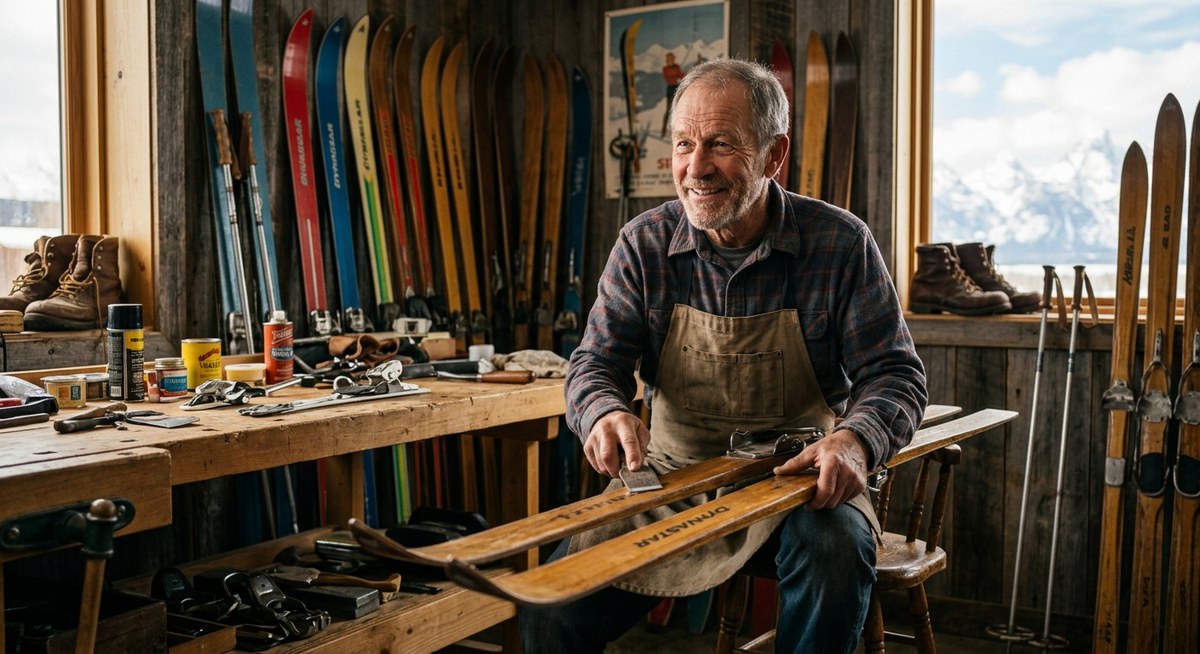
People in Jackson Hole love their ski history. Walk into any gear shop or bar near the base of the Tetons and you will hear stories about the early days. But one resident goes beyond stories. He fills his garage with old skis, bindings, and boots from the 1960s. Then he brings them back to life.
This feature takes you inside the workshop of a Jackson Hole resident who hunts for 1960s ski gear at estate sales and swap meets. You will learn his step by step restoration process, see which mistakes ruin original value, and understand why keeping these pieces alive matters for the local ski culture. Whether you collect vintage gear or just love the sport, his story will change how you see an old pair of boards.
How One Person Started Collecting Old Skis
His name is Mark. He moved to Jackson Hole in the late 1990s and fell in love with the mountain. But his real obsession started at a garage sale near Wilson in 2005. A pair of Head Standards from 1967 sat in a dusty corner. The seller wanted twenty dollars. Mark bought them on a whim.
He did not plan to become a vintage ski gear collector in Jackson Hole. But once he wiped the grime off those Head Standards and saw the original graphics, he was hooked. The wood grain. The steel edges. The straps that looked like they belonged on a fighter pilot helmet. He wanted more.
Today his collection includes over 80 pairs of skis, 40 bindings, and a stack of leather boots that still smell like 1969. He does not keep them hidden. He displays them in his shop and takes them to local events. He even skis on some of them once a season.
Why 1960s Ski Gear Matters
The 1960s was a turning point for ski design. Resin fiberglass started to replace wood. European brands like Kästle and Dynamic competed with American companies like Head and Hart. The equipment was functional but also artistic. Each pair had a personality.
For Mark, the value of vintage ski gear goes beyond nostalgia. It shows how skiing evolved from a niche hobby into a cultural force. He believes that if you want to understand how Jackson Hole became a skiing destination, you need to look at the gear that people used when the resort first opened. You can learn more about that era by reading about the backcountry ski lines every Jackson local should hit before they are gone, but the gear itself tells the story.
The Process of Restoring Vintage Ski Equipment
Restoring 1960s ski gear takes patience. Mark follows a specific sequence to avoid damaging the original materials. Here is his step by step process.
- Inspect and document. He photographs every item from multiple angles before touching anything. This helps him track original condition and identify missing parts.
- Clean gently. He uses warm water, a mild soap, and a soft cloth. No chemicals. No power tools. He dries the gear immediately to prevent rust.
- Assess the bindings. Old bindings often have cracked plastic or frozen springs. He does not force them. He applies a silicone lubricant to pivot points and lets it sit overnight.
- Repair structural damage. Delaminated edges or cracked sidewalls get epoxy. He clamps the area for 24 hours. He never sands the original topsheet because that destroys the graphic.
- Replace safety parts. If a strap or buckle is unsafe, he swaps it with a period correct replacement. He never uses modern hardware.
- Wax and tune. He applies a high fluorocarbon wax for display or a basic all temperature wax if the skis will actually be used. He sets the edge angle to 1 degree side and 2 base.
- Store properly. He keeps skis vertically in a climate controlled room away from direct sunlight. Boots get shoe trees and breathable bags.
Common Mistakes Collectors Make
Many people ruin vintage ski gear without meaning to. Mark sees the same errors over and over. The table below shows the most common mistakes and how to avoid them.
| Mistake | Why It Happens | What to Do Instead |
|---|---|---|
| Using modern epoxy | It is too strong and damages old wood cores | Use a marine grade epoxy that remains slightly flexible |
| Over polishing metal edges | Polishing removes the original patina and value | Clean with a brass brush and mild solvent only |
| Storing skis flat on the floor | Pressure causes camber to flatten over time | Lean them vertically against a wall or use a rack |
| Applying spray lubricant on bindings | Spray can drip into pivot points and attract dirt | Use a drop of silicone oil on a toothpick instead |
| Throwing away original screws and bolts | Replacements often have different thread patterns | Label and keep every original fastener in a baggie |
Tools and Supplies You Will Need
Mark keeps his workspace simple. You do not need a professional shop to restore 1960s gear. Here is a bulleted list of essentials.
- A soft bristle brush for dust and dirt
- Mild dish soap and distilled water
- Microfiber cloths that do not shed lint
- Marine grade two part epoxy
- Small clamps with padded jaws
- Silicone lubricant in a needle tip bottle
- Brass brush for edge cleaning
- Basic ski wax and an iron
- A storage rack that keeps skis upright
- Original or period correct parts sourced from swap meets
He also recommends joining online forums for vintage ski gear. Other collectors share tips and sometimes trade parts. Do not be shy about asking questions. The community is friendly.
How to Find Vintage Ski Gear in Jackson Hole
Finding old equipment is part of the fun. Mark searches in three main places.
- Estate sales in Teton County. Families often sell ski gear that has been sitting in a basement for decades. Show up early. Bring cash.
- Local thrift shops. The shelves in Jackson and Wilson occasionally hold hidden gems. Check every few weeks.
- Online marketplaces. Facebook Marketplace and Craigslist have listings from people who do not know what they own. Search for generic terms like "old skis" or "vintage ski boots."
He cautions against buying rusty gear without inspecting it first. Rust on edges can often be fixed, but rust on binding springs means the part is likely unsafe. Also be careful with boots that have dry rotted leather. They will crack the first time you try to buckle them.
A Personal Connection to the Sport
When Mark skis on a pair of restored 1966 Kästles, he feels a connection to the skiers who came before him. He thinks about the first person who clicked into those bindings and dropped into a chute in the Tetons. That sense of shared experience is what drives him.
He also sees his collection as a way to teach younger skiers about the sport's roots. He has given talks at the National Museum of Wildlife Art and shared his gear with local schools. Kids are amazed that people once skied without shaped sidecuts and with bindings that barely released.
"If you want to understand how good modern gear is, you have to feel what old gear was like. It humbles you. It makes you grateful for every advancement. And it reminds you that skiing has always been about the mountain, not the equipment."
Integrating Restoration Into a Busy Life
Mark works a full time job. He does not have a huge workshop. His garage is a single car space, and he uses fold out tables for projects. He devotes one evening per week to restoration. It is a slow hobby. That is the point.
He suggests that anyone interested in becoming a vintage ski gear collector in Jackson Hole start small. Pick one pair of skis. Focus on cleaning and basic waxing. Do not try to restore five pairs at once. The process is meditative. Rushing ruins the joy.
Where the Collection Is Headed
In 2026, Mark plans to host a public exhibit at a local venue. He wants to show how ski gear evolved from 1960 to 1969. Each year will have a dedicated pair of skis with matching bindings and boots. He is still looking for a complete 1963 set from the brand Spalding.
He also wants to partner with Jackson Hole's volunteer search and rescue team for a fundraiser. His idea? A vintage ski race where participants must use equipment from the 1960s. The proceeds would go toward rescue training.
How You Can Start Your Own Collection
Maybe you do not have 80 pairs of skis yet. That is fine. Here is a checklist to begin.
- Decide your focus. Do you want only 1960s gear or a broader range?
- Set a budget. Vintage ski gear can cost anywhere from ten dollars to five hundred per pair depending on rarity.
- Learn to spot fake graphics. Some companies reprint old stickers and sell them as original. Touch the material. Original stickers feel thin and papery.
- Build relationships with shop owners in Jackson Hole. They sometimes get trade ins from older customers who are downsizing.
- Keep a log of what you buy, what you paid, and what condition it was in. This helps when you decide to sell or trade.
What This Hobby Says About Jackson Hole
Jackson Hole has always been a place where people hold onto the past while charging into the future. The town respects its roots. Whether it is the cowboy poetry scene or the quiet dedication of the local composting moms, there is a through line of preservation. Vintage ski gear collectors fit right into that tradition.
Mark is not alone. There are at least a dozen serious collectors in Teton County. Some focus on skis. Others collect lift tickets, trail maps, or old clothing. They meet once a year at a backyard gathering to show off their finds. It is a small community, but it is passionate.
Keeping the History Alive for the Next Generation
Mark does not want his collection to end up in a dumpster. He plans to leave it to a local museum or to a younger collector who promises to care for it. He thinks about this often. The skis have stories. They deserve to keep telling them.
If you stop by his garage on a Saturday afternoon, he will probably hand you a pair of 1968 Dynamic VR17s and ask you to guess what they are made of. You will run your fingers over the edges and feel the weight. Then he will smile and say, "That is the sound of history."
So the next time you see a dusty pair of old skis at a yard sale, do not walk past them. Pick them up. Look at the base. Check the bindings. You might be holding the start of something. Just ask the guy in Jackson Hole who could not resist a twenty dollar pair of Heads.
A Living Piece of Ski Culture
Restoring 1960s ski equipment is not about turning a profit. It is about honoring the people who skied before chairlifts reached the summit. It is about understanding that every pair of skis has a story, and that story is worth telling. Mark proves that one careful repair at a time.
If you want to see his collection in person, watch for announcements at local gear shops. He usually brings a few pairs to share during the winter season. And if you bring him a pair of old Head Standards, he might just tell you the whole story all over again.