
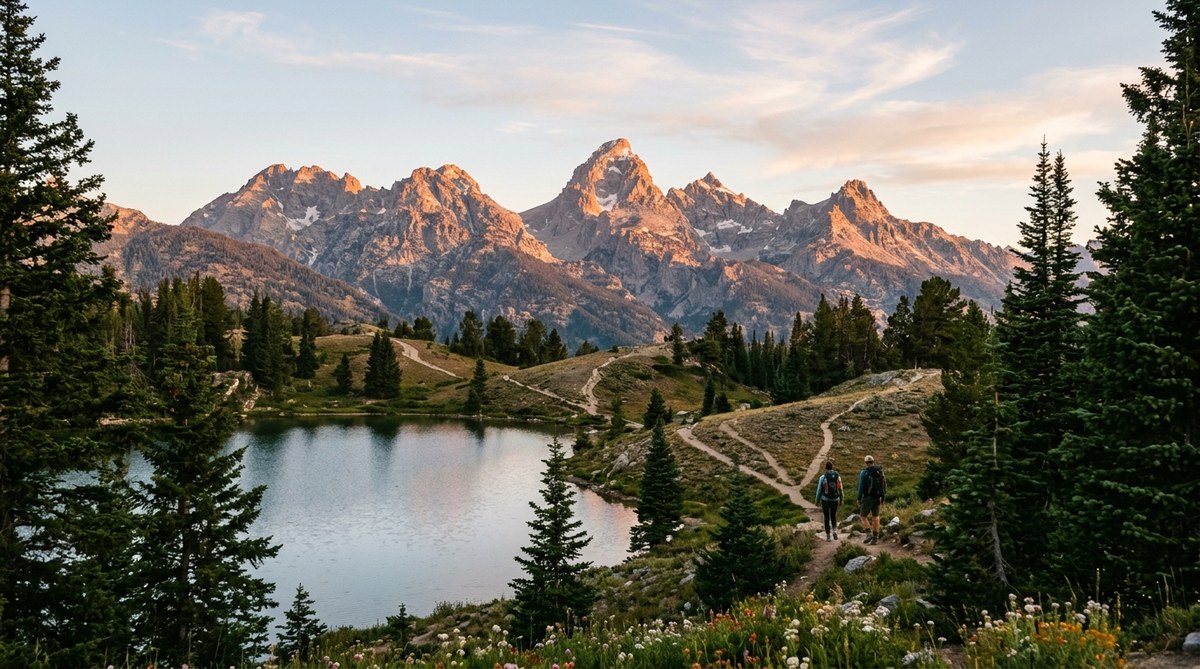
You have already seen the postcard images. Schwabacher Landing at sunrise. The Cathedral Group reflected in a still lake. Those spots are iconic for a reason, but they come with a price: bumper-to-bumper traffic in the park loop and a line of tripods at every turn. You did not drive all the way to Jackson Hole to stand in a queue. You came here to feel the quiet power of the Tetons, to hear nothing but the crunch of granite under your boots.
We asked local rangers, search and rescue volunteers, and the guides who sleep in the backcountry for their top picks. Every single one mentioned the same thing. The most underrated hiking trails Grand Teton has to offer are not on the front page of the park map. They require a little extra legwork, a willingness to drive a dirt road, or a start time before the sun hits the peaks. This guide is for you if you want solitude, wildlife, and views that feel like a secret.
Grand Tetons five most underrated trails deliver alpine lakes, wildflower meadows, and moose sightings without the crowded parking lots. These routes require moderate fitness and proper bear safety. Go early, pack your spray, and leave the selfie stick behind. You will earn the solitude, and you will never look at a crowded trailhead the same way again.
Where the Crowds Are Not
Grand Teton National Park welcomed over 3 million visitors in 2025, and 2026 is shaping up to be busier. Most of those people go to the same three places. Jenny Lake, String Lake, and the Taggart Lake Loop. Those are beautiful hikes. No one is arguing with that. But if you want to understand what makes this valley special, you need to go deeper.
| Common Experience | Underrated Alternative |
|---|---|
| Waiting 40 minutes for a parking spot at Jenny Lake | Walking onto an empty lot at the Granite Canyon Trailhead |
| Sharing the trail with 200 people per hour | Seeing fewer than 10 parties all day |
| Hearing highway noise from the main park road | Pure silence broken only by pika calls |
| Standard postcard views | Uninterrupted personal vistas |
The table above tells the story. Every hike we recommend here offers the same jaw-dropping Tetons scenery you came for, but without the carnival atmosphere.
1. Granite Canyon Trail to Marion Lake
Most visitors stop at the Laurance S. Rockefeller Preserve and do the Phelps Lake Loop. It is a great hike, but it is far from empty. Keep driving south on Moose Wilson Road until you hit the Granite Canyon Trailhead. The parking lot is small, which keeps the numbers low.
This trail follows Granite Creek through a dense forest of lodgepole pine and fir. After about three miles, the canyon opens up and you get your first glimpse of the massive granite walls. Keep going to Marion Lake. It sits at 9,200 feet in a stunning alpine bowl. The water is so clear you can see every pebble at the bottom.
What makes this one of the best underrated hiking trails Grand Teton preserves is the variety. You hike through forest, then meadow, then talus slopes, then alpine tundra. It is like getting four different environments in a single day. Bring your fishing rod if you have one. The cutthroat trout in Marion Lake are hungry and the crowds are nonexistent.
“Granite Canyon is my go to recommendation for people who want to understand the Tetons without the chaos. You get the same granite spires you see from the highway, but you feel like you have the entire range to yourself.”
Sara Martinez, Backcountry Guide and Jackson Hole Search and Rescue volunteer
2. Death Canyon to the Patrol Cabin
Do not let the name scare you. Death Canyon got its name from an old fur trapper story, not from any real danger. This trail offers some of the most dramatic terrain in the park, and almost no one hikes the full route.
Start at the White Grass Ranger Station, about 3.5 miles up the gravel Moose Wilson Road. The trail follows Death Canyon Creek past massive boulder fields and through stands of aspen. After 4.5 miles and 2,300 feet of elevation gain, you reach the historic Death Canyon Patrol Cabin. This log cabin was built in the 1930s by the Civilian Conservation Corps. It still serves as a patrol station for rangers today.
The views from here are staggering. You look straight up the canyon toward the Teton Crest, and the walls rise 3,000 feet on either side. This is a strenuous hike, no two ways about it. But the solitude reward ratio is better than almost any trail in the park.
3. Moose Ponds via the River Trail
Most people drive straight past the Moose Ponds. They are right off the Teton Park Road, a short boardwalk loop that takes fifteen minutes. The secret is to turn the boardwalk into a full hike.
From the Moose Ponds boardwalk, pick up the River Trail heading south. This path follows the Snake River through the willow flats. You will see moose. You will see beaver. If you are lucky, you will see a river otter sliding down a muddy bank. The trail winds for about five miles one way and connects to the Grassy Lake Road if you want to make a full day of it.
This is the flattest hike on our list, but do not let the lack of elevation fool you. The wildlife viewing here is unmatched. The trail is also a great option for late afternoon when the main trails are still crowded. The light filters through the cottonwoods and turns the river gold.
Local tip: Bring binoculars and a field guide. You can easily spend two hours identifying birds alone. For a deeper look at the valley’s wildlife, read about the local biologist who she-s-documented-every-moose-birth-in-grand-teton-for-30-years.
4. Open Canyon to the Teton Crest
Most people who want to reach the Teton Crest use the Paintbrush Canyon or Cascade Canyon routes. Those are classics for a reason, but they are also packed by 9 a.m. Open Canyon offers a quieter, more rugged path to the same high country.
The trailhead is near Lupine Meadows, but do not park there. Keep driving further up the dirt road to the actual Open Canyon parking area. The trail gains elevation immediately. You climb through thick timber, then break out into open meadows filled with lupine and Indian paintbrush in July and August.
The payoff comes when you reach the crest at about 10,200 feet. You stand on the spine of the Tetons, looking west toward the Teton Basin and east toward the Jackson Hole valley. The wind is constant up here, so bring a shell. But the silence between gusts is total.
This is a long day. Plan for 12 to 14 miles round trip with over 3,500 feet of elevation gain. Start before sunrise. Bring plenty of water. And make sure someone knows your route. The how-jackson-hole-s-volunteer-search-and-rescue-team-saves-lives-in-the-backcountry team handles several calls here each year from unprepared hikers.
5. Snowshoe Cabin via Two Ocean Lake
The spread of the park gets almost no attention. Most visitors stick to the Teton Park Road corridor. But the northern section near the Colter Bay area has trails that see a fraction of the traffic. Two Ocean Lake is the perfect example.
The loop around Two Ocean Lake is a gentle 6.4 miles through forest and along the shoreline. But the real magic comes from the spur trail to the Snowshoe Cabin. This historic structure was built in the 1920s by a homesteader named John Sargent. He lived here year round, trapping and guiding. The cabin is still standing, preserved by the park service.
The trail to the cabin climbs through a beautiful spruce forest and opens onto a hillside with views of the lake below. In late summer, the huckleberries are thick. Stop and pick a handful. The cabin itself is a time capsule of early Jackson Hole life. You can peek through the windows and see the old cast iron stove, the wooden bunk, the tools hanging on the wall.
This hike is perfect for families or anyone who wants a moderate day with a cultural twist. It also pairs well with a stop at the Colter Bay Visitor Center to learn about the parks history.
How to Find More Seclusion
If you want to build your own adventure, follow these three rules:
- Go early or go late. The parking lots fill by 8:30 a.m. from June through September. If you arrive at 6 a.m., you will have the trail to yourself. If you start at 4 p.m., you will see the crowds heading out as you head in.
- Learn the dirt roads. Moose Wilson Road, the Grassy Lake Road, and the Pacific Creek Road all lead to trailheads that most tourists never find. A sedan can handle most of them, but a vehicle with a little clearance helps.
- Check the backcountry permit board. The rangers post daily trail conditions and wildlife sightings. They will tell you which trails are empty right now.
Bear safety is not optional. Every single trail in Grand Teton is grizzly and black bear habitat. Carry bear spray. Know how to use it. Travel in groups if you can. Make noise on blind corners. The bears deserve respect, and so do you.
For a deeper understanding of what makes this place tick, from the snowpack to the wildflowers, read our guide on how-to-read-weather-in-the-tetons-when-your-life-depends-on-it.
A Word on Respecting Quiet Places
The Tetons are not a theme park. They are a living, breathing landscape that has been home to Indigenous people for thousands of years and to wildlife for much longer. When you find a quiet trail, treat it with care. Pack out everything you packed in. Step off the trail to let wildlife pass. Keep your voice low so others can hear the birds.
The reason these trails stay underrated is that the people who love them keep them that way. They do not post the GPS coordinates on social media. They do not leave trail markers made of rocks. They share the knowledge in person, over a campfire, or in a conversation with a friend.
You are now part of that tradition. Wear your boots thin. Come back next year. Bring someone new and teach them the same respect.
Why These Trails Matter to the Local Way of Life
Every summer, the valley swells with visitors. That tourism is the economic engine of Jackson Hole, but it also strains the land. Locals know that the best way to protect these places is to spread people out. When hikers choose a lesser known trail, they relieve pressure on the fragile alpine meadows around Jenny Lake. They give the wildlife more room to move. They keep the experience special for everyone.
The five trails we highlighted are not remote expeditions. They are accessible to anyone with a decent fitness level and a willingness to drive an extra fifteen minutes. That is all it takes to trade a crowded highway for a secret canyon.
If you want to understand why the people who live here wake up before dawn every day, take one of these hikes. Watch the light hit the east face of the Grand Teton from a place you reached on your own two feet. That feeling cannot be bottled, and it cannot be bought.
For more stories about the people who live and work in this valley, from chefs to chefs to cowboys, check out our feature on why-jackson-hole-locals-start-their-day-before-sunrise. And when you get back from your hike, stop by one of the restaurants in our guide to where-locals-actually-eat-15-jackson-hole-restaurants-off-the-tourist-trail. You will need the calories.
Now go lace up your boots. The trail is waiting.