
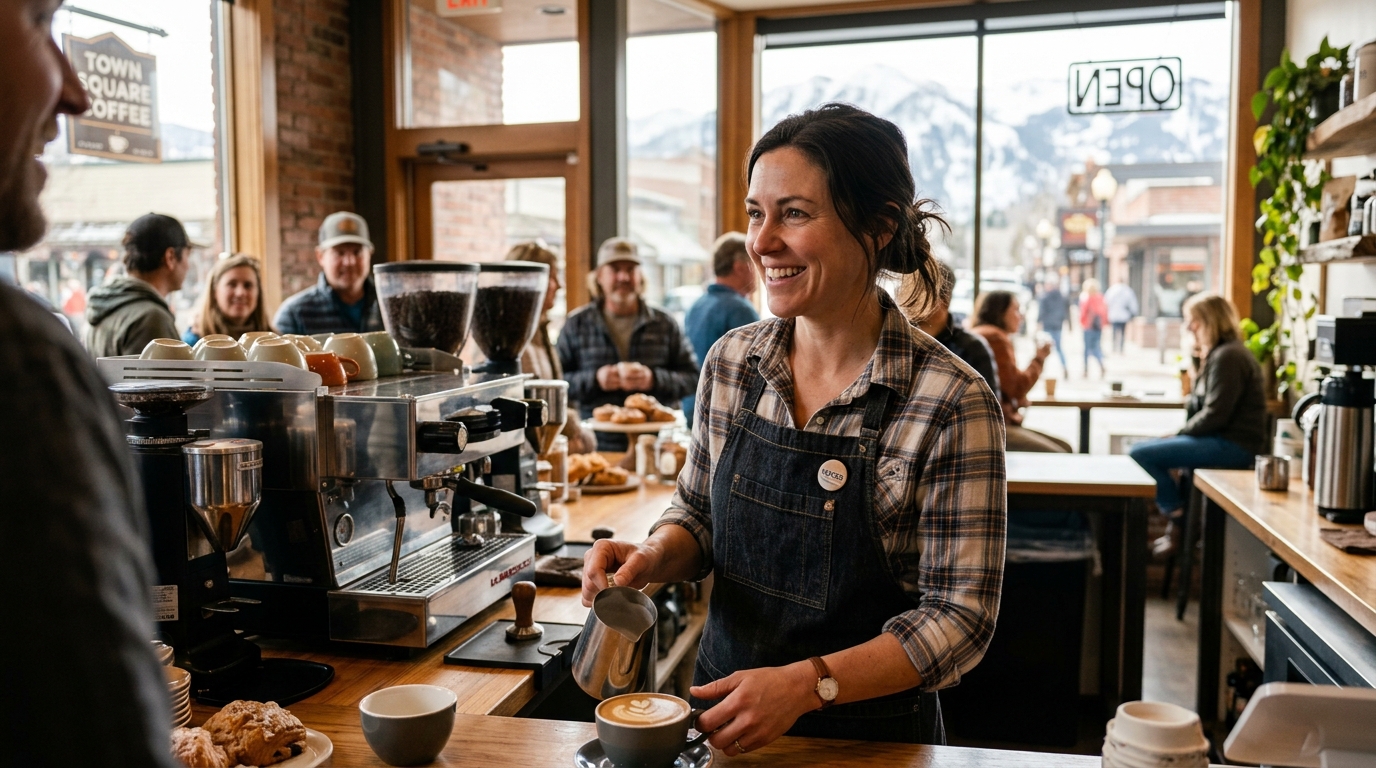
Sarah Martinez has been pulling espresso shots at Cowboy Coffee on Broadway for eight years. She knows the ski patrol supervisor takes his Americano black with two ice cubes. She remembers the real estate agent’s daughter just got accepted to Montana State. She asks the retired rancher about his hip surgery without needing to check notes.
This isn’t customer service training. This is what happens when a barista who knows everyone downtown becomes the unofficial keeper of a community’s stories.
Downtown Jackson’s most connected barista demonstrates how genuine human connection transforms a coffee counter into community infrastructure. Through deliberate memory practices, consistent presence, and authentic curiosity, one person creates social glue that holds together everyone from construction workers to gallery owners. This story reveals why these daily interactions matter more than ever in a transient resort town.
The Memory System Behind the Counter
Sarah doesn’t use a customer database. She doesn’t take notes on her phone between orders.
Instead, she’s built what she calls her “coffee context system.” When someone orders, she links their drink to a detail they’ve shared. The oat milk latte belongs to the woman training for the Grand Teton half marathon. The cortado with honey goes to the guy who just moved here from Santa Fe to work at the art museum.
Her method breaks down into three steps:
-
Anchor the drink order to a life detail during the first conversation. Not their job title. Something they care about. A project. A worry. A hope.
-
Add one new detail each visit. The marathon trainer mentioned her daughter’s soccer team. The museum worker talked about finding an apartment that allows his two dogs.
-
Reference the previous detail before asking about something new. “How did that gallery opening go?” leads naturally to “What’s next on your calendar?”
This isn’t manipulation. It’s intentional care scaled through repetition.
What a Barista Learns That Others Miss
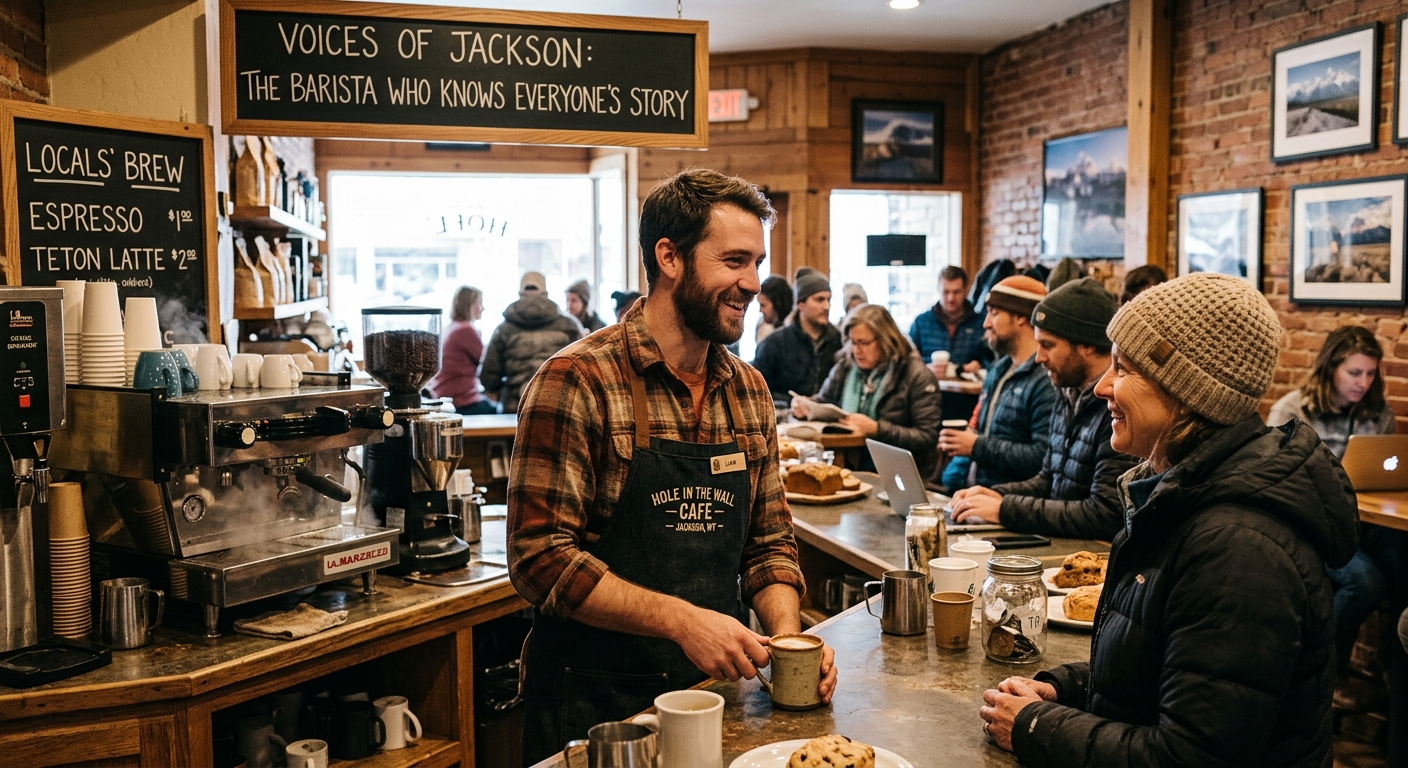
Sarah sees patterns nobody else notices.
She knew the construction boom was slowing two months before the headlines hit because the contractors stopped ordering pastries with their coffee. Just drinks. Tighter budgets.
She predicted the yoga studio would close because the owner’s morning routine changed from calm to frantic. Different order time. Stressed voice. Within six weeks, the lease sign went up.
The information flow works both ways. When the ski patrol supervisor mentioned avalanche conditions during morning rush, three backcountry skiers in line changed their plans. When the retired rancher talked about seeing a grizzly near Cache Creek, parents adjusted their hiking routes.
“I’m not trying to be the town gossip. But I am trying to be the person who connects people who should know each other. That’s different.” – Sarah Martinez
Her role resembles what sociologists call a “network hub.” She doesn’t just serve coffee. She facilitates the weak social ties that make communities resilient.
The Regulars Who Built the Culture
Every coffee shop has regulars. Cowboy Coffee has what Sarah calls “the 6:47 crew.”
They’re not a formal group. They don’t sit together. But they all arrive within the same twelve-minute window every weekday morning, and they’ve created an unspoken community protocol.
The crew includes:
- A wildlife biologist heading to Grand Teton National Park
- Two nurses finishing night shift at the hospital
- A contractor who frames houses in the valley
- A writer working on a book about the untold history of Jackson Hole’s Basque community
- A retired teacher who volunteers at the library
They know each other’s orders. They save seats during crowded periods. They cover each other’s coffee tab when someone forgets their wallet.
Sarah didn’t create this. She recognized it and protected it.
When a new employee wanted to rearrange the seating to “optimize flow,” Sarah explained why those specific tables stay in that specific configuration. The 6:47 crew needs their space. That’s not inefficiency. That’s infrastructure.
How Downtown Relationships Actually Work
The barista who knows everyone downtown operates differently than the barista who knows everyone’s order.
Knowing orders is transactional memory. Useful but shallow.
Knowing people requires understanding the gaps between what they say and what they mean. The regular who always seems cheerful but orders a decaf instead of regular might be dealing with anxiety. The couple who used to come in together but now arrives separately might be heading toward divorce.
Sarah doesn’t pry. She notices. And she adjusts her energy accordingly.
| Approach | What It Looks Like | What It Builds |
|---|---|---|
| Transactional | “The usual?” | Efficiency |
| Personal | “How’s your mom doing after her surgery?” | Trust |
| Community-minded | “You should meet the person behind you. You’re both into backcountry skiing.” | Networks |
| Protective | Recognizing when someone needs silence instead of chat | Safety |
The protective mode matters most. Some mornings, people need coffee and quiet. Sarah reads that in body language. Headphones in. Eyes down. Minimal words.
She doesn’t take it personally. She adjusts.
The Stories That Never Leave the Counter
Sarah keeps confidences the way ski patrollers keep weather conditions in their working memory. Critical information, held carefully, shared only when safety requires it.
She’s heard about:
- Job losses before the employer announced layoffs
- Pregnancies before family knew
- Affairs, divorces, cancer diagnoses
- Financial collapses and unexpected windfalls
- Addiction struggles and recovery victories
None of this becomes gossip. It becomes context.
When the regular going through a divorce snaps at another customer, Sarah smooths it over. When the person who just lost their job seems withdrawn, she doesn’t push conversation. When someone celebrates six months sober, she remembers without making it awkward.
This emotional labor is invisible until it’s gone. Coffee shops without this kind of barista feel different. Colder. More transactional. Less like a third place and more like a vending machine with chairs.
What Changed During the Pandemic
March 2020 nearly broke the system Sarah had spent years building.
Cowboy Coffee shifted to takeout only. No seating. No lingering. Grab and go.
The 6:47 crew scattered. Some left town entirely. Others hunkered down. The daily rhythm that had sustained connection vanished.
Sarah started writing names on cups with small personal notes. “Hope your garden is growing.” “Thinking of your dad.” “Miss seeing you.”
Small gestures. But they mattered.
When the café reopened for indoor seating in summer 2020, the crew reassembled. Not everyone. Some had moved away permanently, part of the pandemic exodus that reshaped Jackson Hole’s demographics. But enough returned that the culture survived.
The pandemic taught Sarah something crucial about her role. The coffee is replaceable. The connection isn’t.
Building Your Own Version of This
You don’t need to be a barista to practice what Sarah does. You need consistency, curiosity, and a place where paths cross naturally.
Here’s how to start:
- Pick one regular interaction point. The gym. The dog park. The trail you hike. The brewery you visit.
- Learn three names this week. Not just names. One detail about each person.
- Return to the same place at the same time. Consistency creates the conditions for recognition.
- Ask follow-up questions. “How did that thing you mentioned go?” signals you were listening.
- Introduce people to each other. “You both mentioned loving cross-country skiing. Have you met?”
The mechanics are simple. The commitment is harder.
Sarah shows up six days a week. Same café. Same shift. For eight years.
That consistency is the foundation. Without it, none of the rest works.
The Economics of Caring
Cowboy Coffee pays Sarah $18 per hour plus tips. Her take-home is roughly $42,000 annually.
She could make more working three jobs like many resort town residents. She could leave the service industry entirely.
She stays because the work feeds something money doesn’t measure.
“I know more about what’s actually happening in this town than people who’ve lived here thirty years,” she says. “Not because I’m nosy. Because people tell me things. That feels like wealth.”
Her boss understands the value she creates. The café doesn’t advertise. It doesn’t need to. Sarah is the marketing.
New residents ask locals where to get coffee. The answer is always Cowboy Coffee. Not because the beans are exceptional. They’re good, not great. But because Sarah makes people feel known.
That’s worth more than a loyalty program.
When the Barista Becomes the Story
Last winter, Sarah’s apartment building caught fire. She lost almost everything.
Within 48 hours, the community she’d served for eight years mobilized.
The 6:47 crew organized a fundraiser. The ski patrol supervisor donated furniture. The real estate agent found her a rental. The retired rancher showed up with his truck to help her move.
More than $23,000 came in. Clothes, kitchen supplies, gift cards, cash.
Sarah cried through her first shift back at work. Not from sadness. From recognition.
She’d spent years learning everyone’s stories. Now she was inside one, and the community was writing the next chapter for her.
“I never expected anything back,” she said. “But I’m learning that caring isn’t a one-way thing. It builds something that holds everyone.”
The Difference Between Service and Connection
Most customer service training focuses on speed, accuracy, and friendliness.
Sarah does something different. She practices what researchers call “relational work.” The invisible labor of maintaining social bonds that make organizations and communities function.
Relational work includes:
- Remembering personal details without being asked
- Noticing mood shifts and adjusting interaction style
- Connecting people who share interests or needs
- Holding space for difficult emotions
- Celebrating small victories others might miss
This work is gendered and undervalued. It’s often dismissed as “just being nice.”
But it’s skilled labor. Sarah has developed expertise over thousands of hours of practice. She reads micro-expressions. She tracks conversation threads across weeks. She manages emotional complexity while making lattes under time pressure.
The café industry doesn’t have a career ladder for this. There’s no promotion to Senior Community Connector.
Sarah does it anyway because the work itself is the reward.
What Happens When She’s Not There
Sarah takes one week off per year. She visits family in New Mexico.
Regular customers notice immediately. The replacement baristas are competent. They make good drinks. They’re polite.
But they don’t ask about the hip surgery. They don’t know who takes ice cubes in their Americano. They don’t connect the backcountry skiers with the avalanche report.
The café functions. The community feature goes dormant.
“It’s like when your favorite teacher is out sick,” one regular explained. “The substitute is fine. But it’s not the same. You’re just going through motions.”
This fragility worries Sarah. She’s training two newer employees in her methods. Teaching them to anchor drinks to details. Encouraging them to ask follow-up questions.
But the depth of knowledge she carries can’t be transferred in a training manual. It lives in her memory, accumulated through years of presence.
When she eventually leaves, something irreplaceable will leave with her.
Why This Matters More in Resort Towns
Jackson Hole’s population fluctuates wildly. Summer brings tourists. Winter brings ski season workers. Spring and fall see exodus and return.
The permanent resident population hovers around 10,000. But the town serves millions of visitors annually.
This creates social fragmentation. People pass through. Relationships stay shallow. Community bonds weaken.
The barista who knows everyone downtown becomes critical infrastructure in this context. Sarah provides continuity in a transient environment.
She’s the person who remembers you left for three months and asks how your winter in Mexico went. She introduces the new seasonal worker to the established local. She maintains the social fabric that keeps the town feeling like a community instead of a resort.
Similar dynamics play out in other mountain towns. Telluride. Aspen. Park City. Anywhere the tourism economy creates population churn.
The people who stay, who show up consistently, who remember names and stories become the anchors. Without them, these places become collections of strangers who happen to occupy the same geography.
The Rituals That Create Belonging
Cowboy Coffee has unwritten rules that Sarah enforces gently.
You bus your own table. You don’t take phone calls inside. You acknowledge regulars even if you don’t know them well. You leave the corner table for the 6:47 crew during morning rush.
These aren’t posted anywhere. New customers learn by observation and occasional gentle correction.
“The table by the window is usually saved for someone,” Sarah will say. “But there’s a great spot by the fireplace.”
She’s not being exclusionary. She’s protecting the social ecosystem.
The rituals create predictability. Predictability creates safety. Safety creates the conditions for vulnerability. Vulnerability creates real connection.
This progression is why some coffee shops become third places while others remain commodity providers.
Sarah understands this instinctively. She’s never read Ray Oldenburg’s work on third places. But she’s built one anyway.
What the Next Generation Needs to Learn
Sarah worries about younger baristas who’ve grown up with digital communication as their primary mode.
“They’re great at Instagram,” she says. “But they struggle with eye contact. They don’t know how to hold a conversation that goes beyond the transaction.”
She’s not being a boomer about it. She’s noticing a skill gap.
The ability to read facial expressions, manage silence, ask open-ended questions, and remember details without digital assistance are muscles that atrophy without use.
Coffee shop counters are training grounds for these skills. So are other jobs that require reading people and situations, from ski instruction to guiding to teaching.
Sarah has started being more explicit about teaching these skills. She’ll pause during slow periods and explain why she asked a customer a specific question. She’ll point out body language cues. She’ll model how to exit a conversation gracefully when the line is building.
“This stuff used to get passed down naturally,” she says. “Now we have to be intentional about it.”
The Coffee Counter as Community Hub
Walk into Cowboy Coffee on any weekday morning and you’ll see Sarah facilitating a dozen micro-interactions.
She introduces the photographer to the gallery owner. She tells the trail runner about the new route the mountain biker just mentioned. She lets the contractor know the cabinet maker is looking for work.
These connections happen because Sarah holds the network map in her head. She knows who needs what and who has what to offer.
This is how communities actually function. Not through formal networking events or Facebook groups. Through daily, informal exchanges facilitated by people who pay attention.
The economic value is real. Jobs get filled. Collaborations form. Resources get shared. All because one person at a coffee counter knows everyone downtown and uses that knowledge generously.
Where the Stories Live Now
Sarah has been thinking about documentation. Eight years of stories. Thousands of people. A living oral history of downtown Jackson.
She’s started writing some of it down. Not the confidential stuff. The community moments. The time the whole 6:47 crew showed up for the contractor’s daughter’s high school graduation. The morning everyone wore cowboy hats to celebrate the rancher’s 80th birthday. The spontaneous fundraiser for the family whose house burned down.
These stories matter. They’re the social glue that makes Jackson Hole more than a beautiful place with expensive real estate.
They’re proof that community isn’t dead. It’s just harder to build in a world optimized for efficiency over connection.
And they demonstrate that one person, showing up consistently with genuine curiosity and care, can create something that holds hundreds of people together.
The Thread That Holds Everything Together
Sarah doesn’t think of herself as special. She’s doing what baristas have done for decades. Centuries, really, if you count the coffeehouse tradition going back to the Ottoman Empire.
But in 2026, in a resort town where housing costs push out longtime residents and tourism reshapes the culture every season, her role has become more critical.
She’s the person who remembers. Who connects. Who notices. Who cares.
The barista who knows everyone downtown isn’t just serving coffee. She’s maintaining the invisible infrastructure that makes a place feel like home.
Next time you’re at your local coffee shop, pay attention to who’s doing this work. Learn their name. Ask them a question. Remember the answer.
Then come back tomorrow and pick up the thread. That’s how community gets built. One conversation at a time. One remembered detail. One connection made.
Sarah will be there at 6:30 tomorrow morning, warming up the espresso machine and getting ready for the 6:47 crew. Same as always. That consistency is the foundation everything else is built on.