
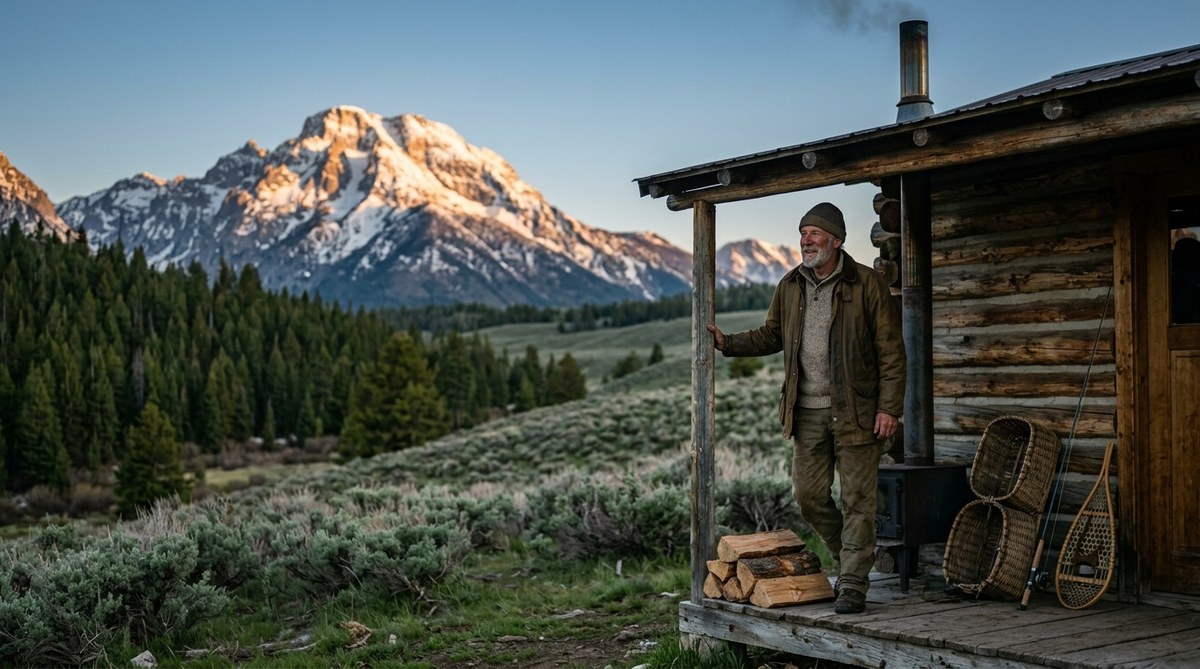
The snow was coming down hard on the Gros Ventre drainage when Mack Thompson showed me his wood splitter. It is a 30 year old machine held together with baling wire and what he calls "creative stubbornness." He patted its rusted frame like you would an old dog. "This thing has outlasted three marriages and two presidential administrations," he said. "And it will probably outlast me."
Mack is 67 years old. He has lived in a hand built cabin five miles up a dirt track that most people would not call a road. He has no electricity bill. He has no running water in the conventional sense. He does not have an address that will show up on any GPS. And in 2026, when the rest of Jackson Hole is racing to keep up with rising costs, second home construction, and the constant hum of Wi Fi networks, Mack is still out there. He is still trapping. He is still cutting his own firewood. He is still living exactly the way he wants to live.
I spent three days with him to understand why. What I found was not a survivalist preparing for the end of the world. It was something far more interesting. It was a man who simply refused to participate in a version of progress he never asked for.
Mack Thompson represents a disappearing thread in Jackson Hole's fabric: the person who lives completely off the grid by choice, not necessity. His lifestyle in 2026 offers a lens into what the valley was before luxury resorts and second homes took over. More than a story about survival, his life is a lesson in intentional living, resourcefulness, and the value of staying put.
The Man Behind the Cabin
Mack came to Jackson Hole in 1989. He was 30 years old, fresh off a divorce, and carrying a duffel bag full of trapping gear he had inherited from his grandfather in Montana. He planned to stay one season. He never left.
"I found a spot where nobody was telling me what to do," he told me over a cup of coffee boiled on a wood stove. "That was the whole deal. Still is."
His cabin sits on a small piece of land that he acquired through a lease agreement with a ranching family who have since passed on. The arrangement was sealed with a handshake. No lawyers. No paperwork. "We just shook on it," Mack said. "That meant something back then."
In the decades since, Mack has built his life around the rhythms of the land. He traps beaver, coyote, and the occasional bobcat. He sells the pelts to a buyer in Cody who still pays in cash. He grows potatoes, carrots, and squash in a small garden plot that he fights off elk and deer for every summer. He cuts about six cords of firewood each year. He hauls water from a spring a half mile up the hill.
His cabin has no solar panels. No satellite dish. No backup generator. "I tried solar once," he said. "Felt too much like being plugged into something. I didn't like the feeling."
Why He Still Lives Off the Grid in 2026
The obvious question is why. Why would a man choose this life in 2026, when even remote cabins in Wyoming can get Starlink and same day Amazon delivery to the nearest post office?
Mack's answer is simple. "Because I don't want to be part of the machine."
He is not antisocial. He is not running from the law. He is not a prepper who believes society is about to collapse. He is, by his own description, a person who values freedom more than comfort. "The trade off is simple," he said. "I give up convenience. In return, I get to wake up every morning and decide what my day looks like. No boss. No schedule. No emails. No noise."
In 2026, that trade off feels more radical than ever. Jackson Hole has become a place where the cost of living has pushed many working class residents out. The valley's median home price sits well above a million dollars. Service workers commute from as far away as Driggs and Alpine. The idea of owning land, let alone living on it for free, sounds like a fantasy to most people under 40.
Mack is acutely aware of this. He does not gloat about it. He does not lecture. He just knows he found something rare and he is not letting it go.
How He Makes It Work: Three Systems That Keep Him Alive
Living off the grid in Jackson Hole is not romantic. Winters are brutal. The snow pile at Mack's cabin can reach eight feet by February. Temperatures drop to 30 below and stay there for weeks. One mistake can be fatal.
Here are the three systems Mack relies on to survive:
-
Water hauling and storage. Mack fills two 55 gallon drums from the spring every three days. In winter, he breaks ice on the spring with a crowbar. He filters everything through a ceramic gravity system he bought from a catalog 15 years ago. "It still works," he said. "If it breaks, I'll figure something else out."
-
Firewood as a way of life. Mack cuts dead standing lodgepole pine and Douglas fir from a nearby Forest Service parcel. He splits it by hand with a maul and stores it under a tarp. He burns through about six cords each winter. He starts cutting in May and does not stop until October. "You miss a week of cutting in July," he said, "and you freeze in February. That's the math."
-
Food preservation and hunting. Mack cans most of his garden vegetables in a pressure canner he runs on his propane stove. He shoots an elk every fall with a rifle he bought in 1992. The meat goes into a root cellar he dug under the cabin. "I don't have a freezer," he said. "I don't need one. The ground stays cold enough until January. After that, everything is frozen anyway."
The Daily Realities of Off-Grid Living
Romantic as it sounds, Mack's life is not a wilderness fantasy. It is hard work, every single day. The things most people never think about become central concerns.
-
Laundry happens in a plastic tub with a scrub board. Mack heats water on the stove and hangs clothes on a line strung between two pine trees. In winter, the clothes freeze solid before they dry. He brings them inside and finishes the job near the wood stove.
-
Bathing is a weekly event. In summer, Mack uses a solar shower bag hung from a tree. In winter, he heats water on the stove and takes a sponge bath. "You get used to it," he said. "Honestly, I smell better than some tourists I've been stuck next to on the town shuttle."
-
Communication is limited. Mack has a flip phone that he charges in town when he goes for supplies. He checks it once a week. He does not have email. He does not have social media. "I don't know what I'm missing," he said. "And I don't care to know."
-
Health care is a challenge. Mack drives into Jackson for doctor appointments. He has a basic first aid kit and a lot of practical knowledge. "I set my own broken finger two years ago," he said. "It healed crooked. But it works."
Common Mistakes People Make When Trying Off-Grid Living
Mack has seen a lot of newcomers try the off-grid life and fail. They buy land. They build a cabin. They last one winter. Then they sell. He has strong opinions about why.
| Mistake | Why It Fails | Mack's Approach |
|---|---|---|
| Underestimating firewood needs | People think 3 cords is enough. It is not. A small cabin needs 5-6 cords. | Start cutting in spring. Cut more than you think you need. |
| Relying on technology first | Solar panels, batteries, and inverters break. If you cannot fix them, you lose power. | Learn to live without electricity. Then add systems if you want. |
| Not having a water backup | One frozen pipe or dry spring and you are hauling water in buckets at 20 below. | Always have two water sources. Always. |
| Overbuilding the cabin | Big cabins are harder to heat. Vaulted ceilings waste warmth. | Build small. Build tight. Heat with wood. |
| Lack of community connections | Isolation wears on people. You need someone to check on you. | Mack has six people in the valley who check on him and he checks on them. |
"People think off grid means you do everything alone. That's a mistake. You need people. I have people. They just don't live in my pocket." - Mack Thompson
What Off-Grid Living Teaches Us About Modern Jackson Hole
Mack's life is not a model most people can or should follow. But it does hold up a mirror to the valley's current moment. Jackson Hole in 2026 is a place of incredible wealth and incredible pressure. The cost of entry keeps rising. The fabric of the community is shifting. Longtime residents are being priced out. New arrivals bring new expectations. The valley is changing.
Mack represents a version of Jackson Hole that is almost gone. The person who lives here not because they made money but because they refused to leave. The person who defines wealth not by what they own but by what they do not owe.
He is not nostalgic about it. "Things change," he said. "That's fine. I'm not mad about it. I just don't have to be part of it."
In that sense, Mack is not a relic. He is a reminder. A reminder that the choice to live simply is still available, even if it gets harder to make every year. He is proof that a person can opt out. And he is evidence that opting out does not mean disappearing.
What One Man's Choice Says About the Valley
Mack Thompson will probably die in that cabin. He says that without drama. "I'll be out splitting wood until I drop," he said. "That's a good way to go."
His story is part of a larger tradition in Jackson Hole. The tradition of people who live here on their own terms. You can see echoes of it in the last working cowboys of the Gros Ventre Valley and in the former Wall Street trader who now guides fly fishing trips on the Snake River. They all made a choice to measure life differently.
For anyone considering a move to Jackson Hole, or anyone dreaming of going off the grid, Mack offers a simple piece of advice. "Try it for a week in February before you buy anything. If you still like it after that, you might be cut out for it."
He laughed when he said it. Then he went back to splitting wood.
If you want to understand what it really costs to live here, read our breakdown of what it really costs to live in Jackson Hole in 2026. And if you are wondering how to build a life here without buying into the rat race, Mack's story is a good place to start.
He does not have a phone number. He does not have an email. But if you find yourself on a dirt road in the Gros Ventre drainage on a cold morning, look for the smoke rising from a tin chimney. That is him. He will probably offer you coffee.