
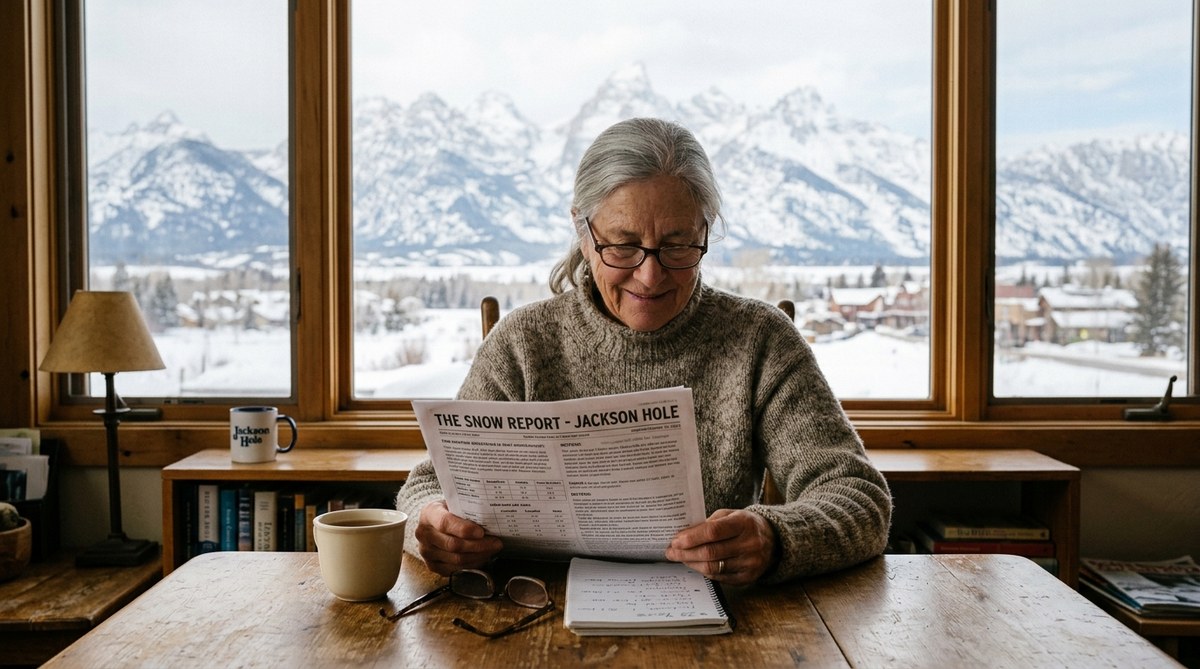
Every morning, before the first chairlift starts moving and before most of Jackson Hole has even poured its coffee, a woman in a modest house near the Snake River opens her laptop. She pulls up the daily snow report from Jackson Hole Mountain Resort. She reads the number of new inches, the base depth, the temperature at the summit, the wind speed. She studies the conditions for each trail. Then she closes the tab and goes about her day. She has done this every day for 25 years. She has never once put on a pair of skis.
This is not a story about skiing. It is a story about how a daily ritual can connect a person to a place and a community, even without direct participation. For 25 years, one woman has read the Jackson Hole snow report every day and never skied. Her routine shows that belonging does not require being on the mountain. It only requires showing up, in whatever way fits your life.
A Routine Born of Curiosity
The woman, who asked to remain unnamed to keep the focus on the habit, moved to Jackson Hole in the late 1990s. She worked a desk job at a local nonprofit. She had no interest in skiing. The terrain scared her, the cost of gear seemed absurd, and the idea of standing in a freezing line for a lift felt like a bad way to spend a day off. But she quickly noticed that the entire town revolved around snow. Conversations started with “How much did we get last night?” Her coworkers planned their weeks around powder days. The snow report was the pulse of the valley.
One winter morning, out of simple curiosity, she opened the resort’s website and read the snow report. She wanted to understand what everyone was so excited about. The numbers felt abstract at first. But over time, she learned the language. A 6-inch overnight meant big grins at the office. A 1-inch dusting meant a quiet day. She started checking the report daily, partly to feel included in the collective mood of the town.
By the third winter, it was automatic. She would wake up, make tea, and read the report before anything else. She learned the year round cycle: early season base building, midwinter storms, spring corn. She knew which runs held snow longest and which areas melted out first. She had never stepped on a groomer, but she could tell you when Rendezvous Bowl was likely to be in prime condition.
What the Snow Report Means to Her
For this woman, the snow report is not about planning a ski day. It is about connection.
- It anchors her day in a rhythm shared by thousands of people.
- It gives her a topic of conversation with anyone, from the barista to the bartender.
- It makes her feel like an insider, even though she chooses to stay off the slopes.
- It provides a weather forecast that is more local and more honest than any app.
- It offers a small dose of adventure without the risk of broken bones.
She told a friend once that reading the report was like reading about a parallel life. She could imagine the snow falling on the peaks, the skiers carving tracks, the quiet before the first tram. It was a story that unfolded every 24 hours, and she never missed a chapter.
The 25 Year Habit
Twenty five years is a long time to do anything. For perspective, consider what has changed in Jackson Hole since 2001. The resort has added new lifts and terrain. The town has grown. The cost of living has skyrocketed. The woman herself has changed jobs, lost people she loved, seen seasons come and go. Through all of that, the snow report remained a constant.
She reads it on good days and bad. When she is traveling, she sets an alarm to check it. Once, during a power outage, she drove to a friend’s house just to get online and read the report. It was a powder day, and she wanted to know the number.
Here is a snapshot of her daily process:
- Wake up between 6 and 6:30 a.m.
- Brew a cup of tea (Earl Grey, always).
- Open the snow report page on her laptop (never on her phone, she says the screen is too small).
- Read the reported snowfall, base depth, temperature, wind, and trail count.
- Check the webcam images for two or three favorite angles.
- Close the laptop and move on to the rest of her day.
- Occasionally, she will mention the conditions at the office. “Looks like a bluebird day up top,” she will say, and people nod.
The whole thing takes less than five minutes. But it has become as essential as the tea.
Who Is This Person? (And Why Doesn’t She Ski?)
The natural question people ask when they hear her story is: why not just ski? The answer has many layers.
First, she has a mild fear of heights that makes chairlifts uncomfortable. Second, she has a bad knee from an old injury. Third, she simply does not have the desire. Skiing is a sport that requires commitment, gear, time, and risk. She respects it. She just does not want to do it.
But the deeper reason is that she does not need to ski to feel connected. Her ritual of reading the report is enough. It gives her a role in the community. She is the person who always knows the conditions. Friends text her before they head up. “How is it looking?” they ask. She becomes a source of information, a quiet oracle of snow.
In a town where so much identity is tied to outdoor recreation, her choice to stay a spectator is almost radical. It challenges the assumption that you must participate to belong. But anyone who lives in Jackson Hole knows that the town is full of people who find their own way to be part of the story: the artist who never camps, the librarian who never hikes, the chef who finishes her shift just as the last skiers come in.
How Her Ritual Compares to a Skier’s Morning
To highlight the contrast, here is a table showing the difference between her morning and that of an average skier on a powder day.
| Aspect | She (the report reader) | The skier |
|---|---|---|
| Wake time | 6 a.m. | 5 a.m. or earlier |
| First action | Read snow report on laptop | Check phone for snow total, then coffee |
| Prep time | 5 minutes | 45 minutes (gear, layers, snacks) |
| Risk level | Zero | High (injury, avalanche, cold) |
| Reward | Quiet satisfaction, conversation starter | Adrenaline, powder turns, stories |
| Cost per day | $0 | Lift ticket plus gear (expensive) |
Both people start their day with snow. Both can tell you how deep it is at the top of Bridger. But their experiences diverge completely after that first glance at the screen.
What the Snow Report Tells Us About Jackson Hole
The snow report is a piece of local infrastructure. It is not just for skiers. Tourists check it to decide if they should buy a lift ticket. Locals use it to plan their work schedule. And for this woman, it is a daily bulletin from a world she chooses to observe rather than enter.
The report itself has evolved over 25 years. It used to be a plain text page with a few numbers. Now it includes high resolution webcams, a grooming report, and detailed trail status. But the core remains the same: a promise of what the mountain offers that day.
Her relationship with the report mirrors the way many people connect to things they love from a distance. A baseball fan who never plays. A music lover who never picks up an instrument. A gardener who only watches from the window. Participation is not the only form of engagement.
“I don’t need to ski to feel the snow. I just need to know it’s there.”
* The woman, in an interview with a friend.
The Unseen Community of Snow Report Readers
She is not alone. Across the country, there are people who check mountain and beach and trail reports daily without ever visiting. They are armchair adventurers. They live vicariously through numbers and webcams. In Jackson Hole, the snow report has a loyal readership that includes people who have been away from the valley for years. Former residents check it to remember home. Parents of ski racers check it to see what their kids are skiing on.
This woman is part of a quiet subculture that values information for its own sake. She does not post about it on social media. She does not brag about how many inches fell. She simply reads, absorbs, and moves on.
For stories of other devoted locals who have built unusual rituals around this landscape, check out She’s Documented Every Moose Birth in Grand Teton for 30 Years. And if you want to understand how the mountain safety culture works from the inside, read How Jackson Hole’s Volunteer Search and Rescue Team Saves Lives in the Backcountry.
Why This Habit Matters More Than It Seems
At first glance, reading the snow report without skiing seems pointless. Why invest time in something you never use? But the woman’s routine is a reminder that place attachment does not require recreation. She loves the Tetons. She walks along the Snake River. She watches the light change on the peaks. The snow report is just another way to feel the mountain’s presence.
In a culture that often equates action with value, her quiet consistency is a small act of resistance. She does not need to conquer the mountain. She is content to let the mountain be, and to be near it in her own way.
A Ritual That Reflects a Changing Town
Jackson Hole in 2026 is not the same town it was in 2001. The snow report is now part of a massive digital ecosystem. Ski resorts compete for visitors with live streams and social media updates. But for this woman, the report remains a personal thing. She does not follow the resort’s Instagram. She does not read the comments. She just wants the numbers.
She has thought about what will happen when she can no longer read the report. Old age might take her eyesight. The internet might change. The resort might close (unlikely, but she considers it). She has decided that as long as she can, she will keep reading. It is her small way of saying “I am still here, and I still care.”
How to Start a Local Ritual Like Hers
If this story inspires you to start a daily connection to your place, consider these steps.
- Choose a piece of local data that matters to your community. It could be a river flow gauge, a farmers market schedule, a bird migration tracker, or a snow report.
- Read it at the same time every day. The repetition matters.
- Do not pressure yourself to act on the information. The goal is awareness, not achievement.
- Let the ritual evolve. You might start checking more details or sharing updates with friends.
- Keep it simple. Five minutes is enough.
The woman’s 25 year habit grew organically. She did not set out to be a record holder. She just started reading, then never stopped.
The Quiet Power of Being a Witness
There is no grand finale to this story. She will probably read the snow report tomorrow morning, just as she has for 25 years. She will see the numbers, imagine the snow, and feel a small satisfaction. Then she will close the laptop and live her day off the slopes.
That is the whole point. You do not have to ski to love winter. You do not have to climb to love mountains. And you do not have to be an active participant to belong to a community. Sometimes, showing up and paying attention is enough.
Next time you see a snow report, think of her. Somewhere in Jackson Hole, a woman is reading it, smiling, and getting ready for another day of a life she built not on the mountain, but in its quiet shadow.