
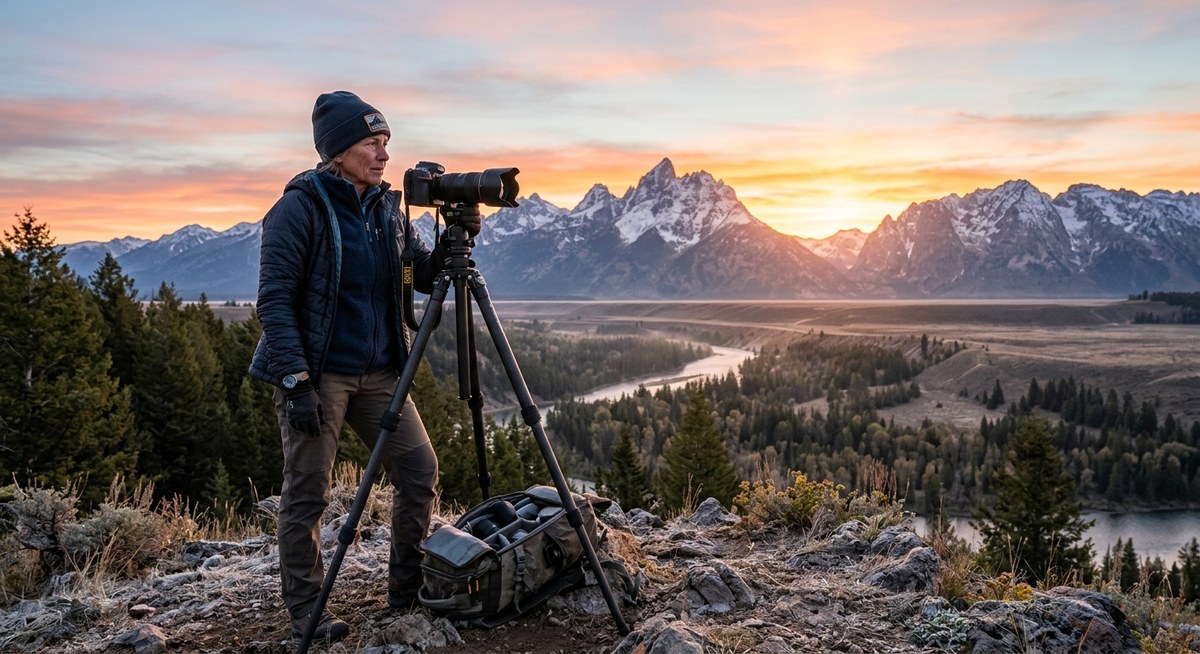
For fifteen years, the alarm has gone off at 4:15 AM. Rain, snow, or clear skies. No exceptions. While most of Jackson Hole is still asleep, she is already pulling on her hiking boots, checking her camera bag, and stepping out into the dark. The Tetons are waiting. And she has made a promise to greet them every single morning.
Consistency is the secret to great landscape photography. One Jackson Hole local has photographed the sunrise over the Tetons every day for 15 years, building an unmatched archive of light, weather, and seasonal change. Her dedication shows how daily practice, patience, and local knowledge create images that no tourist can capture in a single visit.
The Photograph That Started It All
It began with a single frame. She had moved to Jackson Hole in 2011, chasing the same dream that brings so many people here: a life closer to wild places. On her first morning in town, she walked to the edge of the National Elk Refuge and watched the sun hit the Grand Teton peak. She took one photo. It was nothing special by professional standards. But something about that moment stuck with her.
The next morning, she went back. And the morning after that.
Within a month, she realized she had started something. The light was never the same. The clouds were never the same. The snow line on the mountains crept down in autumn and retreated in spring. She wanted to see what a full year looked like. Then two years. Then five.
Now, in 2026, she has missed exactly three mornings. One was due to a hospital visit. Two were because of a blizzard that made driving impossible. She made up for each one by shooting the sunset instead, but she still counts them as gaps in her record.
Why She Keeps Going Back
People often ask her if it gets boring. She laughs at that question.
The Tetons are never the same from one day to the next. The angle of the sun shifts by about one degree each morning. The wildflowers change with the seasons. The animals follow their own schedules. She has seen moose calves take their first steps at dawn. She has watched bald eagles hunt over the Snake River while the sky turned pink. She has photographed the exact moment when autumn frost turned the aspen groves gold.
She keeps a journal alongside her camera. Every morning, she writes down the temperature, the wind direction, and the wildlife she sees. That journal is now 15 volumes thick. It is a record of climate change in the Tetons, documented one sunrise at a time.
“The hardest part is not the early alarm. It is the discipline to keep seeing something new. If you think you have seen it all, you are not looking close enough.” — The photographer, during a 2024 talk at the National Museum of Wildlife Art.
The Gear She Uses After 15 Years
She does not use the most expensive equipment. She uses gear that works in extreme cold, handles moisture, and fits in a small daypack. Here is her current setup:
| Item | Purpose | Mistake She Made Early On |
|---|---|---|
| Mirrorless camera body | Lightweight, good low-light performance | Bought a body without weather sealing. It failed during a snowstorm. |
| 24-70mm lens | Versatile for wide landscapes and details | Used a fixed 50mm for two years. Missed too many wide shots. |
| Sturdy carbon tripod | Sharp images in low light | Bought a cheap aluminum tripod. It froze solid in winter. |
| Remote shutter release | Eliminates camera shake | Forgot it at home on a -20 degree morning. Froze her fingers using the self-timer. |
| Hand warmers | Keeps batteries alive in cold weather | Learned this the hard way after three batteries died in one hour. |
She also carries a thermos of coffee, a headlamp with a red light mode, and a small notebook. The notebook is for sketching compositions before the light arrives.
Her Top 5 Sunrise Locations in Grand Teton
After 15 years, she has her favorite spots. These are the places she returns to most often.
- Oxbow Bend — Best for reflections of Mount Moran in still water. Arrive 45 minutes before sunrise. The parking lot fills early in summer.
- Schwabacher Landing — Classic Teton shot with willow-lined banks. Go in late September for the best fall colors.
- Mormon Row — The historic barns with the Tetons behind them. Winter mornings here are spectacular when snow covers the ground.
- Jenny Lake Overlook — A short hike from the parking area. Great for capturing alpenglow on the Cathedral Group.
- Signal Mountain Summit — Drive to the top for a panoramic view. Best in July and August when the road is open.
She rotates through these spots depending on the season and the forecast. She never stays in one place for more than a week straight. Variety keeps her eyes fresh.
The Daily Routine of a Tetons Sunrise Photographer
Her mornings follow a strict rhythm. Here is how she does it, broken down into simple steps.
- Check the weather at 4:00 AM. She uses a local forecast, not a national app. Mountain weather is too unpredictable for generic predictions.
- Pack the bag the night before. Everything is ready. She does not make decisions in the dark.
- Drive to the location by 5:00 AM. In summer, sunrise is around 5:45 AM. In winter, it is closer to 7:30 AM. She adjusts her schedule accordingly.
- Walk to her chosen spot with a red headlamp. White light ruins her night vision. Red light lets her see without losing the stars.
- Set up the tripod and camera 20 minutes before sunrise. This gives her time to frame the shot and wait for the best light.
- Shoot continuously for 30 to 45 minutes. The light changes every few seconds. She captures dozens of frames.
- Pack up and head home by 7:00 AM. She has a full day ahead. The photography is just the start.
Common Mistakes New Photographers Make
She sees the same errors over and over. Here are the biggest ones.
- Arriving too late. The best light happens before the sun breaks the horizon. If you arrive at sunrise, you have already missed it.
- Using the wrong white balance. Auto white balance makes snow look blue. Set it to “daylight” or “cloudy” for warmer tones.
- Forgetting to check the wind. Still water creates reflections. Wind ruins them. She checks the forecast for wind speed before choosing a location.
- Ignoring the foreground. A great landscape needs depth. She always includes something in the foreground: a rock, a flower, a fence post.
- Staying in one spot. The Tetons have hundreds of angles. Move around. Try different compositions.
What 15 Years of Sunrises Has Taught Her
She has learned more than photography. She has learned about patience. About commitment. About the quiet joy of showing up.
The Tetons have changed in 15 years. Glaciers have retreated. Wildfire seasons have grown longer. Some of her favorite meadows have been overtaken by pine beetles. But the mountains themselves remain. They are a constant in a world that feels increasingly unstable.
She has also learned something about community. Other sunrise photographers have become her friends. They share tips, warn each other about trail conditions, and sometimes meet at the same overlook without planning it. There is an unspoken bond between people who wake up in the dark to chase light.
If you want to start your own sunrise practice, she has one piece of advice: do not try to do what she did. Do not aim for 15 years. Aim for one week. Then one month. Then one season. Let the habit build itself.
The Changing Face of Jackson Hole Through Her Lens
Over the years, her photos have captured more than just mountains. They show the growth of the town itself. Early images from 2011 show empty parking lots at trailheads. Recent images from 2026 show crowds even at dawn. The Tetons are more popular than ever.
She has watched the visitor experience shift. In 2011, she could drive to Schwabacher Landing and have the place to herself. Now she shares it with 20 other photographers on a summer morning. She does not resent the change. She documents it.
Some of her most powerful images show the intersection of nature and human impact. A sunrise over a highway. A moose crossing a road while tourists stop to take photos. Smoke from distant wildfires turning the sky an eerie orange. These images tell a story that goes beyond beauty.
How to Start Your Own Sunrise Photography Practice
You do not need 15 years of experience. You just need to start. Here is her advice for beginners.
- Start close to home. Do not drive to a national park. Find a local hill, a lake, or even a city park. Practice the routine first.
- Use what you have. Your phone camera is fine for learning composition. Upgrade later.
- Learn the light. Sunrise light is soft and golden. Midday light is harsh. Pay attention to how colors change.
- Dress for the weather. You cannot take good photos if you are cold and miserable. Layer up.
- Be safe. Tell someone where you are going. Bring a flashlight. Watch for wildlife.
For a deeper look at the daily rhythms of locals who embrace the early hours, read about why Jackson Hole locals start their day before sunrise.
The Archive That Keeps Growing
Her hard drives are full. She has over 50,000 images from 15 years of mornings. She has started printing her favorites and donating them to local schools. Kids in Jackson Hole can see what their home looked like before they were born.
She plans to keep going. She wants to reach 20 years. Then 25. She wonders what the Tetons will look like then. Will the glaciers be smaller? Will new species move in? Will the crowds get even bigger?
She does not know the answers. But she will be there to photograph whatever comes.
If you want to understand the deep connection between Jackson Hole residents and the land they live on, you might also enjoy the story of a woman who documented every moose birth in Grand Teton for 30 years.
The Gift of Showing Up
The sunrise does not care who you are. It does not care about your camera, your skill level, or your social media following. It happens whether you are there or not.
That is the lesson she carries with her. The mountains do not need her. But she needs them. The daily walk to the overlook, the cold air on her face, the first ray of light hitting the peaks — these are the moments that make life feel full.
She hopes her photos inspire others to slow down. To look closer. To find their own version of this practice. It does not have to be photography. It could be a morning run, a journal, a quiet cup of coffee on the porch. The important thing is showing up.
Tomorrow morning, her alarm will ring at 4:15 AM. She will get up. She will go out. And she will photograph another sunrise over the Tetons. Just like she did yesterday. Just like she will do tomorrow.
For more stories of people who have built extraordinary lives around the rhythms of Jackson Hole, check out the art of living simply in a luxury mountain town.