
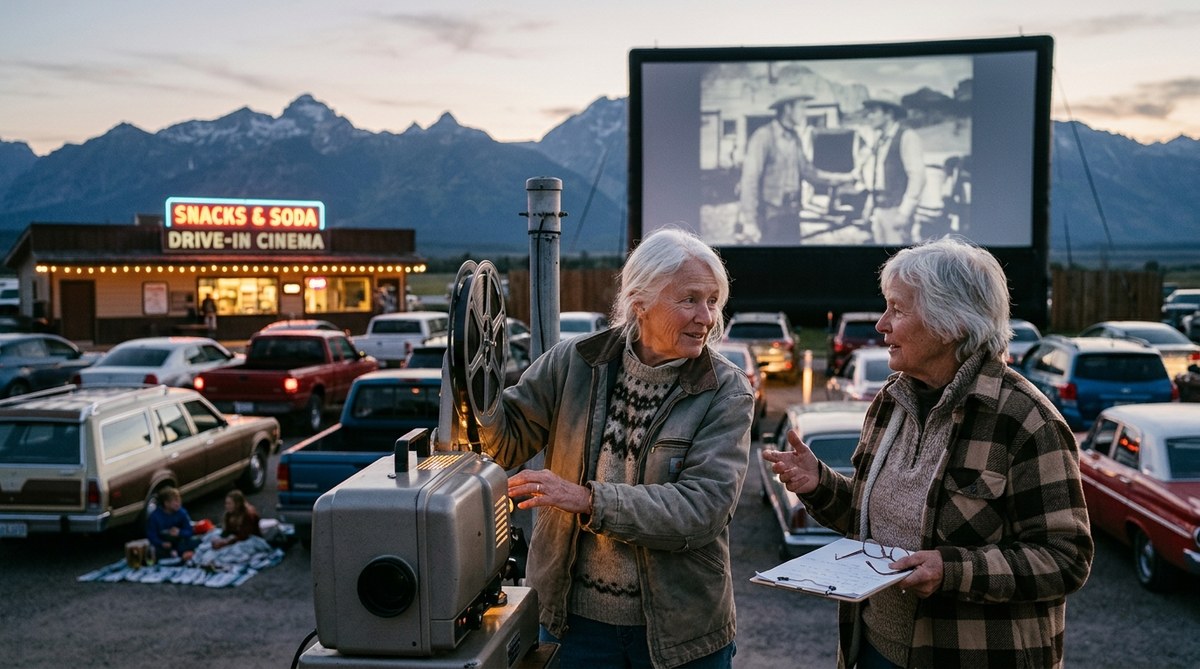
The neon sign flickers to life just as the sun drops behind the Tetons. Cars pull into the gravel lot, one by one. Parents in pickup trucks. Couples in station wagons. A few tourists who stumbled upon this place by accident. They tune their radios to the right frequency. They wait for the first frame to glow against the screen. And none of it would be happening if not for two sisters who refused to let the projector die.
Drive-in theater preservation depends on stubborn local love more than national trends. This Jackson Hole story shows how two sisters kept their family business alive through changing seasons, rising land values, and the shift to streaming. Their methods offer a clear blueprint for any community hoping to save its own last screen under the stars.
When the Last Projector Almost Went Dark
The drive-in has been part of Jackson Hole since the 1950s. Families piled into cars with blankets and popcorn. Kids watched from the back of station wagons in their pajamas. First dates happened under that same screen. For decades, it was simply part of summer.
Then came the 2000s. Land values in Jackson Hole skyrocketed. Developers circled the property like hawks. The old projector needed constant repair. Attendance dropped as streaming services took over. Most towns lost their drive-ins during this period. In fact, according to the United Drive-In Theatre Owners Association, the number of drive-ins across America fell from nearly 4,000 in the 1960s to just over 300 by 2010. Jackson Hole almost joined that statistic.
The theater was owned by the Miller family for three generations. By 2015, the siblings who had inherited it were ready to sell. They had offers. Real money. The kind that could set a family up for years.
But two of those siblings, Margaret and Ruth Miller, said no.
The Sisters Who Wouldn’t Sell
Margaret was 74 at the time. Ruth was 71. Neither had ever married or had children. The drive-in was their inheritance and their responsibility. They had grown up sweeping the concession stand floor. They had sold tickets from a tiny wooden booth as teenagers. They knew every bulb on the marquee by heart.
“We looked at the offer,” Margaret told me when I visited them last summer. “It was more money than we had ever seen. But it felt like we would be selling a friend.”
Ruth nodded from her folding chair behind the ticket booth. “We told our brother we would buy him out. He thought we were crazy. Maybe we were.”
They were not crazy. They were something rarer. They were willing to lose money to keep something alive.
The sisters refinanced their parents’ old house, took out a second mortgage, and used every penny to purchase the theater outright. They had no business plan. They had no marketing strategy. They had a projector that broke down twice a month and a screen that needed repainting every spring.
What they did have was a town that remembered what the drive-in meant.
How Preservation Works When Nobody Is Watching
Drive-in theater preservation does not make headlines. It does not attract big donors or government grants. It happens in small moments. A neighbor shows up with a welding kit to fix a speaker pole. A local mechanic donates an afternoon to get the projector running again. Teenagers volunteer to sweep the lot for free tickets.
The sisters kept the theater alive through a combination of grit and community generosity. They never took a salary for the first five years. They ate dinner from the concession stand. They learned to patch projection bulbs with parts from eBay.
Here is what they did, step by step, and what any community can learn from their approach:
-
They formed a nonprofit called Friends of the Drive-In that let locals donate tax-deductible contributions. This gave people a formal way to help without writing a check to a for-profit business.
-
They started a membership program where families paid $100 a year for guaranteed admission to every screening. It gave the theater a predictable baseline of income before the season even started.
-
They partnered with local businesses to sponsor free community nights. A hardware store paid for one night. A restaurant paid for another. The businesses got their names on the screen, and families got a free show.
-
They diversified beyond movies. The sisters hosted live music, high school graduation ceremonies, and even church services on Sunday mornings. The screen became a community bulletin board.
-
They refused to raise ticket prices above $10 per car, even as costs went up. They decided that affordability was part of the mission.
The Economics of a Single Screen
Running a drive-in in 2026 is not easy. Film prints are rare. Digital projectors cost tens of thousands of dollars. Insurance premiums climb every year. The sisters kept meticulous records, and they shared them with me.
Here is a look at the real numbers behind drive-in theater preservation today:
| Expense Item | Annual Cost | Notes |
|---|---|---|
| Digital projector lease | $18,000 | Required by studios for first-run films |
| Electricity for screen and lot | $7,200 | Lights run from dusk until midnight |
| Film licensing fees | $12,000 | Per film, split with distributor |
| Insurance (liability + property) | $9,600 | Higher for venues with nighttime operation |
| Maintenance and repairs | $6,500 | Projector, speakers, gravel lot grading |
| Concession supplies | $14,000 | Popcorn, candy, soda, hot dogs |
| Staff payroll (seasonal) | $22,000 | Ticket booth, concession, cleanup |
| Total | $89,300 |
And here is how they covered those costs:
| Revenue Stream | Annual Income | Notes |
|---|---|---|
| Ticket sales (average $8 per car) | $42,000 | Based on 150 cars per week, 20 week season |
| Concession sales | $35,000 | Popcorn is the biggest profit item |
| Membership fees | $12,000 | Roughly 120 member families |
| Community night sponsorships | $8,000 | 10 sponsors at $800 each |
| Special events (concerts, graduations) | $6,000 | Venue rental fees |
| Total | $103,000 |
The margin is thin. About $13,700 per year. That goes back into repairs and upgrades. The sisters do not take a paycheck. But they have kept the doors open for a decade.
What Other Communities Can Learn
I asked Margaret and Ruth what advice they would give to anyone trying to save a drive-in in their own town. They laughed at first. Then Ruth leaned forward and spoke.
“You cannot do it for the money. You do it because the screen matters. Because kids need a place to laugh in the dark. Because parents need a place to sit together without looking at their phones. If you go into this thinking you will get rich, you will be disappointed. If you go into it thinking you will keep something beautiful alive, you will be satisfied.”
She paused and added: “Also learn to fix a projector. That will save you a lot of money.”
Their advice for anyone attempting drive-in theater preservation in their own town comes down to a few principles:
- Start with a nonprofit structure to unlock community donations and grants.
- Keep ticket prices low enough that nobody feels priced out.
- Diversify your programming so the screen is used for more than movies.
- Find local business partners who see value in sponsoring community nights.
- Accept that you will work hard and earn little. The reward is not on a balance sheet.
Why Jackson Hole Still Has Its Drive-In
The story of Margaret and Ruth Miller is not unique in its details, but it is increasingly rare in its outcome. Across the country, drive-ins have been paved over for strip malls, housing developments, and storage units. The ones that survive do so because somebody refused to let go.
In Jackson Hole, the sisters have become local legends. Strangers stop them at the grocery store to thank them. Kids draw pictures of the screen and mail them to the ticket booth. The town knows what it almost lost.
The drive-in now shows 20 movies each summer, from classics like “E.T.” and “Jaws” to newer releases. The sisters added a second screening on Fridays to meet demand. They still sell popcorn for $3 a bag. They still wave at every car as it pulls in.
Keeping the Projector Running into the Next Generation
Margaret is 86 now. Ruth is 83. They cannot keep running the theater alone forever. But they have started training a small group of younger volunteers to take over. A local high school teacher runs the projector on weekends. A college student manages the social media page. A retired electrician handles the wiring.
The sisters have no intention of selling. They have written the property into a trust that ensures it will remain a drive-in for at least another 20 years after they are gone. They have made that promise to the community.
“People ask us why we did it,” Margaret said as she handed a ticket to a family in a minivan. “But the real question is why anybody would let it go. You do not get rid of something that holds so many memories. You keep it. You fix it. You pass it on.”
The sun had fully set by then. The first preview was starting. Headlights flickered off one by one. The old speakers crackled to life. And the screen, patched and repainted and held together by love, began to glow.
You can read more stories about the people preserving Jackson Hole’s traditions, like the story of the last working cowboys of the Gros Ventre Valley or how a former Wall Street trader now guides fly fishing trips on the Snake River. These are the threads that hold a town together.
The Millers proved that drive-in theater preservation is not about nostalgia alone. It is about deciding that some things are worth keeping, even when it would be easier to let them go. Their screen still stands because two sisters refused to turn off the lights.
Next time you drive through Jackson Hole in summer, tune your radio to the right frequency. Pull into the gravel lot. Buy a bag of popcorn. And thank the two women in the ticket booth who made sure that moment still exists.