
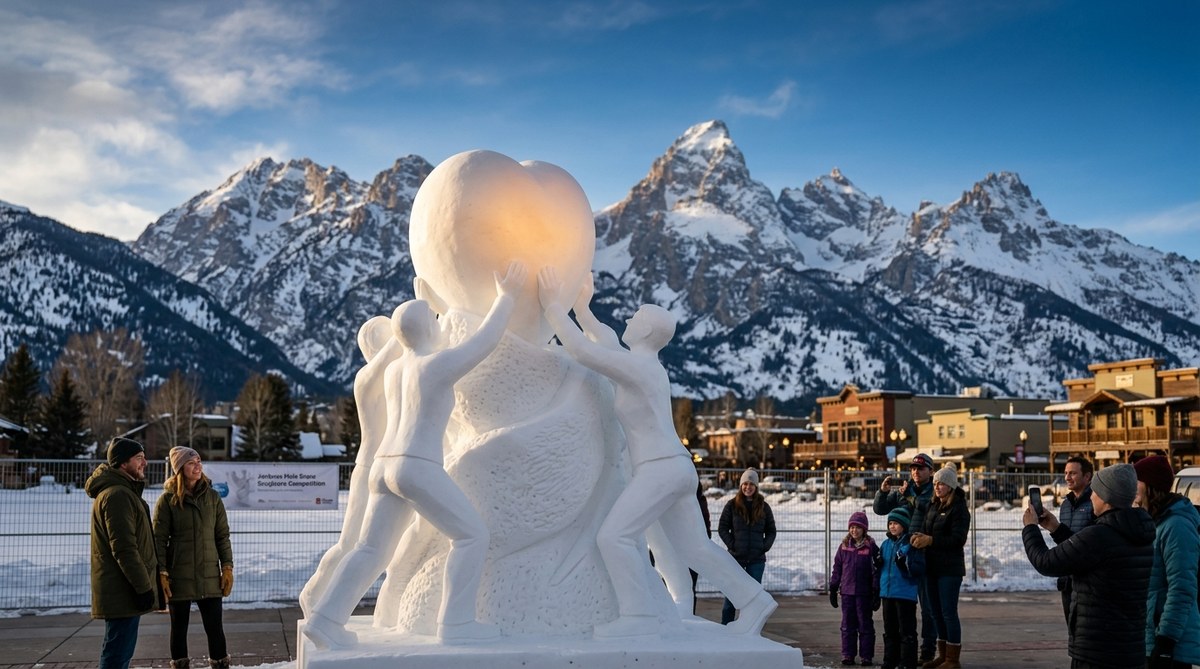
The first time you see a 25 ton block of snow being carved into something alive, it stops you cold. Literally. The temperature is often below freezing. Snow crunches under your boots. Your breath comes out in clouds. And yet, a crowd stands still, watching a team of sculptors chip away at a massive white wall. Over the course of a weekend, that wall becomes a wolf. It becomes a pair of hands. It becomes a story. The Jackson Hole snow sculpture competition happens every winter, and it draws people who love art, who love winter, and who love watching something beautiful emerge from nothing. But this event is not just about the finished sculptures. It is about the process. The community. The shared experience of creating something that will not last.
The Jackson Hole snow sculpture competition is more than a frozen art show. It is a community ritual where locals and visitors gather to watch artists transform massive snow blocks into intricate sculptures over a winter weekend. Rooted in mountain culture and creative expression, this annual event celebrates impermanence, craftsmanship, and the unique spirit of winter in the Tetons. It brings together skiers, artists, and families for an unforgettable Wyoming experience in shadow of Tetons.
The Heart of Winter in Jackson Hole
January in Jackson Hole is not for the faint of heart. The days are short. The snow piles high. The cold settles into your bones. But instead of hiding inside, the town heads to the town square. Or to the ski resort plaza. Or wherever the competition sets up that year. They come to watch artists do something that seems almost impossible.
Each team arrives with a design. Sometimes the design relates to a theme. Other times it is entirely open. The only rule is that every piece must be carved by hand from a single block of snow. No power tools. No shortcuts. Just patience, skill, and a tolerance for cold fingers.
The Jackson Hole snow sculpture competition has grown over the years. What started as a small local event now attracts teams from across the region. Some sculptors are professionals who travel the winter circuit. Others are locals who just love to create. The mix of skill levels is part of the charm. You might see a team of architects competing next to a group of ski instructors.
If you want to understand the creative energy of this valley, you can start by reading about the local artists redefining western art. Many of them have taken part in the snow sculpture competition at some point.
How the Competition Works
The logistics of the Jackson Hole snow sculpture competition are surprisingly intense. Here is how it typically unfolds:
- Teams apply months ahead of time. The competition usually has a cap on participants, and spots fill up fast.
- A few days before the event, snow is packed into large wooden forms. Each block is roughly 10 feet tall, 10 feet wide, and 8 feet deep. That is about 25 tons of snow.
- Teams arrive on Friday morning. They remove the forms and face their block of snow. Some teams have a sketch. Others work from a small model.
- Carving begins immediately. Artists use saws, chisels, scrapers, and other hand tools. The snow is dense and forgiving at first, but it hardens as the weekend goes on.
- Teams work through the weekend. Many sculptors camp out near their block. They work late into the night under lights.
- Judging happens on Sunday afternoon. A panel evaluates each sculpture based on creativity, technique, and overall impact.
- The sculptures remain on display for several days. Visitors can walk among them, take photos, and watch the snow slowly reclaim the shapes.
This format has stayed consistent for years. The simplicity of the rules is part of the appeal. No technology. No gimmicks. Just a block of snow and a vision.
Tools, Techniques, and Common Mistakes
Every sculptor has their own approach. But there are some techniques that show up again and again in the Jackson Hole snow sculpture competition. The table below breaks down what works and what does not.
| Technique | Why It Works | Common Mistake |
|---|---|---|
| Carving from the top down | Reduces the risk of snow cracking under its own weight | Carving the bottom first, which can cause collapse |
| Using a spray bottle to mist the surface | Creates a thin ice crust that holds fine detail | Oversaturating the snow, which turns it into slush |
| Working in layers to build depth | Gives the sculpture a sense of motion and dimension | Carving too deep too fast, which removes material that cannot be replaced |
| Stepping back often to check proportions | Helps catch errors before they are carved too deep | Getting lost in one section and losing the overall shape |
These techniques sound simple, but executing them in freezing temperatures is another story. Your hands get stiff. Your tools get cold. The snow changes texture as the sun moves across the sky. Experienced sculptors learn to adapt.
“The biggest mistake new teams make is underestimating how hard the snow gets. By Sunday morning, that block is rock solid. You have to plan your cuts carefully. Every stroke matters. You cannot rush it.” Tom Kensington, a sculptor who has competed in Jackson Hole for over a decade.
Tom also says the best advice he received was to bring extra gloves. And hand warmers. And a thermos of something hot. The cold is not just uncomfortable. It affects your judgment.
What Judges Look For
The judging criteria in the Jackson Hole snow sculpture competition are clear. Each sculpture is rated on several factors. Here is what the judges care about most:
- Originality of the concept. Is the design fresh and interesting? Does it tell a story?
- Technical precision. Are the edges clean? Are the proportions correct? Can you see the artist’s skill in the details?
- Visual impact from all angles. A good sculpture works from every side. A great one pulls you in from every direction.
- Adherence to the rules. No power tools. No external supports. If a sculpture breaks the rules, it is disqualified.
- Condition at the time of judging. Snow sculptures degrade over time. The ones that hold up best earn higher marks.
The competition is serious, but the atmosphere is not. People cheer for their favorites. Kids run between the sculptures. Dogs sit patiently next to their owners. It feels like a festival, not a contest.
More Than a Contest: A Community Tradition
The Jackson Hole snow sculpture competition is part of a larger pattern in this valley. People here look for reasons to gather in winter. The days are short and the weather is harsh, but the community finds ways to stay connected. This competition is one of those ways.
If you are new to the area, events like this are a great entry point. They bring together long time residents and newcomers. They remind everyone that winter in Jackson Hole is not just about skiing. It is also about sitting still and watching someone carve a story out of snow.
The competition also connects to other cultural traditions in the region. The same spirit of creativity and resilience shows up in the cultural festivals that celebrate the valley’s western heritage. Snow sculpting is just one expression of a community that values craftsmanship and togetherness.
For local businesses, the competition is a boost. Coffee shops stay busy. Restaurants fill up. Hotels see guests who come specifically for the event. The Jackson Hole snow sculpture competition draws visitors who might not otherwise travel in January. That matters for a town that depends on tourism year round.
Plan Your Visit to the 2026 Competition
If you want to see the Jackson Hole snow sculpture competition for yourself, here is what you need to know. The event usually takes place in late January or early February. Exact dates are announced a few months ahead. Check local listings and the event page for updates.
Dress warmly. This is not a casual suggestion. You will stand outside for at least an hour. Wear layers. Bring a hat and gloves. Insulated boots are a good idea. Your toes will thank you.
Arrive early if you want to see the carving in progress. Friday morning is the best time. The blocks are still intact, and the teams are just starting. By Saturday, the shapes are visible. By Sunday, the sculptures are almost complete.
Bring a camera. The sculptures are photogenic at every stage. Morning light is especially good. The low sun casts long shadows that make the details pop.
Stay for the awards ceremony if you can. It is a short event, and the energy is good. Winners get a small prize and a lot of applause. But honestly, every team walks away with something. They walk away with the memory of creating something from nothing.
A Tradition Carved in Snow and Spirit
The Jackson Hole snow sculpture competition matters because it asks us to slow down. In a world where everything moves fast, this event demands patience. You cannot rush a sculpture. You cannot force the snow to cooperate. You have to work with it, one cut at a time.
That lesson applies beyond the competition. It applies to how we live in mountain towns. It applies to how we build community. It applies to how we make art that does not last.
The sculptures will melt. That is the whole point. They are temporary by design. And that is what makes them beautiful. They remind us that some things are worth doing even if they do not last forever.
So next January, when the temperature drops and the snow piles up, head to the town square. Find the teams huddled around their blocks. Watch them work. You will see something rare. You will see a whole community standing together in the cold, watching a story take shape.
And if you want to understand what makes Jackson Hole special, you can also read about what it really costs to live in this valley in 2026 or how newcomers find community in a place that can feel hard to enter. But start with the snow. It is the easiest way in.