
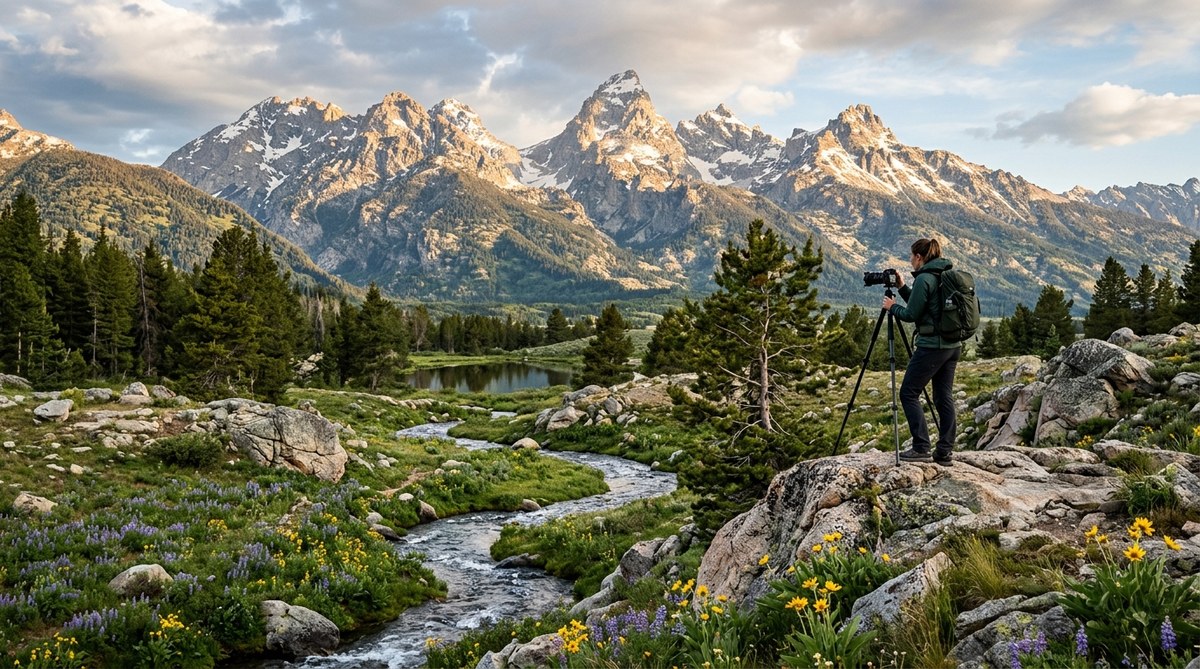
Grand Teton National Park pulls in millions of visitors each year, and nearly all of them stop at the same turnouts. You know the ones: Snake River Overlook, Schwabacher Landing, Mormon Row. Those spots are iconic for a reason, but if you want to bring home images that feel truly yours, you need to wander off the beaten path. The Tetons have a quiet side, a collection of lesser known pockets where the light hits differently and the crowds thin out. As a local media outlet, we have spent years documenting this landscape and talking to the photographers who live here year round. We put together five hidden photography spots Grand Teton regulars keep to themselves. These are the places that will make your feed stand out, and more importantly, they will remind you why you fell in love with this range in the first place.
The best hidden photography spots Grand Teton offers are scattered across the park’s less visited corners: the willow flats along the Gros Ventre River, the beaver ponds near Pacific Creek Road, the sage flats at the base of Mount Hunt, the fall color corridor on Moose Wilson Road, and the winter elk gathering at the National Elk Refuge. Each spot requires a short hike or early start, but the payoff is solitude and light that tourists miss. Use the table below to match your gear and timing.
The Willow Labyrinth of the Gros Ventre
Most visitors drive straight to the Snake River and never look east. That is a mistake. The Gros Ventre River valley holds a maze of willow thickets and oxbow lakes that reflect the Tetons in ways the popular spots cannot match. In late September, the cottonwoods turn gold and the willows glow amber. You can park at the Gros Ventre River pullout about two miles past the Gros Ventre Campground entrance. Walk downstream along the riverbank for ten minutes, then cut inland toward the largest beaver pond. The water is still there, and on a calm morning the reflection of the Grand Teton appears in a frame of waving willow branches.
To get the shot, follow these steps:
- Arrive at the pullout one hour before sunrise.
- Walk east along the river for 200 yards until you spot a narrow game trail heading north.
- Follow the trail through the willows for about five minutes until the pond opens up.
- Set your tripod low to the ground, about knee height, to include the foreground foliage.
- Use a small aperture (f/11 to f/16) to keep the reflection and the mountains crisp.
- Wait for the first rays to hit the summit, then fire off a bracket of three exposures.
This spot works best in September and October, but spring snowmelt can flood the trail, so check conditions at the visitor center. Wildlife is common here. You might see moose wading in the shallows or a coyote slipping through the brush. That is part of the magic. When you are done, consider reading about the last working cowboys of the Gros Ventre Valley to understand the human history of this area.
The Beaver Ponds of Pacific Creek Road
Pacific Creek Road branches off the main highway about halfway between Moran and the Flagg Ranch entrance. It is a gravel road that most people use to access the Pacific Creek trailhead, but the first mile holds a string of beaver ponds that few photographers bother to stop for. The ponds sit right off the road, hidden by a screen of willows. Park at the wide spot near the first culvert and push through the willows for thirty feet. You will find a small pond with lily pads and a direct view of the Teton skyline.
The trick here is to use a polarizer to cut the glare on the water and bring out the autumn color in the willows. Late afternoon light, from 3:30 p.m. to 5:00 p.m., warms up the scene and makes the pond glow. In July and August, the lily pads bloom with white and yellow flowers. That is a narrow window, but worth the timing.
One thing to note: the road can be muddy after rain, and in spring it may be closed for grizzly activity. Check the park alerts before heading out. If you want to understand how the park manages wildlife during high visitation, see our piece on what happens to Jackson Hole’s wildlife when 3 million tourists show up.
The Sage Flats at the Base of Mount Hunt
Most photographers aim for the big peaks, but there is a quiet beauty in the sagebrush flats that stretch out at the base of the smaller peaks on the east side of the valley. Mount Hunt, just south of Signal Mountain, has a gentle slope covered in sage and dotted with boulders. The light in the late afternoon creates long shadows that race across the sage, and the texture of the plants becomes a foreground element that leads the eye straight to the mountain.
To reach the spot, drive to the Signal Mountain Summit Road, but instead of going up, park at the pullout about a quarter mile past the entrance. Look for a faint two track that heads east into the sage. Walk for about ten minutes until you find a spot where the sage is waist high and the mountain fills the frame. Get low, really low, and use a wide angle lens. Focus about one third into the scene to keep both the foreground and mountain sharp.
“The sage gives you a sense of scale that the classic viewpoints never capture,” says Jackson photographer Maria Lin, who has been shooting the Tetons for over 15 years. “When you crouch down and let the sage fill the bottom half of the frame, the mountain feels like it is rising out of a living carpet. That is the shot tourists miss.”
This spot is accessible year round, but spring, when the sage turns a soft blue green, is particularly lovely. For more stories about the people who live in these valleys, check out the story about a ranch hand who became Jackson Hole’s most unexpected artist.
The Fall Color Corridor on Moose Wilson Road
Moose Wilson Road runs along the western edge of the park, past the Teton Village entrance. In early October, the aspen groves along this road explode into yellow and orange. Most people drive it on their way to the tram, but they do not stop at the hidden grove about three miles north of the Teton Village gate. There is a small dirt pullout on the left (west) side of the road, just before the pavement ends. From the pullout, a footpath leads into a dense stand of aspen. Fifty yards in, the trees open up to a small meadow with a direct view of the Grand Teton.
The perfect time is just after a cold front has moved through, when the air is clear and the leaves are at peak. Use a telephoto lens to compress the yellow aspens against the blue sky and the granite peak. A 70 200 mm lens works beautifully here. Try an aperture of f/5.6 to separate the foreground leaves while keeping the mountain recognizable.
This location is busy during fall weekends, but on weekdays you might have it to yourself. For a deeper look at how the community changes with the seasons, read about how Jackson Hole families navigate year round tourism.
The Winter Elk Gathering at the National Elk Refuge
The National Elk Refuge lies just north of the town of Jackson, technically outside the park but still part of the greater Teton ecosystem. In winter, thousands of elk migrate down from the high country and gather on the refuge. The best hidden photography spot is along the Miller Butte overlook, a short hike up a hillside on the east side of the refuge. From there, you can frame the elk herds with the Tetons as a backdrop, and the snow covered valley floor creates a clean, minimalist composition.
Go in January or February, when the elk are at their peak numbers. Bring a long lens, at least 300 mm, and a warm coat. The wind can cut through you up there. Shoot in the early morning, just after sunrise, when the elk are moving and the low sun paints the snow pink. The contrast between the dark animals and the white snow is striking.
Here is a bulleted list of essential gear for this location:
- Telephoto lens of 300mm or longer
- Tripod with a geared head to make small adjustments
- Hand warmers to keep your fingers functional
- A camera rain cover, just in case snow starts falling
- Extra batteries because cold drains them fast
- Binoculars to spot elk before you set up
This spot is rarely crowded, even in the peak winter season. Locals know it, but visitors rarely make the short hike. If you want to learn about the people who brave the cold for a living, read about what it’s really like to spend winter as a ski patrol on Teton Pass.
Techniques to Avoid Common Mistakes
The table below summarizes the common mistakes photographers make at these hidden spots and how to avoid them.
| Mistake | Why It Happens | How to Fix It |
|---|---|---|
| Overexposed reflection | Shooting too late in the morning | Arrive 45 minutes before sunrise and use exposure bracketing |
| Soft foreground in sage flats | Focusing on the mountain instead of the foreground | Manually set focus point one third into the scene |
| Willow branches blocking the view | Setting up too close to the water | Take a few steps back and use a longer focal length (85 135mm) |
| Elk too small in frame | Using too wide a lens at the refuge | Switch to a 400mm lens or crop in post |
| Missed fall color peak | Assuming all aspens peak at the same time | Check the park’s fall color hotline and hike a few days earlier than you think |
Why These Spots Matter for Your Photography
The Tetons are one of the most photographed mountain ranges on earth. That can make it feel like every angle has been done. But the truth is, only a small percentage of visitors go more than a few hundred feet from the road. The spots we shared require a bit of effort: a ten minute walk, a mud puddle to cross, a willingness to get your boots wet. That effort filters out 95 percent of the crowd. The result is a photograph that looks like yours, not a copy of someone else’s.
For a travel photographer or nature enthusiast, finding those quiet corners is what keeps the craft fresh. It is also what earns you the trust of editors and followers. When you post an image from the willow labyrinth or the sage flats, people will ask where you took it. And then you get to smile and say, “A little place most people drive right past.”
That is the essence of this valley. It rewards those who pay attention. So next time you visit, skip the Instagram hotspots and try one of these. You will come home with something that feels true to the Tetons, and true to you. And when you are back in town, stop by one of the taprooms in Teton Valley and swap stories with the locals. They might just tell you about another spot.