
Article
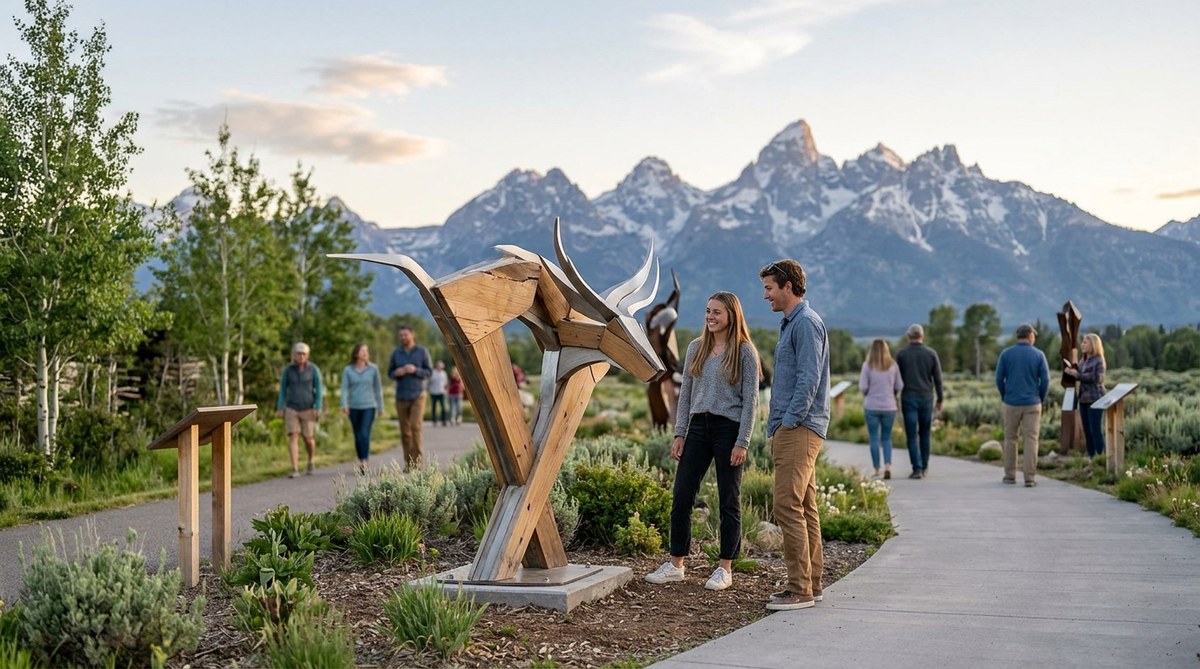
On a cool summer morning, you might spot a 12-foot steel elk standing on a dirt path near the National Elk Refuge. Nearby, a mosaic of river stones forms a trout mid-leap. These are not accidents. They are part of something bigger: the Jackson Hole public art trail, a living gallery that stretches through town, across pathways, and into the edges of the wild. It is a trail that asks you to slow down, look up, and see the valley through the eyes of its artists.
The Jackson Hole public art trail is more than a collection of sculptures and murals. It is a deliberate effort to connect community members with each other and with the land. By weaving art into everyday spaces, the trail invites both locals and visitors to engage with the valley’s culture, history, and environment in a way that feels personal and unexpected.
## A Trail Born from Conversation
The idea for a public art trail did not come from a tourism board or a developer. It grew out of a series of community meetings in the early 2020s, where residents voiced a desire for more shared experiences. Too often, they said, people come to Jackson Hole only for the mountains. They miss the stories that live in the streets, the parks, and the alleys.
Local artist Maria Santander recalls one of those early meetings. “A rancher said, ‘I want my kids to see something beautiful on their walk to school, not just a parking lot.’ That stuck with me.” That conversation sparked what would become a coordinated effort among the Jackson Hole Public Art Commission, private donors, and local nonprofits. By 2024, the first official map was printed. By 2026, the trail includes over 40 installations across a six-mile loop that connects downtown Jackson with the town’s parks, pathways, and the popular Cache Creek trailhead.
## How to Explore the Trail Yourself
If you want to experience the trail, you do not need a guide. The route is marked on a free map available at the visitor center and at most hotels. But for the full experience, follow these steps:
1. **Start at Town Square.** Pick up a printed map or scan the QR code on the arch at the entrance to the square. The first featured sculpture is a bronze bison titled “Sentinel” by local artist Jake Trujillo.
2. **Walk west along Broadway.** You will encounter murals on the sides of buildings that tell the history of the valley’s Basque shepherds and the early cattle drives.
3. **Turn north on Cache Street.** This stretch leads to a small park where a kinetic wind sculpture made from reclaimed ski lift cables spins in the breeze. It is a favorite spot for kids.
4. **Continue toward the National Museum of Wildlife Art.** The trail does not end at the museum’s parking lot. Instead, it loops around the hillside, where large scale installations mimic the shapes of local wildlife. A pair of steel pronghorn seem to race across the sagebrush.
5. **Finish at the Miller Park Pavilion.** Here, a community mosaic tile bench invites you to sit and reflect. Many locals leave small tokens on the bench: a pinecone, a painted stone, a note.
The entire walk takes about two hours at a relaxed pace. For those who prefer biking, the trail is partially compatible with the town’s bike path network. Watch for the small bronze medallions set into the pavement that mark the route.
## Sculptures and Murals That Tell a Story
The installations on the trail are not random. Each piece was selected by a community jury. The themes deliberately reflect Jackson Hole’s identity: wildlife, working land, Indigenous heritage, and the spirit of adventure. Below is a table of four notable stops and what they represent.
| Location | Title | Artist | Material | Theme |
|———-|——-|——–|———-|——-|
| Town Square | Sentinel | Jake Trujillo | Bronze | Wildlife protection |
| Broadway at Glenwood | A River of Stories | Maria Santander | Mosaic tile, glass | Water and watershed |
| Cache Creek Trailhead | Flight Lines | David Alan Clark | Steel, reclaimed cable | Migration and movement |
| Miller Park | We Are All Neighbors | Community project | Ceramic, stone | Community unity |
The table only scratches the surface. Walk a few blocks east and you will find a painted utility box featuring a cowboy on horseback. Another block brings you to a sound installation that plays recordings of elk bugles and creek water through a hidden speaker. The variety keeps the trail fresh for repeat visitors.
## How the Trail Builds Connection
What makes the Jackson Hole public art trail different from other outdoor galleries is the way it fosters interaction. People stop. They talk to strangers about what they see. They take photos and share them. They ask questions.
> “When you place art in a public space, you give people permission to pause. In a town where everyone is always rushing to the next hike or the next meeting, that pause matters. It reminds us we share this place,” said Sarah Chen, director of the Jackson Hole Public Art Commission.
The trail also serves as a teaching tool. Local school groups use the installations to learn about sculpture techniques, local history, and environmental science. A fifth grade class adopted the “Flight Lines” piece and researched bird migration patterns in the Tetons. Their findings were posted on a small plaque near the sculpture.
## Practical Benefits for Everyone
For locals, the trail offers free, accessible culture that does not require a lift ticket or a dinner reservation. For visitors, it provides a low-cost activity that deepens their understanding of the valley. Here are some of the benefits that regular users mention:
– **Low barrier to entry.** No fees, no reservations, no special equipment.
– **Year round access.** Unlike many outdoor activities, the trail is open in all seasons. Snowshoes are recommended in deep winter.
– **Family friendly.** Installations are spaced so that short legs can handle the walk. Benches and restrooms are along the route.
– **Community pride.** Locals often point to their favorite pieces and recount stories of how they were created. This shared ownership strengthens the social fabric.
– **Economic ripple.** Art stops encourage people to explore neighborhoods they might otherwise skip, benefiting small shops and cafes.
## Planning Your Visit
The best time to walk the trail is early morning or late afternoon, when the low sun casts dramatic shadows across the sculptures. In summer, the light is golden until about 8 p.m. In winter, bundle up and aim for midday when the sun is highest.
If you only have one day in Jackson Hole, consider pairing the art trail with a visit to the [National Museum of Wildlife Art](https://jacksonhole.media/how-the-national-museum-of-wildlife-art-became-a-hidden-gem-for-locals/). That museum’s sculpture garden connects directly to the public art trail’s northern loop. Another good pairing is a stop at one of the studios featured in [Inside the Studios of Five Jackson Hole Artists Redefining Western Art](https://jacksonhole.media/inside-the-studios-of-five-jackson-hole-artists-redefining-western-art/). Many of those artists contributed pieces to the trail.
## More Than a Gallery
The Jackson Hole public art trail proves that art does not have to live inside four walls to be powerful. It can stand in the wind, get rained on, and still draw a crowd. It can be touched and climbed on (gently). It can become a landmark, like the giant metal antlers that children have started hanging wish ribbons on.
This trail is also a testament to what happens when a community decides to invest in shared beauty. It was not built overnight. It took years of fundraising, planning, and volunteer labor. But the result is a resource that belongs to everyone.
## Walk It Today
Next time you are in Jackson Hole, leave the car parked for a couple of hours. Start at Town Square. Follow the medallions. Let the path lead you past murals that smell like sagebrush and sculptures that catch the afternoon light. Notice how other people react to the same piece you are looking at. That is the point. The trail does not just display art. It creates moments of connection between you and the valley, and between you and the person standing next to you.