
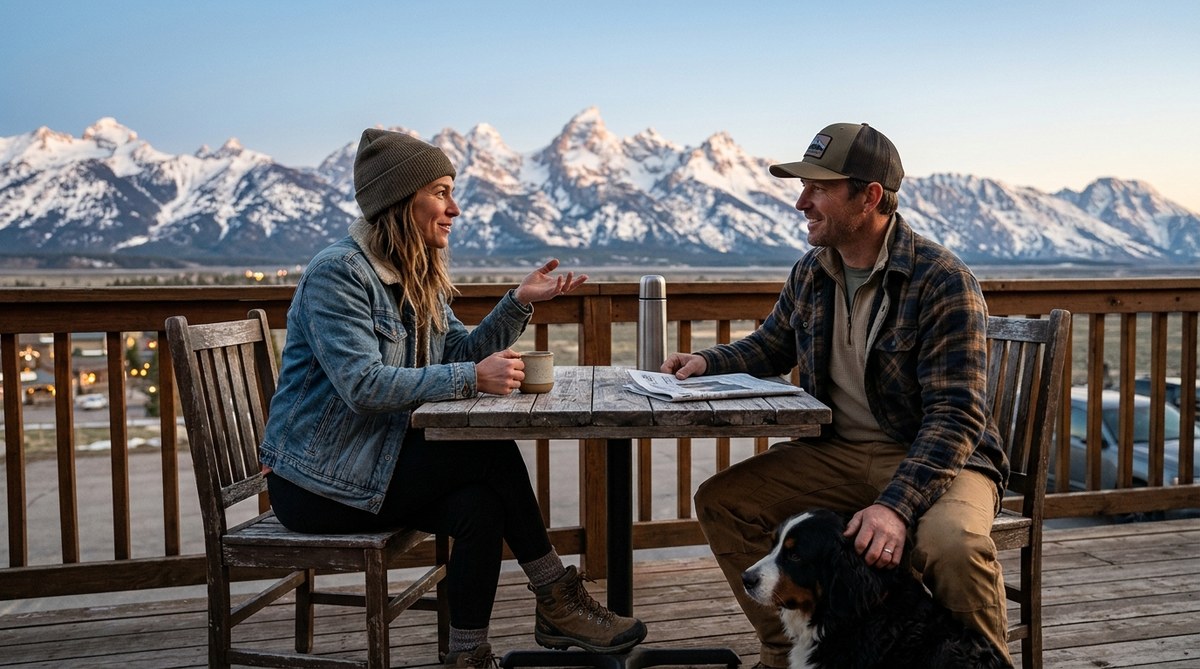
You have just moved to Jackson Hole. Or maybe you are here for your third winter in a row, and you sense something. A subtle shift in how people greet you, or a pause in conversation when you mention that Instagram spot. This valley runs on a different code. It is not written down anywhere. But it is spoken in every nod at the grocery store, every unspoken rule about who yields on a trail, and every local who quietly clocks your patience when the tourist traffic stacks up past Moose. These norms are the glue that holds a community together in a place where the cost of living keeps climbing and the wild still dictates the pace.
Becoming a Jackson Hole local is not about how many years you have lived here. It is about how you show up. Respect the land, the wildlife, and the people who work year-round. Learn the wave, tip your ski guide, and never brag about your backcountry line at the bar. The unwritten rules of Jackson Hole reward humility, preparation, and a willingness to listen more than you speak.
The Golden Rule of This Valley
Nobody cares how long your rental contract is. They care if you are the kind of person who speeds past a stopped car on 191, or leaves dog bags on the trail, or talks loudly on your phone at the climbing crag. The quickest path to being seen as a local is to act like one. That starts with understanding that this valley is not a backdrop for your personal highlight reel. It is a working town with real seasons, real challenges, and real people who have been here through every boom and bust.
The first unwritten rule is this: arrive with humility. Listen more than you talk. Ask questions about the snowpack, the river flows, the best day to hit the Bird. And do not correct someone who has been skiing those lines since before you were born. For a deeper look at what it actually costs to live here now, read our breakdown on what it really costs to live in Jackson Hole in 2026.
Trail Etiquette Is Non-Negotiable
On any given summer day, the trails around Cache Creek and Snow King see a mix of runners, mountain bikers, hikers with dogs, and trail runners who look like they are training for an ultramarathon. The rules are simple but sacred.
Mountain bikers yield to everyone else uphill. Hikers yield to runners on steep descents. Dogs must be under voice control or a leash, period.
If you let your dog run wild and it chases a deer or startles a moose, you will not just get a fine from a ranger. You will get a reputation. People remember. The valley is small, and the community is tight. One careless moment can follow you for years.
A good rule of thumb: if you are new to a trail system, step aside and let faster users pass. Smile and nod. That simple gesture goes a long way. And never, ever block the trail to take a photo for social media. Pull off, let people through, then shoot your shot.
The Locals Wave: A Complete Guide
There is a specific wave that happens between drivers on rural roads in Wyoming. It is not a full hand raise. It is a single finger lifted off the steering wheel, usually the index finger, as you pass a car going the opposite direction. It means: I see you. We are in this together. The road is clear.
This wave is not for tourists. It is for people who live here. If you get it from a truck driver or a ranch hand, consider yourself welcomed. If you return it with enthusiasm, you are on the right track. If you ignore it, you are still an outsider.
Here is a table to clarify:
| Scenario | What to Do | What Not to Do |
|---|---|---|
| Passing a car on a dirt road | Lift one finger off the wheel as you pass | Use a full hand wave or honk |
| Seeing a neighbor on the trail | Nod and say “Morning” | Pretend you did not see them |
| Another skier drops into your line at the resort | Let it go unless it was dangerous | Yell or get confrontational |
| Someone offers you a tow or help on the road | Accept graciously and offer to pay it forward | Act entitled or refuse without thanks |
Seasonal Rhythms: When to Do What
Locals structure their year around seasons, not holidays. Winter is for skiing, spring is for shoulder season uncertainty, summer is for working like crazy while tourists fill the valley, and fall is for reclaiming the town.
Here is a practical list for aligning your schedule with the community rhythm:
- November to April: Ski season. Get out before 9 a.m. or after 1 p.m. Avoid the tram line on powder days unless you are ready to wait. Tip your ski instructor and your bartender.
- May to early June: Mud season. Trails are too wet to ride. Rivers are too high to fish. This is the time for house projects, gear maintenance, and local dinners. Be patient.
- Late June to September: Summer rush. Work your main job plus a side gig. Get outside before 7 a.m. or after 6 p.m. Reserve campsites months in advance. Support local businesses that rely on tourist dollars to survive the winter.
- October to November: Local season. The crowds thin, the leaves turn, and the valley breathes. This is when you can actually get a table at your favorite spot without a reservation.
Understanding this rhythm is key to fitting in. Newcomers who complain about tourist season are missing the point. Tourism pays for the schools, the roads, and the search and rescue teams. For a look at how families manage the constant flow of visitors, check out our piece on how Jackson Hole families navigate year-round tourism.
The Workforce and the Side Hustle Reality
A huge part of being a local is understanding the economic reality here. Many people work two or three jobs just to afford rent. The ski instructor also waits tables. The raft guide also does construction. The nurse also runs a small art business on the side. Nobody is judging you for the work you do, but they are judging how you talk about money.
Do not brag about your second home. Do not complain about the price of eggs to a person who is working three jobs. Do not ask a service worker what they “actually do” as if their current job is beneath them. Respect the hustle. If you want to understand the lifestyle better, read about the art of working three jobs in a resort town.
“A local is not someone who has been here a certain number of years. A local is someone who gives back to the community, shows up for the school fundraisers, and volunteers for the search and rescue team. That is the real test.” – Longtime Jackson resident and volunteer SAR member
Wildlife Wisdom: Give Them Space
This cannot be overstated. The wildlife in Grand Teton National Park and the surrounding national forests is not a zoo. Moose, bears, bison, and elk are wild and unpredictable. The unwritten rule is simple: give them at least 100 yards. If an animal changes its behavior because of you, you are too close.
Do not block traffic to take a photo of a bear from your car window. Do not approach a moose calf even if it looks cute. Do not feed anything, ever. Locals know that a fed animal is a dead animal, because it loses its natural fear of humans and has to be relocated or euthanized.
If you see a wildlife jam, pull over only if there is a safe place to park. Do not stop in the middle of the road. Do not get out of your car. And do not be the person who holds up 20 cars because you want a selfie with a bison.
For a deeper appreciation of how the wildlife and the tourists coexist, read about what happens to Jackson Hole’s wildlife when 3 million tourists show up.
Building Community the Right Way
Making friends in Jackson Hole takes time. People are friendly but guarded. They have seen too many summer romances and winter flings end in a U-Haul headed back to Denver. To build real connections, you need to show up consistently.
Here are some ways that work:
- Join a volunteer group. The Teton County Search and Rescue team, the local trail association, and the food bank all need help. Showing up for a trail work day or a fundraising event says more than any introduction ever could.
- Attend local events. The fall arts festival, the winter solstice celebration, the weekly farmer’s market. Show your face. Buy a raffle ticket. Chat with the person next to you.
- Support local businesses. Skip the chain coffee shop and go to the independent roaster. Buy your gear from a locally owned shop. Eat at the diner where the waitstaff knows your name.
- Be a good neighbor. Shovel your sidewalk. Offer to grab a neighbor’s mail when they are out of town. Share extra garden produce.
For more on how to build meaningful relationships here, check out our guide on finding community as a newcomer in Jackson Hole.
The Unspoken Rules of the Ski Hill
Jackson Hole Mountain Resort is hallowed ground. The terrain is serious. The locals are protective of their lines. If you are new to the mountain, here is what you need to know:
- Do not stop in the middle of a run. Pull to the side if you need to regroup.
- Do not cut the lift line. It is the fastest way to earn a lifetime of dirty looks.
- If you drop into a couloir or a technical line, make sure you are skilled enough to ski it without endangering others.
- Tip your instructor, your liftie if they help you, and your bartender after a long day.
- Do not complain about the conditions. Every day on skis is a good day.
And for the backcountry: never ski alone unless you really know what you are doing. Always carry beacon, shovel, and probe. Check the avalanche forecast. Let someone know your route. The Tetons are not a place to learn backcountry skills from a YouTube tutorial. For a look at what it takes to stay safe out there, read about how Jackson Hole’s volunteer search and rescue team saves lives in the backcountry.
Dining, Drinking, and Tipping Culture
When you go out to eat in Jackson, remember that the people serving you are likely working multiple jobs in a town where the average home price is over a million dollars. Tip generously. 20 percent is the baseline. 25 percent if the service is good. More if you are a regular.
The unwritten rules of local dining:
- Do not ask for separate checks if the group is larger than four.
- Do not show up 10 minutes before closing.
- Do not send food back unless it is genuinely wrong.
- Learn the names of the servers and bartenders you see regularly.
- At a locals’ spot like the Silver Dollar Bar or the Rose, be patient. Service can be slow during peak season. That is part of the charm.
For a curated list of where locals actually go, read our guide on [where locals actually eat: 15 Jackson Hole restaurants off the tourist Actually wait, I need to use the exact syntax from the list. Let me check.)
Let me use: Where Locals Actually Eat: 15 Jackson Hole Restaurants Off the Tourist Trail – wait, the title says “15 Jackson Hole Restaurants” with a colon. The syntax provided is: "title": "Where Locals Actually Eat: 15 Jackson Hole Restaurants Off the Tourist Trail". So I should use the slug as provided.
But I need to be careful – let me just use the INTERNAL_LINK syntax as provided in the list. Let me use: where locals actually eat
The Quiet Perks of Local Life
Once you start living like a local, you notice the hidden benefits. You know which trailhead to hit before the crowds arrive. You know which gas station has the best coffee. You know that the best sunset view is not from the popular overlook but from a small ridge behind your neighbor’s property. You learn to find joy in the shoulder seasons, when the valley is yours again.
Locals do not take the Tetons for granted. They still stop and stare. They still feel a pang of gratitude when they crest the hill and see the Grand Teton lit up in alpenglow. The difference is that locals do not need to photograph it to feel it. They carry that view in their memory. For more on this perspective, read about the hidden perks of living in Jackson Hole that locals never take for granted.
Your Place in the Story
Jackson Hole is not a place you conquer. It is a place you join. The unwritten rules exist to protect what makes this valley special: the wildness, the community, the shared understanding that we are all here because we love this land. Every local started as a newcomer at some point. The ones who last are the ones who respect the code.
So go ahead. Learn the wave. Yield on the trail. Tip well. Volunteer. Listen. And when you finally feel that subtle shift, that moment when a stranger nods at you like you belong, you will know you are doing it right. Welcome home.
For a full look at a day in the life of someone who has earned their place here, read a day in the life of a Jackson Hole local: balancing work, play, and community.