
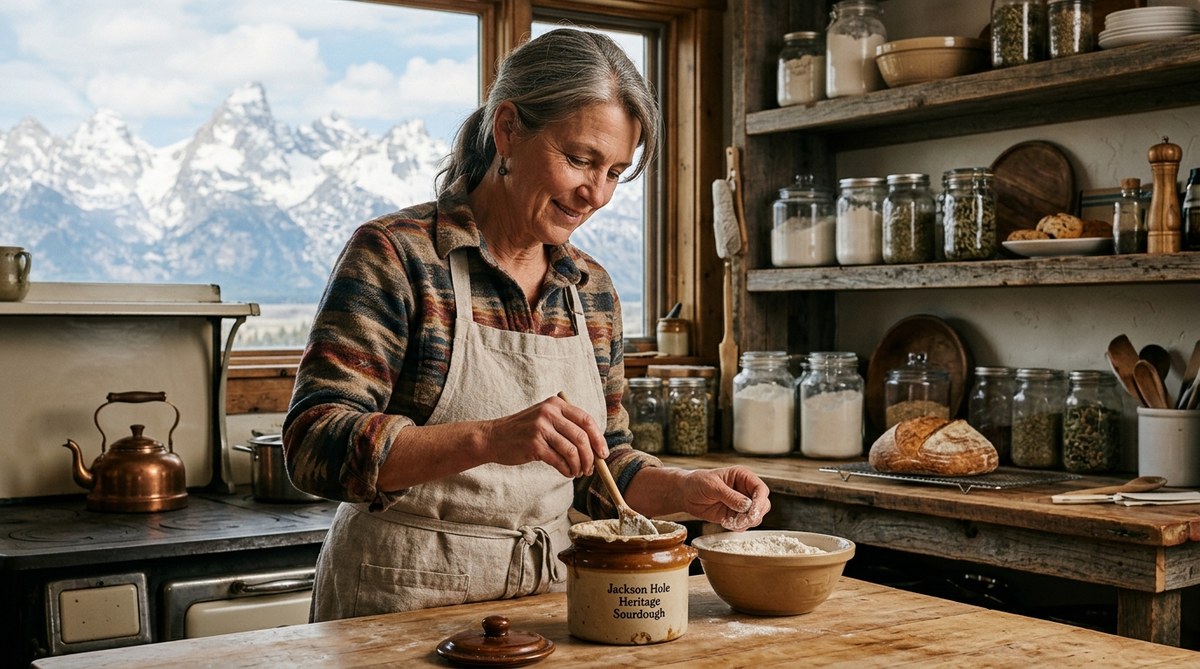
In a small cabin just off the Snake River, a woman pulls a mason jar from her refrigerator. Inside, a bubbling, tangy culture has been alive longer than anyone in Jackson Hole can remember. She calls it “the last sourdough starter.” It arrived in the valley with homesteaders in the late 1800s, survived harsh winters, near extinction, and the relentless pace of modern resort life. This is the story of how one person became the unlikely guardian of a living piece of Jackson Hole’s baking heritage.
A single sourdough starter in Jackson Hole holds over a century of local history. This article follows the woman who is fighting to preserve it, sharing the practical steps to maintain such a culture and the deeper cultural importance of keeping these living heirlooms alive for future generations of bakers.
A Living Relic: The Story Behind the Starter
The starter didn’t come from a fancy bakery or a mail-order kit. It came wrapped in a flour sack, carried by a homesteader named Elsie Mayfield in 1887. She brought it across the plains and into the Tetons, where she used it to bake bread for her family and the crew at the Bar BC Ranch. For decades, the starter was passed down through Elsie’s descendants, each baker adding their own flour, their own water, and their own love.
But by the 1990s, the line was in danger. Elsie’s great-granddaughter moved away, and the starter sat forgotten in the back of an old pantry. That’s when Sarah B., a local food historian, found it during a ranch cleanup. She knew what she had. She took it home, fed it, and brought it back to life.
Sarah is not a professional baker. She’s a fifth-generation Wyomingite who works as a ski instructor during the winter and a hiking guide in summer. But she is fiercely protective of this starter. She calls it “the thread that ties us to the people who built this valley.”
“Sourdough is alive,” she told me, leaning over her kitchen counter. “It changes with the seasons, with the altitude, with your mood. This starter has breathed the same air as the homesteaders. If we lose it, we lose a part of ourselves.”
Her mission is not just to keep a jar of goo active. It is to document, share, and inspire others to start their own heritage cultures. She believes that every baker in Jackson Hole should have a piece of the valley’s culinary DNA in their kitchen.
How One Woman Came to Be the Starter’s Guardian
Sarah’s process for preserving the starter is both scientific and personal. She follows a strict regimen, but she also listens to the starter’s cues. Here are the steps she uses to keep the culture thriving:
- Feed it daily. Sarah uses a 1:1:1 ratio by weight: one part starter, one part whole wheat flour (from a local mill if possible), and one part filtered water. She stirs thoroughly and leaves it at room temperature for four to six hours until bubbly.
- Watch the temperature. Jackson Hole’s high altitude and dry climate mean the starter ferments faster in summer and slower in winter. Sarah keeps a thermometer near the jar and adjusts her feeding schedule accordingly.
- Store it smartly. When not baking, she keeps the starter in the fridge, covered loosely with a cloth. She brings it out once per week for a maintenance feed.
- Share it carefully. Every year, Sarah gives away small portions of the starter to trusted community members. She teaches them how to keep it alive, creating a network of backups.
- Document everything. Sarah keeps a notebook with dates, feeding amounts, and notes on how the bread turned out. She records the weather, the altitude pressure, and the phase of the moon (because, she says, the starter seems to respond).
These steps might seem simple, but they require consistency and care. Many people try to start a sourdough culture and give up within two weeks. Sarah’s approach is about patience and respect for the microbe ecosystem.
The Science of a Century-Old Culture
A sourdough starter is a symbiotic colony of yeast and bacteria. Over time, that colony adapts to its environment. A starter that has lived in Jackson Hole for over a century has developed a unique flavor profile that cannot be replicated elsewhere. The wild yeasts in the Teton air, the minerals in the local water, the type of wheat grown in the valley — all of these become part of the bread.
But mistakes are common, especially for beginners. Here is a table that outlines common issues and how Sarah avoids them:
| Common Mistake | What Happens | Sarah’s Solution |
|---|---|---|
| Using tap water with chlorine | Kills the yeast and bacteria | Use filtered or spring water, left out overnight to dechlorinate |
| Feeding with too much white flour | Weakens the culture over time | Mix in whole grains for nutrients |
| Ignoring temperature swings | Starter becomes sluggish or too acidic | Keep in a stable spot, between 70 and 80 degrees Fahrenheit |
| Forgetting to discard or use the discard | Starter grows too acidic, develops “hooch” (liquid layer) | Discard half before each feed, or use the discard for pancakes |
| Storing without air exchange | Can cause pressure buildup or mold | Cover with a cloth or a loose lid; never seal airtight |
Sarah emphasizes that mistakes are part of the learning process. She admits she has killed her starter twice: once by leaving it in a hot car and once by forgetting to feed it during a backcountry ski trip. Both times, a friend with a backup portion saved the day. That’s why the network of shared starters is so critical.
Why Jackson Hole’s Baking Heritage Matters
Jackson Hole is known for its world-class skiing, stunning landscapes, and high-end resorts. But its heart lies in the stories of ordinary people who shaped this place. The Basque shepherds who once roamed the high country, the ranchers who built the first homesteads, the cooks who fed hungry cowboys — they all left traces. Food is one of the most intimate ways to connect with that past.
Sarah’s work is part of a larger movement to preserve Jackson Hole’s culinary traditions. She often collaborates with other local artisans. For example, she has partnered with the crew at Inside the Kitchen of Cache Creek’s Most Elusive Supper Club to bake bread for seasonal dinners. She also works with the Untold History of Jackson Hole’s Basque Community project, sharing her starter with descendants who want to reconnect with their heritage.
Here are some other ways the community is keeping the baking heritage alive:
- Monthly sourdough workshops at the local library, where Sarah teaches the basics.
- A “starter swap” event held every spring equinox, where bakers exchange cultures and recipes.
- A small network of farmers who grow heirloom wheat varieties specifically for bread making.
- A new program where local restaurants commit to using at least one heritage sourdough product on their menus.
These efforts are not just about bread. They are about identity. When you bake a loaf from a starter that your great-great-grandmother might have touched, you are participating in a conversation across generations.
“This starter is not mine. I am just its caretaker,” Sarah says, her hand resting on the jar. “When I die, someone else will take over. That’s the deal. You don’t own a heritage starter; you borrow it. And you pass it on.”
Keeping the Tradition Alive in Your Kitchen
You don’t need a century-old starter to start your own heritage. Sarah encourages everyone to begin with a new culture and nurture it for six months. By then, it will have adapted to your home and your local environment. After a year, it will be truly yours.
The most important thing is to be consistent. Even if you only feed it once a week, that’s enough to keep it alive. And don’t be afraid to share. The more people who have a piece of your starter, the safer it is.
If you want to learn more about building community around food, check out How Three Local Moms Built Jackson’s First Community Composting Program, a story about grassroots efforts to create a more sustainable town. Sarah’s starter network operates on a similar principle: small actions by many people can preserve something precious.
A Call to Become a Steward of the Loaf
Every time Sarah bakes a loaf, she thinks of Elsie Mayfield, the woman who carried this culture across the prairie. She thinks of the harsh winters when bread was the only comfort. She thinks of the children who grew up eating that bread, and the grandchildren who forgot.
But she also thinks about the future. She dreams of a Jackson Hole where every home has a jar of starter on the counter, where the scent of sourdough mingles with pine and sage. It’s not a romantic fantasy; it’s a practical goal. If enough people commit to the practice, the heritage will never be lost.
So the next time you are in the Tetons, stop by the local farmers market, ask a baker if they have a spare starter, and take it home. Feed it. Name it. Bake with it. And remember: you are not just making bread. You are keeping a thread of history alive.
Sarah’s starter is not the last. It’s the first of many.