
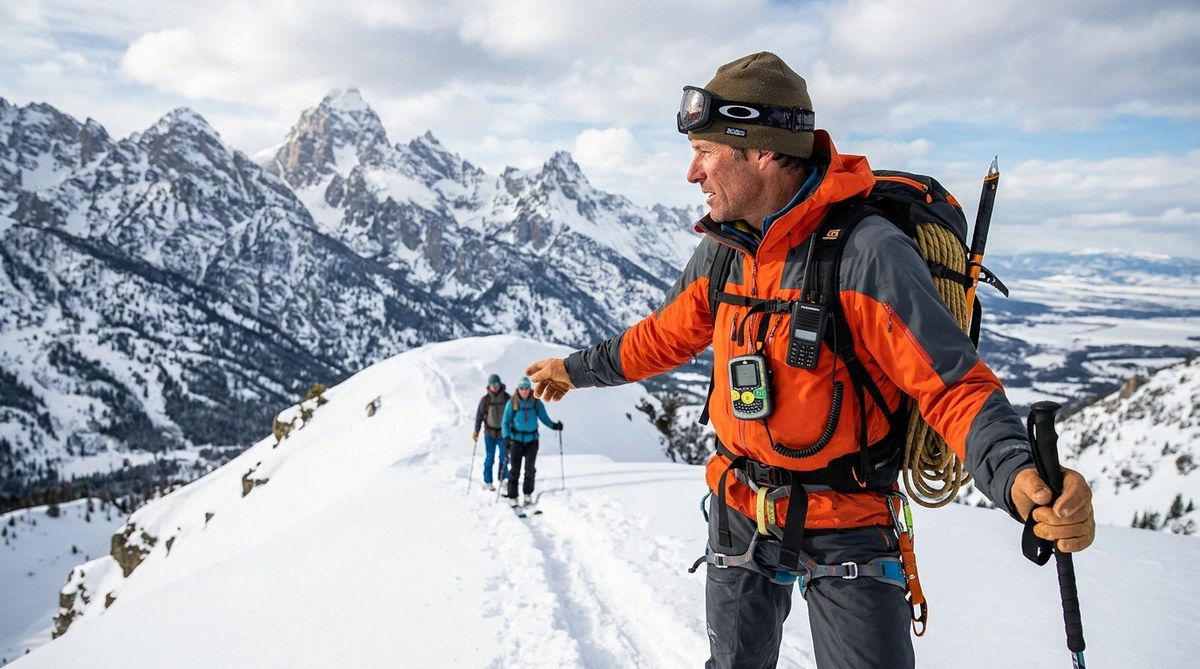
The alarm goes off at 4:15 a.m. outside a modest cabin in Wilson, Wyoming. By 5 a.m., boots are laced, packs are packed, and a well worn topo map is spread across the kitchen table. This is how most days start for a Tetons backcountry guide who has spent the last fourteen winters navigating the steep, snow loaded slopes of the Teton Range. The question that drives every decision from that first sip of coffee to the final glide back to the trailhead is the same one that brings visitors here from across the country: how do you balance raw, unfiltered adventure with the kind of safety that lets you come home to tell the story?
A professional Tetons backcountry guide relies on daily weather analysis, avalanche terrain assessment, and group communication to manage risk without killing the stoke. The secret is not avoiding danger altogether. It is making calculated choices that keep the adventure alive while respecting the mountains. Whether you ski or hike, these principles apply to anyone heading into the backcountry this season.
What a Guide Checks Before the Sun Comes Up
Guides in the Tetons do not wake up and head straight for the trail. The first hour of the day is a ritual of data gathering that would look familiar to a meteorologist or a search and rescue coordinator. Weather forecasts get cross referenced against multiple models. Snowpack reports from the Bridger Teton Avalanche Center get read out loud. Recent wind patterns, temperature swings, and solar radiation all get weighed against the planned route.
One guide I spoke with pulls up three different weather models every morning. He looks at the North American Mesoscale model, the Global Forecast System, and a high resolution model that focuses specifically on the Wyoming ranges. If they disagree, the conservative vote wins every time. That discipline has kept him from committing to a line that looked good on paper but turned into a wind loaded nightmare by midday.
The guide also checks recent observations from other parties. The Teton backcountry community is small and tight knit. A text from a ski patrol friend on Teton Pass can change the plan for the whole day. This kind of local intelligence is something no app can replace.
The Three Pillars of Teton Backcountry Decision Making
After years of guiding, most local guides boil safety down to three core areas. These are not theoretical concepts. They are the framework for every route choice, every turn, and every call to turn around.
1. Terrain Management
The Tetons offer world class steeps, couloirs, and alpine bowls. But not every slope is safe on every day. A guide manages terrain by choosing aspects and angles that match the current snowpack stability. They avoid slopes between 30 and 45 degrees when the avalanche danger is elevated. They look for ridges, wind sheltered zones, and features that reduce exposure.
2. Snowpack Science
The snowpack in the Tetons is famously complex. A weak layer of faceted snow near the ground can linger for months. A guide digs snow pits, performs compression tests, and looks for signs of instability like collapse or cracking. They do not rely on guesswork. They rely on data gathered from the actual snow at their feet.
3. Group Dynamics
Adventure is better with friends, but groupthink can kill. A good guide checks in with every client multiple times per day. They ask questions like “How are you feeling?” and “What is your comfort level with this slope?” They watch for fatigue, peer pressure, and the urge to push for the summit when conditions say no.
Here is a numbered look at the practical process a guide follows before dropping into any serious line:
- Stop at a safe zone below the slope. Pull out the avalanche transceiver and do a quick signal check with the group.
- Assess the slope angle with an inclinometer. If it reads over 35 degrees and the danger is considerable or higher, the line gets a hard no.
- Look for red flags like fresh wind loading, recent avalanche debris, cracking underfoot, or collapsing snowpack. One red flag means stop and evaluate. Two means turn around.
- Choose a descent route that provides safe islands and escape options. Never commit to a line that pins the group into a terrain trap like a gully or a cliff band.
- Communicate the plan clearly. Every person knows the route, the meeting points, and what to do if someone gets caught in a slide.
When the Risk Is Worth Taking
A guide does not seek zero risk. That would mean staying home. The goal is acceptable risk with high reward. The difference comes down to preparation and honesty.
Consider a typical midwinter day in the Tetons. The forecast calls for cloudy skies with light wind. The avalanche danger is rated moderate on northwest through northeast aspects above 9,000 feet. A guided group eyes a north facing couloir that holds soft snow and minimal wind exposure. The guide digs a pit, finds a stable snowpack structure, and decides the line is within the acceptable range. The group drops in one at a time, each person skiing to a safe zone before the next person starts. The adrenaline is real. So is the margin of safety.
That balance is the essence of guiding in the Tetons.
Common Mistakes That Can Turn a Great Day Into a Rescue
Not every party that heads into the Teton backcountry comes out under their own power. The local search and rescue team stays busy every season. Most incidents share similar patterns. Here is a table that breaks down the most common errors and the better approach.
| Common Mistake | Why It Happens | Better Approach |
|---|---|---|
| Skipping the morning weather check | Overconfidence or laziness | Build a 15 minute check into your pre trip routine every single day |
| Ignoring small signs of instability | Strong desire to ski the line | Treat cracking or collapsing as a hard stop. Turn around immediately |
| Letting one person make all the decisions | Groupthink or deference to the strongest skier | Use a shared decision making model. Every voice gets heard |
| Carrying gear but not knowing how to use it | Bought the transceiver but never practiced | Run a rescue drill with your group before every tour |
| Pushing through fatigue on the way out | Ego or fear of slowing the group | Plan extra time for the exit. Exhaustion causes most late day accidents |
As one veteran guide told me, “I have never seen someone get into trouble because they turned around too early. I have seen plenty get into trouble because they wanted it too badly.”
The mountains will be there tomorrow. The snow might not be perfect, but you will be alive to ski another day. That is the only metric that matters.
How to Choose a Guide for Your Teton Backcountry Trip
If you are planning a backcountry trip to the Tetons and you are not a local, hiring a guide is the smartest investment you can make. But not all guides are equal. Look for credentials that go beyond a social media following.
Certifications matter. An AMGA (American Mountain Guides Association) certification is the gold standard. Guides with an AMGA ski guide or alpine guide credential have passed rigorous exams that test their technical skills, decision making, and judgment. A lot of local guides also hold Wilderness First Responder (WFR) certification and carry advanced avalanche training like the Pro 1 or Pro 2 level.
Ask questions before you book. A good guide wants you to ask. They will share their experience level, their favorite zones, and how they handle changing conditions. If a guide brushes off your questions or promises an epic day no matter what, that is a red flag.
The best guides in Jackson Hole do not need to sell themselves. Their reputation comes from the community. They are the ones teaching avalanche courses at the community college. They are the ones volunteering on the search and rescue team. They are the ones seen around town with muddy boots and a calm, steady presence.
For a deeper look at what keeps people safe in these mountains, read our story on how Jackson Hole’s volunteer search and rescue team saves lives in the backcountry.
The Gear That Makes the Difference
You do not need the most expensive gear to be safe in the Tetons. But you do need the right gear, and you need to know how to use it. Here is a bulleted list of the essentials that every guide carries, even on a bluebird day:
- Avalanche transceiver, probe, and shovel. Carried on your body, not in your pack. Every single person in the group must have all three.
- A dedicated communication device. In many parts of the Tetons, cell service does not exist. Guides carry a two way radio or a satellite messenger like an InReach.
- A first aid kit tailored to trauma and cold weather injuries. Think chest seals, tourniquets, and blister care, not just band aids.
- Extra insulation. A puffy jacket and a waterproof shell stay in the pack year round. Hypothermia does not care about the forecast.
- Navigation tools. A map and compass as a backup to the GPS on your phone. Batteries die. Screens break.
One guide I know carries a small notebook and a pencil in a ziplock bag. He sketches terrain and writes observations throughout the day. That notebook has saved him more than once when a digital device failed.
For a closer look at how our community documents the wild moments that shape this valley, check out the story on a local who has documented every moose birth in Grand Teton for 30 years.
The Culture of Safety in Jackson Hole
Backcountry culture in Jackson Hole has changed over the past decade. More people are getting into the sport. Social media makes every powder turn look effortless. But the locals who live here year round know that the mountains demand respect.
The community response to close calls is not judgment. It is education. When someone gets caught in a slide or triggers a close call, the story gets shared in a way that helps others learn. The avalanche center publishes detailed reports. Guides hold free community sessions at the town library. The culture is built on the idea that we all go home together.
That ethos extends to how guides treat their clients. A guide does not care how many Instagram followers you have. They care whether you can stop on a dime, read the snow, and listen when they say it is time to turn around.
If you are curious about the rhythm of life in this valley during the quiet months, read about what the real Jackson Hole is like when the tourists leave.
How to Prepare for a Guided Day in the Tetons
You booked a guide. You are excited. Now what? Preparation can make the difference between a day that feels like a struggle and a day that feels like flow.
First, get your fitness in order. The Tetons are not a place to find your legs. You want to arrive with a baseline of endurance that lets you enjoy the day instead of surviving it. Hiking with a weighted pack on stairs or hills in the months before your trip will pay off in spades.
Second, practice your skills. If you are skiing, make sure your turns are solid in variable snow. If you are hiking, know how to self arrest with an ice axe and crampons. Guides can teach you a lot, but they cannot teach you how to ski in a single morning.
Third, pack your bag the night before. Checklists help. Guides use them. You should too.
Fourth, arrive with an open mind. The plan might change. The weather might shift. The snow might not cooperate. The best days in the Tetons are often the ones that did not go according to plan.
When Adventure Calls and Safety Answers
The Tetons are one of the most beautiful and dangerous mountain ranges in North America. Every year, the peaks draw thousands of people who want to test themselves against something bigger than their daily lives. That desire is not something to suppress. It is something to channel.
A local backcountry guide does not stand between you and the mountain. They stand beside you. They share their knowledge, their instincts, and their hard won experience so that you can push your limits without pushing past the edge of safety.
The next time you drop into a couloir or crest a ridge in the Tetons, remember that the line between adventure and disaster is thin. But it is also knowable. With the right preparation, the right guide, and the right mindset, you can walk that line and come back ready to do it again.
For more stories that capture the evolving culture of Jackson Hole, read about what it really costs to live in Jackson Hole in 2026 and finding community as a newcomer in Jackson Hole.