
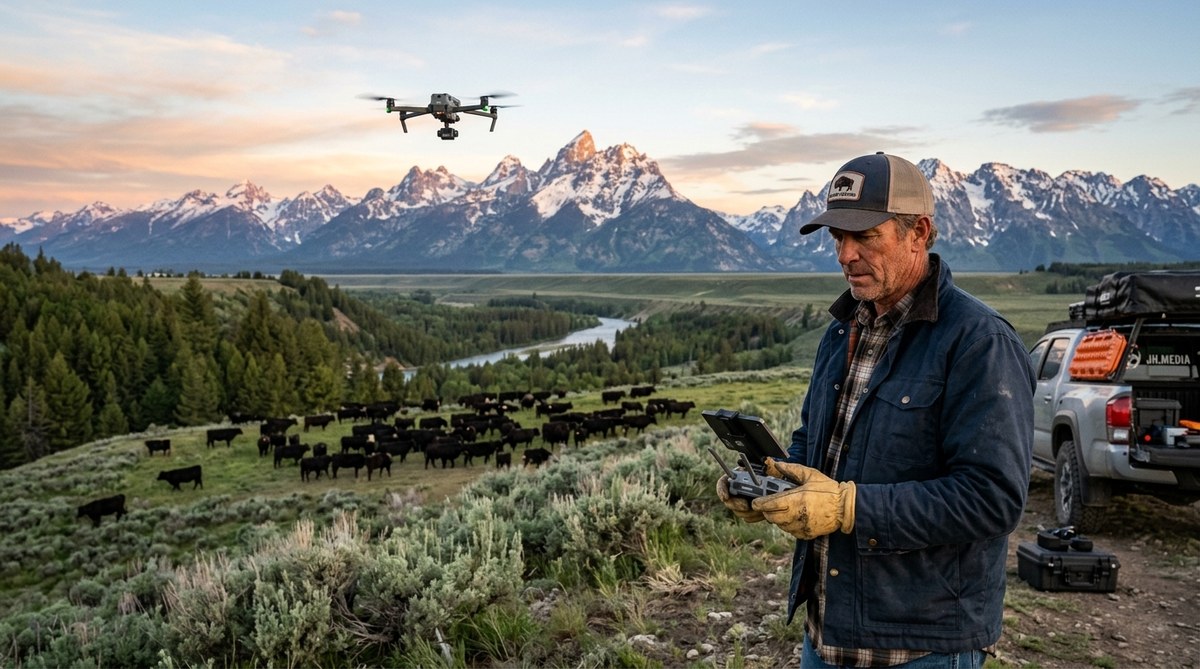
The first time Tom pulled the drone out of his truck, his neighbor just laughed. “You gonna herd cows with that thing?” The neighbor shook his head and drove off. That was two years ago. Last fall, that same neighbor called to ask where he could buy one.
Tom runs a small cattle operation in the Gros Ventre Valley, just east of Jackson Hole. For years, he lost two or three calves each season to wolves. It was never enough to put him out of business, but it hurt. More than the money, it hurt to find the carcasses. He tried guard dogs, fencing, even night riders on ATVs. Nothing stopped the losses completely. Then he heard about a pilot program in Oregon where biologists were using drones to haze wolves away from livestock. He figured it was worth a shot.
Drones are proving to be an effective non-lethal tool for reducing wolf attacks on cattle. By combining aerial surveillance with targeted hazing, ranchers can deter predators without harming them. The approach is gaining traction across the West as a practical alternative to lethal control methods that divide communities.
How a Drone Changes the Game
Wolves are smart. They learn patterns fast. If a rancher checks the herd at the same time every day, the wolves adjust. They attack at night, or during a storm, or right when the rancher is hauling hay to a different pasture. A drone changes that calculus.
Tom flies his drone at random times. Sometimes at dawn. Sometimes at midnight. Sometimes he does not fly for three days, then goes out twice in one evening. The wolves never know when the buzzing machine will appear. Over time, they start associating the open pasture with that noise. They move on.
The drone does two things. First, it lets Tom see what is happening in real time. The camera feed shows him where the herd is bunched up, where the stragglers are, and whether any predators are nearby. Second, the drone itself becomes a tool for hazing. When he spots a wolf, he flies the drone directly at it. The wolf usually runs. If it does not, he activates a speaker mounted on the drone that plays loud human voices or barking dogs.
The Practical Steps to Get Started
If you are a rancher or livestock manager thinking about trying this, here is the process Tom recommends. It is simpler than you might expect.
-
Buy a drone with a thermal camera. You need the thermal imaging to spot wolves at night. A standard camera does not work in the dark. Tom uses a DJI Matrice 300 with a Zenmuse H20T sensor. It is expensive, around $15,000, but cheaper options are appearing in 2026. You can also find used units from survey companies upgrading their fleets.
-
Get your Part 107 license from the FAA. You need this to fly commercially, even if you are just protecting your own cattle. The test costs about $175 and takes a weekend to study for. Tom says it is the hardest part of the process, but not because the test is hard. It is just paperwork he did not want to deal with.
-
Set up a flight pattern around your pasture boundaries. Do not fly directly over the herd at first. The cattle need to get used to the drone. Tom spent a week just flying the perimeter, letting the cows hear the sound from a distance before bringing it closer.
-
Fly at random intervals. This is the most important step. If you fly at the same time every night, the wolves will simply wait until you land. Tom uses a phone app to set random alarms. Sometimes he flies at 2 a.m. Sometimes at 5 p.m. The unpredictability is what makes it work.
-
Use hazing only when you see a wolf. Do not chase the drone around for fun. The goal is to teach wolves that the drone appears only when they are near cattle. If you fly it constantly for no reason, the wolves will habituate and stop caring.
What Works and What Does Not
Tom learned a few hard lessons in his first season. He shared what worked and what did not.
| Technique | Result | Why |
|---|---|---|
| Thermal camera patrols at night | Highly effective | Wolves move mostly at night; thermal sees them easily |
| Random flight times | Prevents habituation | Wolves cannot predict when the drone will appear |
| Playing human voices through a speaker | Works for a few weeks | Wolves learn the voice is not a real threat |
| Flying the drone directly at a wolf | Very effective | Wolves perceive it as a predator and flee |
| Using a cheap consumer drone | Failed | Short battery life and no thermal camera made it useless |
| Flying the same route every night | Failed | Wolves learned the pattern and avoided the drone |
Tom says the biggest mistake is buying a drone without thermal imaging. A standard camera is useless at night, and that is when most attacks happen. He also warns against flying too low. If the drone gets within 20 feet of a wolf, the wolf might jump and try to catch it. You lose a $15,000 drone that way.
What the Wildlife Biologists Say
Tom is not the only one doing this. Wildlife managers across the West are paying attention. I spoke with Dr. Sarah Kendrick, a wildlife biologist who studies predator behavior in the Greater Yellowstone Ecosystem. She has been monitoring Tom’s operation for the past year.
The results are promising. We have documented a 70 percent reduction in calf losses on Tom’s ranch compared to the three years before he started using drones. The wolves have not left the area, but they have shifted their hunting patterns to avoid the drone. That is exactly what we want to see. Non-lethal deterrence that changes behavior without removing animals from the ecosystem.
Dr. Kendrick emphasized that drones are not a silver bullet. They work best as part of a broader strategy that includes guard animals, fencing, and range riders. But she noted that drones fill a gap that nothing else can. Guard dogs are great during the day but less effective at night when wolves are most active. Fencing is expensive and hard to maintain across thousands of acres. Drones give ranchers eyes in the sky at the time when they need them most.
The Cost Breakdown
Tom is upfront about the expense. A full setup costs between $10,000 and $20,000 depending on the drone model and camera. The Matrice 300 he uses is on the high end. Newer models from Autel and Parrot are coming to market in 2026 with thermal cameras built in for around $8,000.
He spends about $500 a year on batteries. Each flight lasts about 30 minutes on a single battery, so he carries six batteries per night. He also pays $300 a year for insurance and another $200 for software updates.
Compare that to the cost of losing calves. A single calf is worth $800 to $1,200 at market. If you lose five calves in a season, that is $5,000 gone. The drone pays for itself in two to three years. And that does not include the peace of mind.
A Growing Movement
Tom is not alone anymore. He knows three other ranchers in Teton County who started using drones this year. They share tips in a group chat. One of them figured out how to mount a small spotlight on the drone to illuminate the pasture at night without spooking the cattle. Another rigged a speaker that plays coyote howls, which seems to work better than human voices.
The approach is spreading beyond Wyoming. Ranchers in Oregon, Montana, and Colorado are testing similar setups. Some conservation groups are even offering grants to help ranchers buy the equipment. The idea is gaining traction because it offers a middle path. It does not require killing wolves, which many ranchers dislike doing anyway. And it does not require accepting losses, which no rancher can afford.
The Limits You Need to Know
Tom wants people to understand that drones are not magic. They require work. You have to charge batteries, update software, and fly in bad weather. Rain grounds the drone. High wind grounds the drone. Deep snow makes it hard to see the cattle on the thermal camera because the ground is cold and the cows blend in.
Wolves are also adaptable. Tom has seen wolves that initially ran from the drone start to ignore it after a few weeks. He has to keep changing his tactics. Sometimes he flies low and fast. Sometimes he hovers high and plays noise. Sometimes he does not fly at all for a week, then hits them with three nights in a row.
He also stresses that drones do not solve the problem of wolves that have already killed and developed a taste for beef. Once a wolf has successfully taken a calf, it is much harder to scare it away. In those cases, lethal removal may still be necessary. But drones can prevent that first kill from happening.
Practical Advice for Ranchers Considering Drones
If you are thinking about trying this on your own operation, here are the key points to remember.
- Start with a used thermal drone if budget is tight. Check auction sites and survey equipment dealers.
- Take the Part 107 test. It is not hard and it keeps you legal.
- Fly random patterns. Consistency is the enemy of deterrence.
- Pair the drone with other methods. Guard dogs and fencing still matter.
- Do not expect perfection. You will still lose animals. But you will lose fewer.
- Keep a log of flights and sightings. It helps you refine your strategy and proves the method works if you ever need to show data to regulators or neighbors.
The Quiet Change Happening in the Valley
Tom does not see himself as a pioneer. He just wanted to stop losing calves. But his approach is part of a larger shift happening in Jackson Hole and across the West. Ranchers are adopting technology that lets them coexist with wildlife instead of fighting it. It is not about being soft. It is about being smart.
The drones to protect cattle from wolves movement is still young. But it is growing. Every season, more ranchers buy drones. Every season, the equipment gets cheaper and the techniques get better. Tom thinks that in ten years, most large cattle operations will have at least one drone in the barn.
He might be right. Last week, his neighbor the one who laughed at him two years ago stopped by again. He did not laugh this time. He asked if Tom could teach him how to fly.
What This Means for the Future of Ranching
The conversation around wolves and livestock has been stuck for decades. Ranchers want to protect their herds. Conservationists want to protect wolves. The two sides rarely agree. Drones offer a way out of that stalemate. They give ranchers a tool that works without requiring lethal force. They give conservationists a reason to support ranchers instead of fighting them.
It is not a perfect solution. No solution ever is. But it is a step forward. And in a place like Jackson Hole, where the landscape demands compromise, that matters.
If you want to read more about the people shaping life in this valley, check out our story on the last working cowboys of the Gros Ventre Valley or our piece on what happens to Jackson Hole’s wildlife when 3 million tourists show up. For a deeper look at how locals balance tradition and innovation, read the art of living simply in a luxury mountain town.
One Rancher’s Advice for Anyone Thinking About Trying This
Tom’s final piece of advice is simple. Do not wait until you have a problem. Buy the drone before you lose the calf. Learn to fly it in the summer when the weather is good and the pressure is low. That way, when the wolves show up in the fall, you are ready.
He says it took him a full season to get comfortable with the drone. He crashed two of them. He lost one in a tree. He spent hours watching YouTube tutorials. But now, he can fly the thing with one hand while drinking coffee with the other. It just takes practice.
If you are a rancher or a wildlife manager looking for a non-lethal way to reduce predator attacks, start small. Borrow a drone from a friend. Rent one for a weekend. See if the approach fits your operation before you invest. The technology is not going anywhere. It is only getting cheaper and better.
And if you are in Jackson Hole, swing by Tom’s place. He will show you how it works. He might even let you take the controls. Just do not crash it into his hay barn. He will never let you live that one down.