
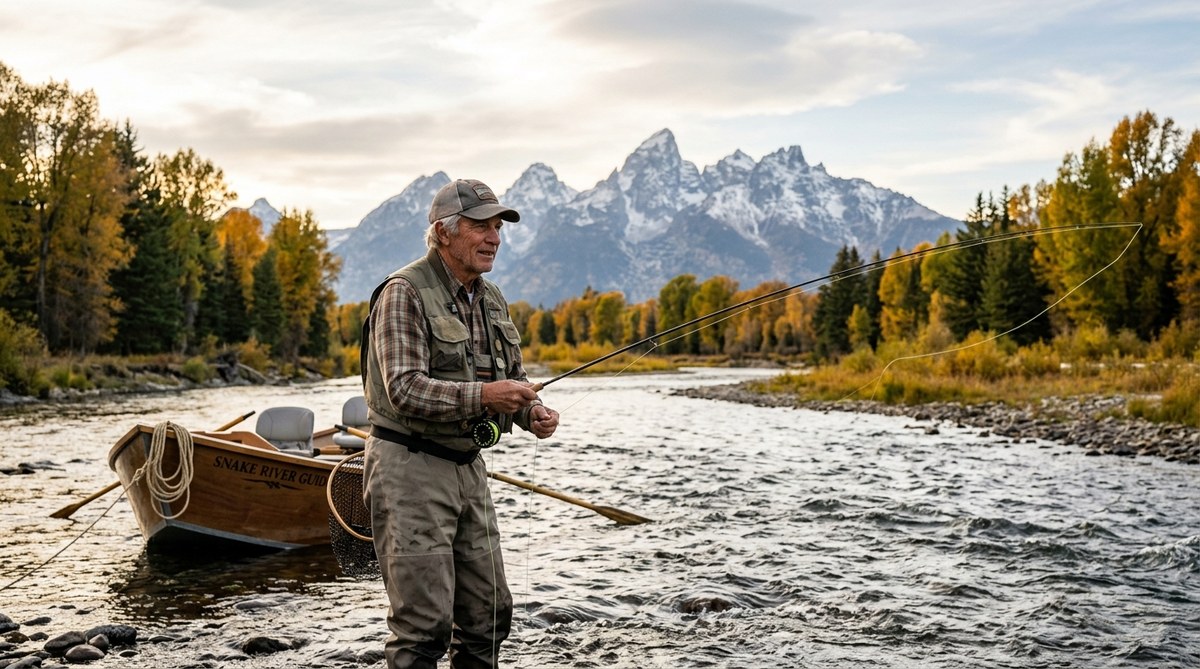
The first time I stepped into a drift boat with a guide who had been floating the Snake River since before I was born, I expected fishing tips. I got something else entirely. Over the course of a long afternoon, as we worked cutbanks and dodged afternoon thunderstorms, the conversation drifted from hatch charts to heartbreak, from mending line to mending relationships. By the time we pulled the boat out at the takeout, I realized I had not just learned about fly fishing. I had accidentally sat through a master class in how to live well.
That guide was Frank. He has been guiding on the Snake River for 50 seasons. He is the oldest active fishing guide in Jackson Hole, and he has no plans to stop. Over five decades, he has watched the river change, watched the town change, and watched thousands of anglers step into his boat nervous and leave a little more settled. I asked him what he had learned. He laughed, stripped some line through his fingers, and said, “The river teaches you everything if you let it.”
After 50 seasons on the Snake River, Jackson Hole’s oldest fishing guide has learned that patience is not passive, reading water is a metaphor for reading people, and the best anglers are the ones who stay curious. This article shares the life lessons that only a half-century on the river can teach.
What the River Taught Him About Patience
Frank says most people get patience wrong. They think it means waiting quietly for something to happen. But on the Snake River, patience looks different. It means casting to the same seam forty times because you know a fish is there, even if your arm gets tired. It means sitting through a hailstorm because the hatch is about to pop. It means watching a client struggle with a knot for five minutes and not grabbing the rod out of their hands.
The river taught Frank that patience is active. It is a choice you make over and over, sometimes minute by minute. He told me about a father who brought his teenage son out for a float. The kid was distracted, on his phone between casts, clearly not interested. Most guides would have written the day off. Frank just kept casting, kept talking, kept showing the kid how the light hit the water. Around three in the afternoon, the kid put his phone away. By five, he was asking questions. Frank says that day taught him more than the kid ever knew.
“Patience is just trust with a longer timeline. You trust the fish. You trust the river. You trust that the person in your boat will find their way. Most things that matter take longer than you want them to.”
How to Read Water Like You Read People
Frank believes that reading a river and reading a human being use the same skill set. You look for surface clues, but you also pay attention to what is happening underneath. On the Snake, that means spotting the subtle seams where fast water meets slow. It means noticing the foam lines that trace the currents. It means understanding that the biggest fish are rarely in the most obvious spots.
He broke it down into a practical process. Here is how Frank teaches his clients to read water, and he says it works for reading people too.
- Scan the surface for contrast. Look for where the light changes, where the current shifts, where the bubbles gather.
- Identify the edges. The most productive water is almost never in the middle. It is along the banks, behind rocks, at the tailouts of pools.
- Watch for movement. A dimple on the surface, a flash of silver, a bird diving. Those are clues that something is happening below.
- Stay still and watch for five minutes before you cast. Most anglers rush. The ones who wait catch more fish.
- Adjust your approach based on what the water tells you. If the fish are rising, match the hatch. If they are not, change your depth or your fly.
Frank says the same steps work with people. Scan for contrast. Notice the edges. Watch for small movements. Stay still before you speak. Adjust based on what you learn.
The Three Mistakes He Sees Every Season
Over fifty years, Frank has watched anglers make the same mistakes. He does not judge them for it. He says making mistakes is how you learn. But he also says there are three errors that cost people the most, both on the water and in life.
| Mistake | How It Shows Up on the River | How It Shows Up in Life |
|---|---|---|
| Rushing the cast | Throwing line before the drift is ready | Making decisions before you have enough information |
| Fighting the current | Trying to force a boat where the river does not want to go | Resisting change instead of working with it |
| Ignoring the small signs | Missing a subtle rise because you are looking for a big splash | Overlooking small problems until they become big ones |
Frank says the best anglers he has ever known are the ones who slow down. They take their time. They watch. They wait. And when they finally make a move, it is deliberate. He says the same is true of the best people he has known. They do not rush. They do not force things. They pay attention to the details.
What Fifty Seasons Taught Him About Change
Jackson Hole has changed dramatically since Frank started guiding. The town has grown. The river has more pressure. The fish are smarter. Some guides complain about it. Frank does not. He says the river has always been changing. The water level fluctuates. The channels shift. The hatches come earlier some years and later others. Change is not the problem. The problem is thinking things should stay the same.
He told me about a stretch of the Snake that used to hold huge brown trout in the 1980s. For about a decade, that stretch was his secret spot. Then a flood changed the channel, and the fish moved. He spent two seasons trying to find them again. Eventually, he accepted that the river had rewritten itself. He stopped looking for the old spot and started learning the new one.
That lesson stayed with him. He says the people who struggle in Jackson Hole are the ones who want it to be the way it was. The people who thrive are the ones who adapt. He sees the same thing in relationships, in careers, in everything. Flexibility is not a weakness. It is survival.
The Tools That Have Stayed the Same
While the river changes, some things have not. Frank still uses a bamboo rod he bought in 1978. He still ties his own flies. He still starts every morning the same way. He wakes up before dawn, makes a pot of coffee, and sits on his porch for fifteen minutes with no phone, no radio, just the sound of the wind in the cottonwoods.
He says that morning ritual is the most important part of his day. It resets him. It reminds him that he does not need much to be happy. A warm cup of coffee. A quiet moment. A river that will be there when he is ready.
- A good pair of waders that do not leak
- A fly box organized by hatch, not by color
- A sharp knife for cutting line and cutting apples
- A reliable drift boat that has been patched more times than he can count
- A willingness to be wrong about what the fish want
Frank says the gear matters less than the attitude. He has seen people with ten thousand dollars worth of equipment catch nothing, and he has seen kids with a hand-me-down rod land the fish of the day. The river does not care about your budget. It cares about your presence.
How to Build a Life That Lasts in a Resort Town
Jackson Hole is not an easy place to stay. The cost of living keeps climbing. The tourist season gets longer. A lot of people come for a summer or a winter and then leave. Frank has watched generations of guides cycle through. Most of them burn out. A few of them stay.
He says the ones who stay have three things in common. First, they find a way to live simply. They do not try to keep up with the vacation homes and the luxury condos. They live in small cabins or shared houses. They drive old trucks. They value experience over stuff. Second, they build community. They show up for each other. They help fix boats, share flies, and watch each other’s dogs. Third, they keep learning. The guides who think they know everything are the ones who leave. The guides who stay curious are the ones who last.
Frank has seen the town cycle through many trends. He has seen fly fishing become trendy and then fade and then come back. He has seen the river go from quiet to crowded and back again. Through all of it, he has kept doing the same thing. He shows up. He pays attention. He treats every client like they might teach him something.
What He Wants Every Angler to Know
If Frank could sit down with every angler who comes to Jackson Hole, he would tell them one thing. The fish do not care about your reputation. They do not care about your gear. They do not care about how many rivers you have fished. They only care about what you are doing right now, in this moment, with this drift.
He says the same is true of life. The past does not matter. The future is not here yet. All you have is this cast, this conversation, this afternoon on the water. If you are not fully present for it, you are missing the whole point.
Frank is 74 years old. He still guides five days a week during the season. He still gets excited when a client lands their first cutthroat. He still learns something new every time he pushes the boat off the ramp. He says that is the secret. Not the fly patterns or the drift techniques or the secret spots. The secret is staying open. Staying curious. Staying willing to be surprised.
The Legacy of a River Life
Frank does not think of himself as a legend. He thinks of himself as a guy who got lucky enough to spend his life doing something he loves. But the people who have floated with him know better. They remember the way he pointed out an osprey nest and then told a story about the pair that built it fifteen years ago. They remember the way he tied on a fly with cold, wet hands and did it without complaint. They remember the way he made them feel like the only person on the river.
That is the legacy of fifty seasons. Not the fish caught or the miles floated. It is the way he made people feel connected to something bigger than themselves. It is the way he taught patience without ever saying the word. It is the way he showed that a life spent paying attention is a life well lived.
For more stories about the people who define this valley, check out our piece on why a former Wall Street trader now guides fly fishing trips on the Snake River. You can also read about the last working cowboys of the Gros Ventre Valley and what it really costs to live in Jackson Hole in 2026.
Taking the River Home
You do not have to spend fifty seasons on the Snake to learn from Frank. You just have to be willing to slow down. Next time you step into a river, or into a conversation, or into a quiet moment of your own, try Frank’s approach. Watch before you act. Stay curious. Trust that the thing you are looking for will show up, but only if you are patient enough to let it.
The river teaches everything. You just have to show up and listen.