
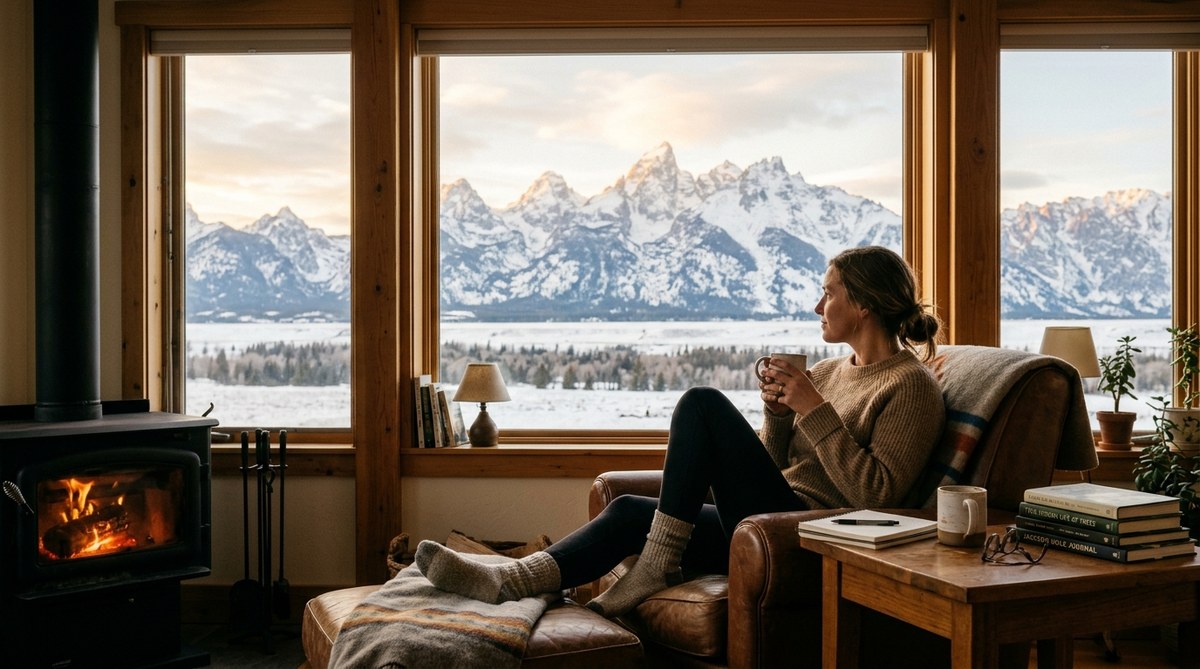
The alarm never goes off before seven. The coffee is ground by hand. The first sip happens on a porch facing the Tetons, not in a car on the way to the lifts. This is the Jackson Hole slow morning, and for the people who live here year round, it is not a luxury. It is a survival strategy.
Visitors often arrive with a packed itinerary. They want to squeeze every dollar out of a trip that costs more than most vacations. But locals know something that the guidebooks rarely print. The best part of Jackson Hole is not the summit of a 10,000 foot peak or a reservation at a sold out restaurant. The best part is the quiet hour between waking up and joining the world. That hour is sacred here.
A Jackson Hole slow morning is a deliberate practice of starting the day with calm intention before the valley wakes up. Locals use this time to connect with nature, avoid tourist congestion, and build resilience for a demanding lifestyle. By shifting your routine just one hour earlier or later, you can transform your entire experience of the valley.
The Difference Between a Tourist Morning and a Local Morning
Tourists wake up late, scramble for parking, stand in line for breakfast, and hit the trailhead at ten when the sun is already high and the crowds are thick. Locals do the opposite. They wake up early, but they do not rush. The key is the gap between waking and doing.
A local morning looks like this. You wake up naturally, without an alarm if possible. You make a proper pour over or a French press. You sit still. You watch the light move across the face of the Grand Teton. You might read a few pages of a book. You might write in a journal. You do not touch your phone for the first thirty minutes.
Only after that do you move. You lace up your boots. You step outside. You walk the dirt path behind your rental or your cabin. You breathe the cold air. You listen to the birds. By the time you reach a trailhead, the sun is fully up, but the parking lot is still half empty. You have already won the day.
How to Build Your Own Slow Morning Routine
You do not need to live here full time to adopt this rhythm. Whether you are visiting for a week or settling in for a season, these steps will help you find the same peace that locals protect.
- Set your intention the night before. Decide what your morning will look like. Lay out your clothes. Prep your coffee setup. Choose one thing you want to notice outside, like the color of the sky or the sound of a particular bird.
- Wake up without your phone. Charge it in another room. Use a basic alarm clock if you need one. The first thing you see should be natural light, not a notification.
- Make a ritual out of coffee or tea. Do not rush this step. Use a kettle that whistles. Pour slowly. Smell the grounds. Hold the warm mug with both hands.
- Sit in one spot for at least fifteen minutes. Find a porch, a bench, or a patch of grass. Do not multitask. Do not scroll. Just sit.
- Move your body gently. This is not a workout yet. Stretch. Walk around the block. Do a few sun salutations. Let your body wake up on its own timeline.
- Eat something simple and warm. Oatmeal with local honey. A scrambled egg from the farmers market. Toast with butter. Nothing complicated.
- Leave the house only when you feel ready. If you are heading to a trail or a ski run, aim to arrive after the first wave of early birds but before the late crowd. That sweet spot is usually between 9 and 10 a.m.
“I tell everyone who moves here that the first hour of the day is not for productivity. It is for presence. If you skip that hour, you spend the rest of the day trying to catch up to yourself.” – Samira K., Jackson resident of 14 years
What a Slow Morning Does for Your Mind and Body
There is a reason so many people in Jackson Hole work in outdoor guiding, hospitality, or remote creative jobs. The pace of life here demands a certain mental clarity. A slow morning is the foundation for that clarity.
When you start the day with calm intention, your nervous system stays in a parasympathetic state. That means lower cortisol, steadier heart rate, and better decision making. You are less reactive. You handle the inevitable frustrations of mountain town life, like a sudden snowstorm or a packed grocery store, with more grace.
A slow morning also helps you regulate your energy. Instead of spiking your adrenaline with a rush out the door, you ease into the day. That sustained energy carries you through the afternoon without the crash that comes from a frantic start.
Common Mistakes People Make When Trying to Slow Down
Even well meaning visitors and newcomers stumble into patterns that ruin the peace. Here are the most common slip ups and how to avoid them.
| Mistake | Why It Happens | The Local Fix |
|---|---|---|
| Sleeping in too late | Jet lag or late night socializing | Go to bed by 10 p.m. for the first three nights. Your body adjusts to mountain time fast if you let it. |
| Checking email immediately | Work anxiety or habit | Put your phone on airplane mode before bed. Keep it off until after breakfast. |
| Eating a heavy breakfast | Hotel buffets or convenience | Stick to protein and fat. Skip the pancakes and pastries. They cause a mid morning energy dip. |
| Planning the whole day during coffee | Over scheduling | Write your plans the night before. Morning is for being, not planning. |
| Skipping the sit down step | Feeling restless or bored | Start with five minutes. Set a timer. It feels awkward at first, but the stillness becomes addictive after three days. |
Where to Practice a Slow Morning in Jackson Hole
Not everyone has a porch with a view. If you are staying in a hotel or a rental without outdoor space, you can still find a spot to sit still. Locals guard these places like secrets.
- The patio at the base of Snow King. Go before 8 a.m. Bring your own mug. Watch the town wake up below you.
- The bench behind the National Museum of Wildlife Art. Most visitors head straight inside. The outdoor sculpture trail is empty in the early hours.
- Any pull off along the Moose Wilson Road. Park safely. Sit on the hood of your car. Listen to the Snake River run.
- The lawn at the Chapel of the Transfiguration. The windows frame the Tetons like a painting. The morning light is extraordinary.
If you want to read more about how locals protect these quiet spaces, check out our story on the unwritten rules of being a Jackson Hole local. It explains why we do not post exact coordinates for certain spots.
How a Slow Morning Changes Your Relationship with the Valley
After a week of slow mornings, something shifts. You stop seeing Jackson Hole as a checklist of things to do. You start seeing it as a place to be. The mountains become less of a backdrop and more of a companion. The air smells different. The silence feels alive.
This is why people who move here for a season often stay for a decade. The valley rewards patience. It reveals itself slowly. A rushed visitor sees the Tetons. A slow local feels them.
If you are new to town, or just visiting, give yourself the gift of a week without a single early reservation. Let your body find its own rhythm. Let the valley show you what it looks like when no one is watching. You can read about what it’s really like to spend winter as a ski patrol on Teton Pass to understand how even the most adrenaline driven locals build slowness into their day.
The Science of Slowing Down at Altitude
Jackson Hole sits at 6,237 feet. That altitude affects your sleep, your digestion, and your mood. A slow morning is not just a preference here. It is a physiological necessity.
At higher elevation, your body works harder to oxygenate your blood. That means you need more rest, not less. Rushing raises your heart rate and taxes your system. Slowing down gives your body time to adjust. Locals know this intuitively. They do not schedule hard physical activity before 10 a.m. They let the morning unfold gently.
If you are coming from sea level, plan for at least two days of slow mornings before you attempt a big hike or a long ski. Your lungs will thank you. So will your mood.
A Table of Morning Styles: Visitor vs. Local
This table breaks down the typical choices and their outcomes.
| Element | Visitor Approach | Local Approach | Result for the Local |
|---|---|---|---|
| Wake up time | 7:30 a.m. (rushed) | 6:30 a.m. (unhurried) | Calm nervous system, no parking stress |
| First action | Check phone | Sit outside | Lower cortisol, better focus |
| Breakfast | Pastry and coffee to go | Eggs and toast at home | Stable blood sugar, no crash |
| Arrival at trailhead | 9:30 a.m. (crowded) | 8:30 a.m. (quiet) | Solitude, wildlife sightings |
| Mid morning energy | Fading by 11 a.m. | Steady until 1 p.m. | More productive, less irritable |
| Afternoon mood | Irritable, tired | Content, grounded | Better relationships, better decisions |
Why This Matters More in 2026
Jackson Hole is growing. More people are moving here. More visitors are coming each year. The pressure on infrastructure, trails, and parking is real. The slow morning is not just a lifestyle choice anymore. It is a way to preserve the quality of life that makes this place special.
When you slow down, you take up less space. You create less demand on the system. You leave room for others to find their own quiet. This is how a community stays healthy. It is how we keep the valley from becoming just another crowded resort town.
If you want to understand how locals handle the summer crowds without losing their minds, read our guide on how Jackson Hole locals actually handle the summer crowds without losing their minds. The answer starts with the morning.
The One Thing You Can Do Tomorrow
You do not need a full overhaul of your schedule. Just try one thing. Tomorrow morning, wake up thirty minutes earlier than you planned. Do not fill that time with anything productive. Just sit. Drink something warm. Look at the mountains. Let yourself be bored for a few minutes.
That is the whole practice. That is the power of a Jackson Hole slow morning. It does not require a special location, expensive gear, or a perfect routine. It just requires you to stop moving long enough to feel where you are.
A Final Word on the Rhythm of the Valley
The Tetons have been here for millions of years. They will be here tomorrow. The elk, the moose, the eagles, they all move at a pace that matches the land. Humans are the only ones who try to outrun it.
You do not have to live here forever to learn from this place. You just have to be willing to sit still for one morning. Let the valley set the pace. You might find that the slow morning becomes the part of your trip you miss the most.
If you want to read more about the people who have fully embraced this way of life, check out our profile on the last working cowboys of the Gros Ventre Valley. They know more about slow mornings than anyone.