
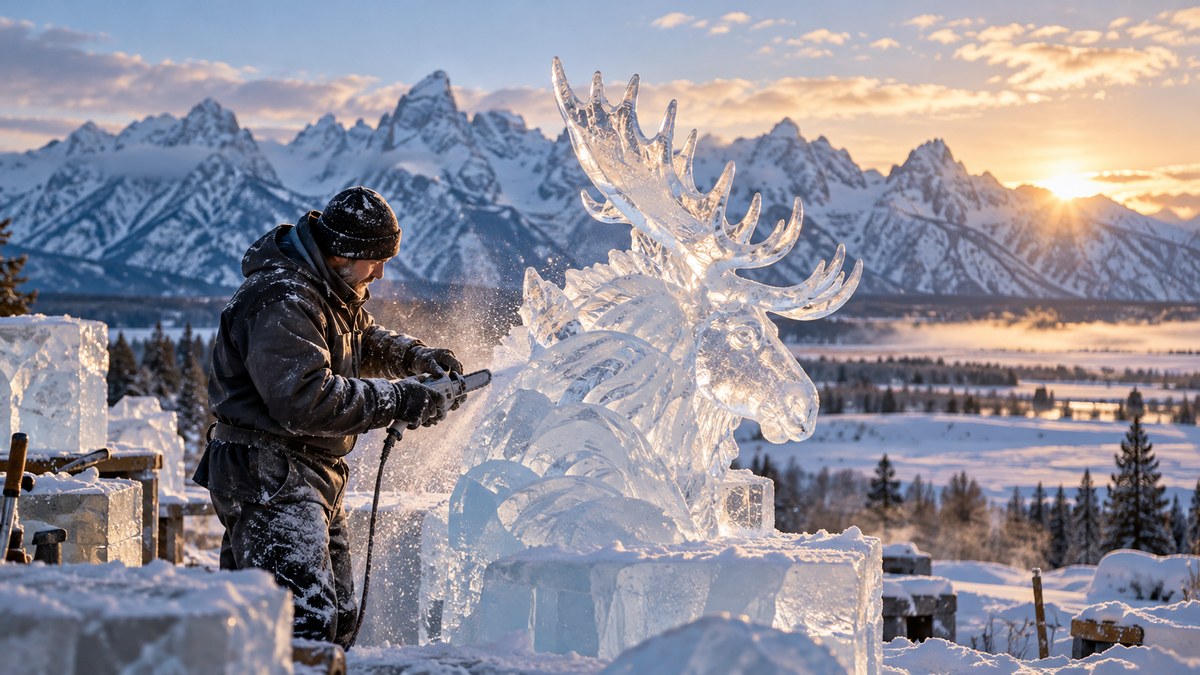
The parking lot behind the old rodeo grounds looks like any other frozen patch of asphalt in January. Cars huddle under a crust of frost. The wind cuts straight through a down jacket. But if you follow the low hum of a chainsaw and the occasional burst of laughter, you will find a small group of people standing around a two-hundred-pound block of ice. They are not trying to get warm. They are waiting for their turn to carve.
Jackson Hole ice carvers are a rare breed. They do not fight the cold. They use it. While most of us run inside when the thermometer drops below zero, these artists head out to their makeshift studios. They turn a brutal Wyoming winter into something fragile and beautiful. This is the quiet art of winter, and it happens right here in the shadow of the Tetons.
Jackson Hole ice carvers harness sub-zero temperatures to create stunning sculptures that last only as long as the cold holds. Their craft demands patience, precision, and a deep respect for the elements. Whether you are a winter traveler or an art lover, watching them work offers a rare glimpse into a tradition that defines our valley’s creative spirit.
Why the Cold Matters More Than the Talent
You might think ice carving is all about artistic skill. It is not. The real teacher here is the weather. Jackson Hole ice carvers will tell you that a warm winter is their worst enemy. The best ice comes from a specific recipe: clear, hard, and free of bubbles. That kind of ice only forms when the temperature stays below twenty degrees Fahrenheit for several days straight.
Locals call it “blue ice” because of the deep color it takes on when the light hits it just right. Commercial ice blocks from a freezer do not behave the same way. They crack under pressure. They melt too fast. They lack the crystalline structure that holds a delicate wing or a horse’s mane in place.
That is why the best work happens outside, in the open air, often at night. One carver told me that his favorite conditions are ten below zero with no wind. “The ice feels like stone,” he said. “You can take your time. You can trust it.”
The Tools of the Trade
A Jackson Hole ice carver does not walk into a studio and pick up a paintbrush. The tool kit is loud, sharp, and dangerous. Here is what you will find in their truck bed:
- A chainsaw with a specialized bar for cutting curves
- Hand chisels in a dozen sizes
- A die grinder with diamond-coated discs
- Heat guns for welding pieces together
- Plastic tubs of water for “gluing” joints
- Sandpaper and rasps for smoothing
The chainsaw does the heavy lifting. It removes the bulk of the material in minutes. But the real work starts after that. A carver might spend four hours on a single detail, like the feathers on an eagle’s wing or the face of a bighorn sheep. One slip and the whole piece is ruined.
“You have to think three moves ahead. If you cut too deep, you cannot add the ice back. You have to start over or change the design completely.” – Local Jackson Hole ice carver with fifteen years of experience.
How a Block of Ice Becomes a Masterpiece
The process looks chaotic from the outside, but it follows a strict order. Jackson Hole ice carvers rely on a method that has not changed much in decades.
-
Select and transport the ice. The carver finds a source of clear, dense ice. This often comes from a local pond or a supplier who freezes it in layers. The block weighs between 200 and 400 pounds. Moving it requires a sled, a truck, and at least two strong backs.
-
Rough out the shape. Using a chainsaw, the carver cuts away the largest chunks. This stage is aggressive. The goal is to remove everything that does not look like the final subject. A horse starts as a block with a rough head and neck. A bear starts as a lump with a hint of shoulders.
-
Refine the details. Hand tools take over. The carver switches to chisels and grinders. This is where the sculpture comes to life. Eyes, fur, feathers, and muscle contours emerge slowly. The carver works from top to bottom, so that falling debris does not damage finished areas.
-
Weld and assemble. Large sculptures often require multiple blocks. The carver “glues” them together with water. A thin layer of water freezes instantly in the cold, bonding the pieces into one solid form. This technique allows for towering sculptures that stand ten feet or more.
-
Finish and protect. The final step is smoothing. The carver uses sandpaper and a heat gun to create a glass-like finish. A thin coat of water can be sprayed on to fill micro cracks. The sculpture is now ready for display.
Common Mistakes and How to Avoid Them
Even experienced carvers make errors. The cold plays tricks on your hands and your judgment. Here is a table of the most common mistakes and the fixes that local carvers use.
| Mistake | Why It Happens | How to Fix It |
|---|---|---|
| Ice cracks during carving | Temperature change or internal stress | Let the ice rest at outside temp for 24 hours before cutting |
| Details melt too fast | Warm hands or tools | Wear insulated gloves; cool chainsaw bar between cuts |
| Pieces do not bond | Water freezes too slowly | Use colder water; work in sub-20 degree temps |
| Sculpture topples over | Weight distribution is off | Add a wider base or use a hidden support rod |
| Surface looks cloudy | Too much heat from grinder | Use a finer grit and work slower |
Where to See Jackson Hole Ice Carvers in Action
You do not need a private invitation to watch this craft. The best place to see Jackson Hole ice carvers is at the annual Winterfest in Town Square. Every February, the square fills with blocks of ice and the sound of chainsaws. Carvers compete to create the most impressive piece in under eight hours. Spectators stand close enough to feel the spray of ice chips.
If you miss the festival, check the front of the National Museum of Wildlife Art. They often commission live carvings during the holiday season. The museum’s outdoor plaza provides a natural gallery for these temporary works.
Some local resorts also hire carvers for special events. A five-foot elk head might appear at a lodge entrance overnight. A frozen bar top might greet guests at a private party. These pieces are never advertised. You have to be in the right place at the right time.
What Makes a Great Ice Sculpture Last
The irony of ice carving is that the best work does not last. A great sculpture will survive a week if the weather stays cold. A warm afternoon or a sudden chinook wind can destroy it in hours. Carvers accept this. They do not see it as a loss. They see it as part of the deal.
One carver compared it to a sand mandala. “You spend days creating something perfect, and then it disappears. That is the point. It teaches you to let go.”
That attitude is what sets Jackson Hole ice carvers apart from other artists. They are not building for permanence. They are building for the moment. They carve because they love the process, not the product.
The Culture Behind the Craft
This is not a hobby you can pick up in a weekend. Most Jackson Hole ice carvers learned from a parent or a mentor. The skills are passed down like a family recipe. The community is small. Everyone knows everyone. If you show up to a carving event with a dull chainsaw, someone will hand you a sharp one without saying a word.
The culture is also deeply tied to the valley’s identity. Winter here is not a season to endure. It is a season to use. The same cold that keeps tourists indoors is the raw material for art. That is a very Jackson Hole way of thinking. It is the same mindset that drives people to ski in a blizzard or walk to work in negative temperatures.
For a deeper look at how locals embrace the winter lifestyle, read our story about why Jackson Hole locals start their day before sunrise. It captures the same spirit of making the cold work for you.
How to Start Carving Ice Yourself
If this article has inspired you to try, start small. You do not need a chainsaw or a two-hundred-pound block. You need a block of clear ice from the grocery store, a sharp knife, and a cold garage.
Here are a few tips for beginners:
- Wear waterproof gloves. Your hands will get wet, and wet hands freeze fast.
- Work from a reference photo. Do not guess the proportions.
- Cut away from your body. Ice chips are sharp.
- Accept that your first piece will look like a potato. That is normal.
- Keep the ice cold. If it starts to drip, put it back in the freezer for twenty minutes.
The local community is welcoming to newcomers. If you show up to a Winterfest carving event and ask questions, the carvers will talk to you. They love their craft and they love sharing it.
The Lasting Impression of a Temporary Art
There is a reason people stop and stare at an ice sculpture. It is not just the beauty. It is the knowledge that the beauty is borrowed. The sun will take it back. The wind will erode it. The night will soften its edges. By morning, the elk head might be a shapeless lump. By the weekend, it will be a puddle on the pavement.
That fragility is what makes it powerful. Jackson Hole ice carvers understand this better than anyone. They do not fight the impermanence. They lean into it. They carve knowing that the clock is already ticking.
Next time you see a frozen sculpture in Town Square or outside a lodge, stop for a moment. Look at the way the light bends through the ice. Notice the tool marks. Think about the person who stood in the cold for hours to make it. Then watch it melt. That cycle is the whole point.
If you want to experience more of the valley’s creative spirit, check out our piece on how Jackson Hole’s public art trail connects community and creativity. It is a perfect follow-up to understanding how art lives and breathes in this valley.
Winter’s Quiet Collaboration
The relationship between a carver and the cold is not a battle. It is a partnership. The cold provides the canvas. The carver provides the vision. Together, they create something that neither could produce alone.
That is the real story of Jackson Hole ice carvers. They are not fighting the elements. They are working with them. And in a place where winter lasts half the year, that is the only way to make art that matters.
So the next time the temperature drops and the wind picks up, do not just hibernate. Go outside. Find a block of ice. Watch someone carve. You might learn something about patience, impermanence, and the strange beauty of a Wyoming winter.