
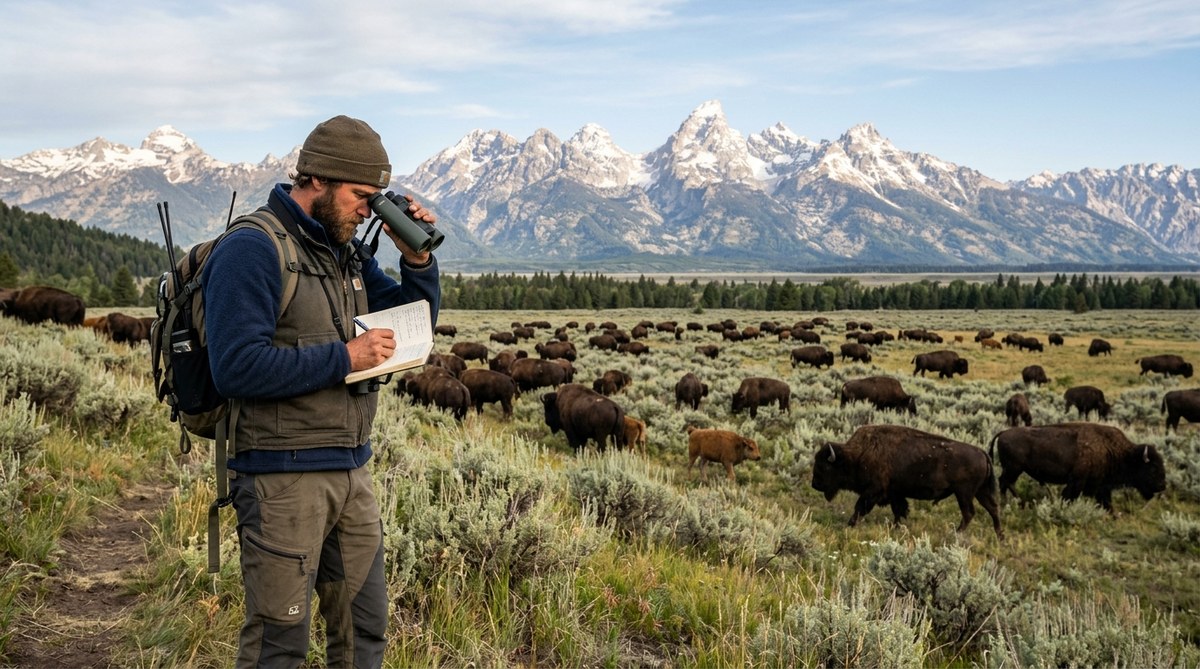
The first time I drove out to the Antelope Flats with him, I thought he was showing off. He pointed to a bison half a mile off and said, “That’s Clara. She’s the one with the notch in her left horn, and she’s been hanging around the edges of the herd since she lost her calf two winters ago.” I squinted. I saw a brown blur. He saw a biography. That’s the moment I understood what it means to be a real Teton bison tracker — not just someone who watches animals, but someone who lives with them, remembers them, and gives them names.
A 30-year-old Teton bison tracker can name every animal in his herd by combining daily observation, natural landmark memory, and a deep understanding of bison family lines. He uses ear notches, horn shapes, and seasonal behavior patterns instead of GPS tags. His method proves that patient, on-the-ground tracking still beats technology for reading wild herds in Grand Teton country.
The Man Behind the Names
Jake Molina is thirty years old. He’s been tracking bison in the Teton region since he was nineteen. That’s eleven winters, eleven calving seasons, and thousands of miles on foot and horseback. He works for a private ranch that borders Grand Teton National Park, but his real job is simpler: he keeps the herd healthy and he knows who they are.
Most people assume he uses ear tags or radio collars. He doesn’t. “The only tag I use is the one in my head,” he told me one morning while we watched a bull scratch against a fence post. “Bison have personalities. They have grudges. They have favorite spots to graze. Once you see that, you don’t need a number.”
His memory isn’t a party trick. It’s a survival tool. When a bison goes missing or gets injured, Jake knows within hours because he notices who’s absent from the group. That kind of awareness can mean the difference between catching an illness early or losing an animal.
How He Learns Their Names
Jake follows a specific process when a new calf is born. He doesn’t rush to name it. He watches first.
- Observe the mother’s behavior. The calf inherits the mother’s territory and social rank. Jake notes who the mother associates with and who she avoids.
- Identify a unique physical marker. It might be a white patch on the shoulder, a crooked tail, or a specific way the animal holds its head while walking.
- Assign a name based on that marker. Names like “Chip,” “Dottie,” and “Hooks” come from visible features. Others, like “Sunny” for a calf born during a clear morning, come from circumstance.
- Repeat the name out loud every time he sees the animal. This locks the memory. He says the name three times in his head while looking at the bison.
- Test himself at a distance. He scans the herd and tries to name every animal he sees before he gets close enough to confirm.
“If I can name them from a quarter mile, I’ve got them,” he said.
What Makes a Good Tracker
Not everyone can do what Jake does. It takes a specific set of habits and attitudes. Here are the traits he says matter most:
- Patience. You can’t rush a bison. You can’t rush the learning either.
- A visual memory for shapes. Horns are like fingerprints. No two are identical.
- Willingness to be outside every day, in every weather condition.
- Humility. You will make mistakes. A bison you thought was one animal turns out to be another.
- A sense of humor. Jake names some animals after their bad attitudes. “Grumpy” is a real bison in his herd.
Techniques That Work (and Ones That Don’t)
I asked Jake to break down what actually helps and what wastes time. He gave me a clear list.
| Technique | Works? | Why |
|---|---|---|
| Memorizing horn shapes | Yes | Horns grow distinct curves and chips over time |
| Using ear notches | Yes | Natural tears and bites create permanent marks |
| GPS collars | Sometimes | Good for location, bad for personality |
| Naming by color alone | No | Too many bison look alike from a distance |
| Relying on photos | Partially | Photos help, but they don’t capture movement |
| Asking other trackers | Yes | Multiple eyes catch different details |
Jake’s rule: “If you can’t describe a bison to someone else without pointing, you don’t know them yet.”
Common Mistakes Beginners Make
When I first tried to track with Jake, I made every mistake in the book. He was patient, but he also laughed at me. Here are the errors he sees most often.
- Getting too close. Beginners want a good look. Bison are not dogs. They spook. Jake stays at least 200 yards away unless the animals are used to him.
- Forgetting the context. A bison that looks alone might be waiting for the rest of the herd. Jake watches for at least ten minutes before he decides what’s happening.
- Naming too fast. He waits until a calf is at least three months old. Early names based on newborn fluff often stop fitting after the first molt.
- Ignoring the elders. Older bison teach the younger ones where to graze and when to move. If you don’t know the matriarchs, you don’t know the herd.
- Assuming bison are dumb. “They remember people,” Jake said. “If you treat them badly once, they will avoid you for years.”
“The best tool I own is a notebook. I write down who ate where, who fought who, and which cow is favoring her right leg. That notebook is worth more than any GPS collar.” — Jake Molina
Why This Matters for Visitors
If you come to Jackson Hole hoping to see bison, you will. They’re everywhere — along the Moose-Wilson Road, in the sagebrush flats near the airport, and sometimes blocking traffic on Highway 89. But seeing them is different from understanding them.
A good tracker can show you the difference between a resting herd and a stressed one. He can point out which bull is about to challenge for dominance and which cow is about to give birth. That kind of knowledge turns a casual wildlife sighting into a real encounter.
If you want to try tracking yourself, Jake suggests starting with one animal. Pick a bison you see regularly — maybe one that grazes near your campsite — and give it a temporary name. Watch it for ten minutes every day. Note where it goes, who it stays near, and how it reacts to noise. After a week, you’ll know more about that single animal than most people learn in a year.
The Deeper Connection
Jake’s ability to name every bison isn’t just a skill. It’s a relationship. He talks about the herd the way other people talk about their neighbors. He knows who’s having a bad season, who’s raising a strong calf, and who’s getting old.
That kind of connection is rare. In a place like Jackson Hole, where the pace of life keeps speeding up, Jake slows down. He watches. He remembers. He names.
I asked him if he ever forgets a name. He laughed. “All the time. But the bison don’t care. They don’t know I named them. The names are for me. They’re my way of paying attention.”
How to Spot a Tracker in the Field
You might meet someone like Jake if you spend enough time in the Teton backcountry. Here’s how to recognize them:
- They carry binoculars but rarely use them. They trust their eyes first.
- They stand still for long periods. They don’t fidget.
- They talk to the animals. Quietly. Under their breath.
- They can tell you the history of a specific patch of grass.
- They smile when they see a calf they haven’t named yet.
What Tracking Teaches You
Tracking bison isn’t just about bison. It’s about paying attention to the world. Jake says the same skills apply to reading weather patterns, understanding river currents, and even navigating human relationships.
“You learn to see what’s actually there, not what you expect to see,” he said. “That changes everything.”
If you want to read more about the people who live this kind of life in Jackson Hole, check out the story of the last working cowboys of the Gros Ventre Valley. Or read about what happens to Jackson Hole’s wildlife when 3 million tourists show up. For a closer look at how local experts read the land, how to read weather in the Tetons when your life depends on it is a must-read.
The Art of Remembering
Jake doesn’t see himself as special. He sees himself as lucky. “I get to spend my days with animals that have been on this continent for thousands of years,” he said. “They don’t care about my problems. They just want to eat and rest and raise their young. That’s a good way to live.”
Next time you’re in the Tetons, pull over when you see a herd. Don’t just take a photo. Watch. Pick one bison and try to remember it. Give it a name. See if you can find it again the next day. You might not get to eleven years of tracking, but you’ll start to see what Jake sees. And that’s the first step toward knowing a place the way a local does.