
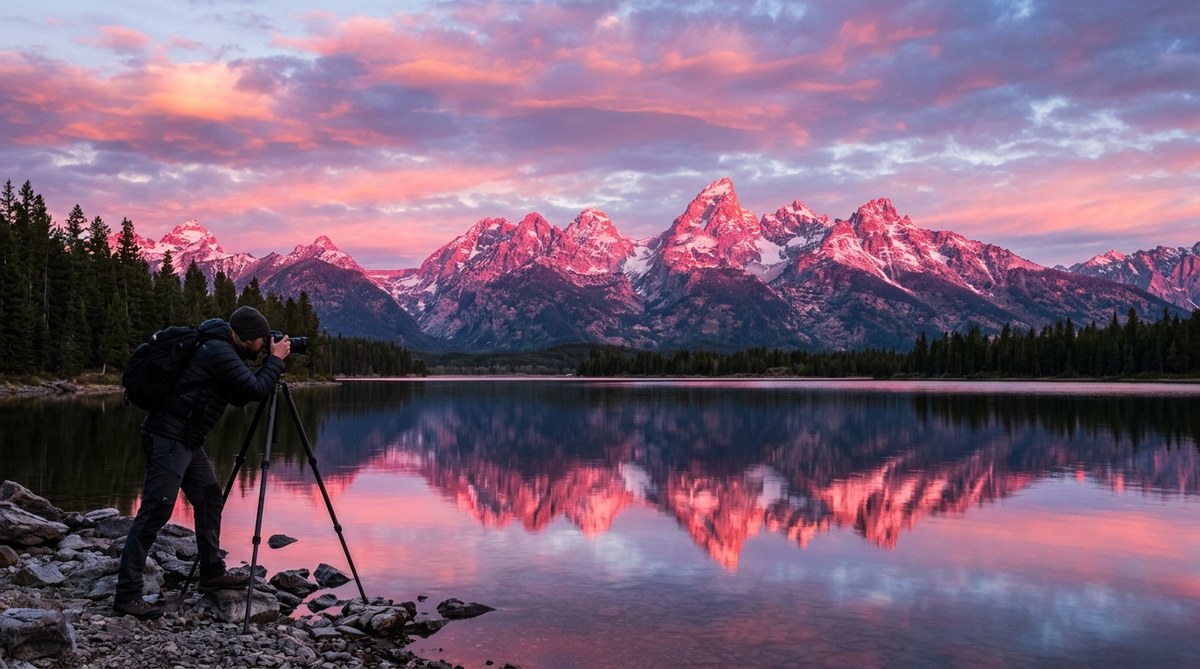
A few times a year, something strange happens in Jackson Hole. The sky does not turn its usual shades of orange and gold. Instead, the Tetons catch a deep, rosy glow that looks almost artificial. Locals call it the “pink moment.” Photographers call it the holy grail. And for good reason. When the mountains turn pink, the light feels less like physics and more like a secret the valley decided to share with you.
The pink sunrise over the Tetons is a rare combination of high cirrus clouds, cold temperatures, and a specific angle of the rising sun. It happens most often in late fall and early winter. To capture it, you need to be in position before dawn, use the right white balance, and know which locations give you the best view of the eastern horizon.
What Makes the Tetons Turn Pink
The science behind the pink light is simple, but the conditions are not. Sunlight passes through more of the atmosphere when it is low on the horizon. Shorter blue wavelengths scatter away, leaving longer red and orange wavelengths to color the clouds. For the Tetons to appear pink, you need a layer of high-altitude cirrus clouds to catch that light. If the sky is completely clear, you get a golden sunrise but no pink. If the clouds are too thick, the light never reaches the mountains.
The best months for Tetons pink sunrise photography are September through December. The air is dry, the sun rises later, and cold mornings create the crisp visibility you need. Spring and summer have their own beauty, but the pink glow is harder to catch because of haze and lower cloud ceilings.
Where to Stand for the Pink Light
Location matters as much as timing. You want a clear view of the eastern sky with the Tetons rising in the foreground. Here are the most reliable spots for catching the pink sunrise.
- Oxbow Bend – This is the classic spot for a reason. The Snake River reflects the mountains, and when the pink light hits, the reflection doubles the effect. Arrive early. The parking lot fills up fast.
- Schwabacher Landing – A longer drive down a dirt road, but the payoff is huge. The beaver ponds create multiple reflection points. You can shoot the Tetons from water level.
- Jenny Lake Overlook – A short walk from the parking area gives you a wide view of the entire Teton range. The pink light spreads evenly across the peaks here.
- Mormon Row – The historic barns make a strong foreground. The pink light on the mountains behind them creates a classic Wyoming image.
- Taggart Lake Trailhead – Less crowded than the others. You get a direct view of the Grand Teton, and the lake adds a mirror surface.
How to Predict a Pink Sunrise
You cannot just show up and hope. You need to read the sky the night before. Local photographers use a few reliable signs.
- Check the cloud forecast for high cirrus clouds. Look for a cloud cover between 20 and 40 percent. Too many clouds block the light. Too few and there is nothing to color.
- Look for cold temperatures. The best pink sunrises happen when the overnight low drops below freezing. Cold air holds less moisture, which means clearer skies.
- Watch the wind direction. A west wind often brings dry air from the mountains. An east wind can push moisture into the valley and ruin the visibility.
- Use a weather app that shows cloud layers. You want to see clouds at 20,000 feet or higher. Low clouds will block the view of the Tetons.
- Set your alarm for 90 minutes before sunrise. You need time to drive, set up, and wait. The pink light often appears 10 to 15 minutes before the sun crests the horizon.
Camera Settings for the Pink Glow
Getting the right exposure is tricky. The pink light is subtle, and your camera might try to correct it into something neutral. Here is a table of settings that work well for Tetons pink sunrise photography.
| Setting | Recommended Value | Why It Works |
|---|---|---|
| White Balance | 5500K to 6500K | Keeps the pink tones warm without making them look orange |
| Aperture | f/8 to f/11 | Gives you sharp focus from foreground to mountain peaks |
| Shutter Speed | 1/2 second to 2 seconds | Smooths water reflections and captures the soft light |
| ISO | 100 to 400 | Keeps noise low while allowing a slower shutter |
| Exposure Compensation | -0.7 to -1.0 EV | Prevents the highlights from blowing out on the snow |
A common mistake is to let the camera set the white balance automatically. Auto white balance often removes the pink cast because it thinks the image is too warm. Set it manually to preserve the color.
Common Mistakes and How to Avoid Them
| Mistake | Why It Hurts Your Shot | How to Fix It |
|---|---|---|
| Arriving too late | The pink light lasts only 10 to 15 minutes | Be in position 45 minutes before sunrise |
| Using auto white balance | Camera removes the pink tones | Set white balance to 6000K or use a custom preset |
| Overexposing the sky | Pink light looks washed out | Bracket your exposures and underexpose by 1 stop |
| Ignoring the foreground | Mountains look small without a reference | Include water, trees, or barns in the frame |
| Not checking the forecast | You waste a morning on cloudy or clear skies | Use a cloud layer app the night before |
“The pink sunrise is not something you can force. You have to respect the weather and show up even when you are tired. I have shot 40 mornings in a row to get one good frame. That is the deal you make with this valley.” – Local photographer who has been shooting the Tetons for 15 years
When to Give Up and When to Wait
Not every cold morning produces pink light. Sometimes you stand in the dark for an hour and the sun rises gray. That is part of the process. The photographers who get the best shots are the ones who treat every morning as practice.
If the sky is completely clear at dawn, pack up and try again another day. If there is a thin layer of high clouds, stay. The pink light often appears after you have already decided nothing is happening. Give it until 10 minutes after the official sunrise time. If the mountains are still gray, the conditions are not right.
Building a Portfolio Around the Pink Light
Once you have a strong pink sunrise image, you can build a series around it. Think about different seasons, different foregrounds, and different weather conditions. A pink sunrise in November looks different from one in March. The snow line is lower in winter, and the light hits the peaks at a different angle.
You can also pair your Tetons pink sunrise photography with other local stories. The valley has a deep culture of people who wake up early and pay attention to the world around them. That same discipline shows up in the work of local artists, the habits of the working cowboys of the Gros Ventre Valley, and the routines of the woman who has photographed every sunrise over the Tetons for 15 years. You are not just chasing light. You are joining a tradition of people who pay attention.
The Gear You Actually Need
You do not need the most expensive camera to capture the pink glow. What matters more is a sturdy tripod and a lens that lets you shoot at a medium aperture. A wide-angle lens between 16mm and 24mm is ideal for capturing the full mountain range. A telephoto lens between 70mm and 200mm works well for compressing the peaks and isolating a single mountain.
Bring extra batteries. Cold weather drains them fast. Keep your spare battery in an inside pocket close to your body. A remote shutter release helps you avoid camera shake during those longer exposures.
A Final Word on the Pink Sunrise
The pink sunrise over the Tetons is not a secret. It is a reward for people who wake up early, read the weather, and drive out into the dark. You will miss more mornings than you hit. But the mornings you do hit will stay with you. The light does not last long. That is what makes it valuable.
So set your alarm. Check the clouds. Drive out to your spot. And when the mountains start to glow, you will know exactly why you came.
Your Next Step
Pick one of the five locations listed above and commit to shooting there three mornings this month. Use the forecast tips to choose your days. Bring a thermos of coffee and a patient attitude. The pink light will come eventually. When it does, you will have the shot you came for.