
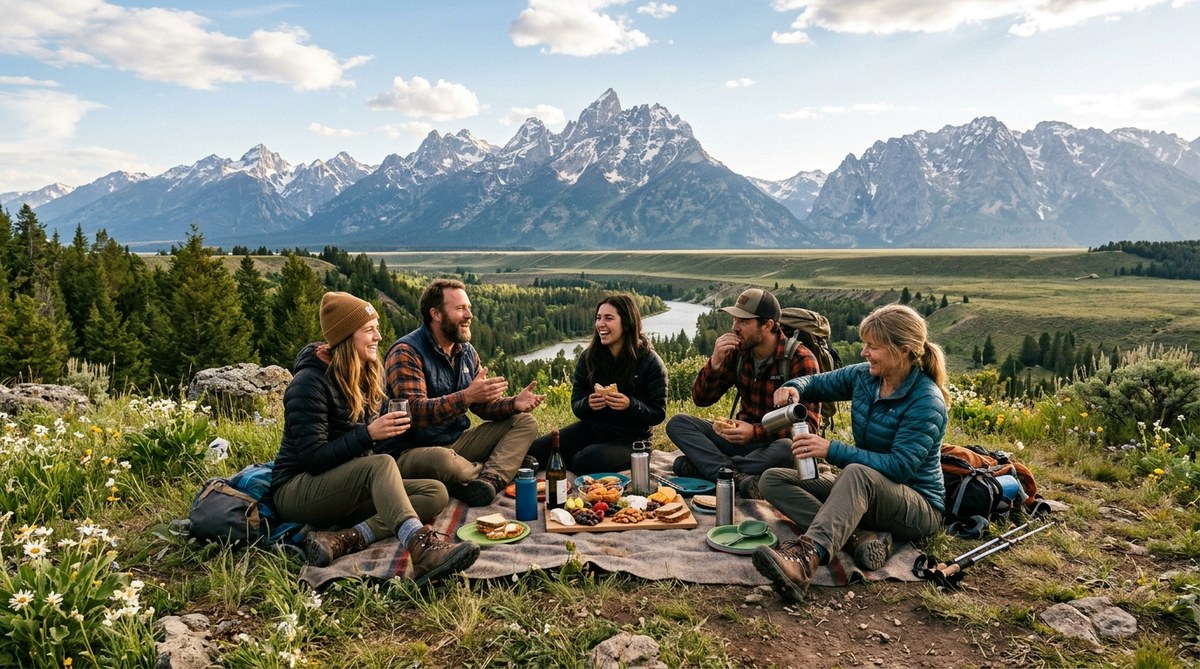
The Tetons rise like a wall of granite and snow, and every summer morning, visitors line up at the same crowded pullouts with their camp chairs and deli sandwiches. They eat with their backs to the mountains, staring at a parking lot. Meanwhile, a handful of locals pack their panniers and hike past the “No Stopping” signs, heading toward places that don’t appear on any souvenir map. These are the real Jackson Hole backcountry picnic spots.
The best Jackson Hole backcountry picnic spots require a short hike, a willingness to leave the main road, and a bear canister. Locals guard these places like family secrets. This guide shares five of them, with directions, timing tips, and the unwritten rules of backcountry dining in the Tetons.
What Makes a Good Backcountry Picnic Spot
A true backcountry picnic spot is not just about the view. It is about the journey, the quiet, and the absence of other people. The locals featured in this piece agreed on a few criteria when we asked them to share their favorites.
- The spot must be reachable within 45 minutes from a trailhead.
- It must have natural seating (logs, rocks, dry grass).
- Water access is a bonus but not required.
- The location must be outside a national park boundary to avoid permit headaches.
- Most importantly, it must feel like a secret.
These are not the places you will find on a trail app with hundreds of check-ins. These are the spots where the only sound is the wind moving through lodgepole pines and the occasional splash of a cutthroat trout rising for a mayfly.
Spot One: The Granite Bench Above Moose Creek
Megan R., a backcountry guide who has lived in Jackson for twelve years, shared this one with a caveat. “Do not post the coordinates,” she said. “Just tell people to park at the Moose Creek pullout on the Moose Wilson Road and walk upstream until they see the big slab of granite.”
The hike is less than two miles, mostly flat, following the creek through a corridor of old-growth spruce. You will cross the creek twice. Wear shoes that can get wet. The granite bench appears on the left bank, tilted slightly toward the sun, with a view of the south face of Teewinot. It is warm by mid-afternoon, even in September.
Megan’s tip: pack a thermos of soup in October. The bench holds heat, and you can sit there until the alpenglow fades.
Spot Two: The Aspen Grove on the Red Hills Trail
This one came from Tom H., a retired geologist who has been mapping Teton backcountry trails for thirty years. The Red Hills Trail starts near the base of Teton Pass and climbs gently through a burn scar from 2015. Most people turn around when they hit the charred trees. Keep going.
After about 1.5 miles, the trail enters a stand of mature aspens. In late September, the ground is carpeted with yellow leaves. There is a flat area big enough for a blanket, with a fallen log that faces the opening. You can see the entire Jackson Valley from here, but the trail is so quiet on weekdays that you might see a moose cow and calf moving through the understory.
Tom’s rule: “If you see another person, wave once and then go back to your sandwich. This is not a social trail.”
Spot Three: The River Bend on the Upper Snake
Local fly fishing guide Samira K. spends her summers on the Snake River. She knows every bend, every gravel bar, and every place where the water slows enough to wade. Her favorite picnic spot is a gravel bar about a quarter mile upstream from the Highway 22 bridge, on the west bank.
There is no trail. You park on the shoulder, scramble down a steep bank, and walk along the water until you find the bend. The gravel bar is wide, flat, and covered in smooth stones. You can sit with your feet in the water while you eat. The current is slow here, and the trout are visible in the shallows.
Samira’s advice: “Bring a small fishing rod. Even if you do not catch anything, casting into that pool is meditation. And if you do catch a trout, you have the freshest sashimi in the valley.”
Spot Four: The Hidden Meadow Above the Elk Ranch Flats
This spot is a bit more work. It requires a 3.5 mile hike with 800 feet of elevation gain. The trailhead is at the end of the Elk Ranch Flats road, which is dirt and can be muddy in June. The meadow is not marked on any map.
You will know you are close when the trail opens into a clearing ringed by whitebark pines. The grass is deep, and in July it is dotted with blue lupine and red paintbrush. There is a single rock outcrop at the edge of the meadow that provides a panoramic view of the entire Teton Range. This is the place to watch the sunset.
The local who shared this spot, a woman named Eliza who works at the National Museum of Wildlife Art, said she has been coming here for eight years and has never seen another person. “It is my church,” she said. “I bring a book, a bottle of wine, and a hard cheese. I stay until the stars come out.”
Spot Five: The Cottonwood Grove at the Old Channel
This one is almost impossible to find without a local. The Old Channel is a side channel of the Snake River that dried up decades ago, leaving a braided wash of sand and cobble. Cottonwoods have grown up in the old riverbed, creating a cathedral of green.
To get there, park at the end of the dirt road that runs behind the Jackson Hole Airport. Walk east through the sagebrush for about a mile. You will see the cottonwoods before you hear them. The leaves rustle like water. There is a sandy spot under the largest tree that is perfect for a picnic.
This spot was shared by a group of three local moms who built Jackson’s first community composting program. They use this grove for their monthly potluck. “We bring leftovers from the week,” one of them said. “It is a chance to eat outside and talk about things that are not kids and work.”
How to Plan Your Backcountry Picnic
A successful backcountry picnic in Jackson Hole requires more than just a good location. You need to prepare for weather, wildlife, and the possibility that you will want to stay longer than planned.
- Check the weather before you leave. Afternoon thunderstorms are common in July and August. If the forecast shows a chance of lightning, pick a spot with a short exit route. Do not picnic on exposed ridges.
- Pack a bear canister or a bear-proof bag. Food smells attract bears. Do not leave your pack unattended. Do not cook in your picnic spot if you can avoid it. Eat cold food to minimize odors.
- Bring more water than you think you need. The high altitude and dry air will dehydrate you faster than you expect. A rule of thumb is one liter per hour of hiking.
- Carry a small trash bag. Leave no trace. Pack out everything, including apple cores and orange peels. They do not decompose quickly at this elevation.
- Tell someone where you are going. Cell service is spotty in the backcountry. Leave a note with your route and expected return time.
Common Mistakes and How to Avoid Them
Even experienced locals make mistakes. Here is a table of the most common errors and how to fix them.
| Mistake | Why It Happens | How to Avoid It |
|---|---|---|
| Choosing a spot with no wind cover | Valley winds pick up after noon. | Pick a spot with trees or a rock wall on the west side. |
| Sitting on wet ground | Snowmelt lingers in shaded areas until July. | Bring a sit pad or a piece of closed-cell foam. |
| Forgetting sunscreen | UV is stronger at altitude. | Apply SPF 50 before you start hiking. Reapply after eating. |
| Eating too close to the trail | Other hikers will walk through your spot. | Walk at least 50 feet off the main trail. |
| Not checking for dead trees | Wind can drop branches without warning. | Look up before you sit. Avoid standing dead trees. |
“The biggest mistake people make is treating a backcountry picnic like a tailgate. You are not in a parking lot. You are in a living ecosystem. Act like a guest, not a conqueror.” — Samira K., Snake River guide
Timing Your Picnic for Maximum Solitude
The Jackson Hole backcountry picnic spots listed here are most peaceful during specific windows. July and August weekends are busy everywhere, but you can still find solitude if you time it right.
The best window is a Tuesday or Wednesday in late August. The summer crowds have thinned, the weather is stable, and the light is golden by late afternoon. Aim to arrive at your spot by 2:00 PM. You will have two hours of warm sun, then an hour of soft light, then a slow walk out as the shadows lengthen.
If you are going in June, bring bug spray. The mosquitoes are thick near water until the heat of July dries them out. If you are going in September, bring a warm layer. The temperature drops fast once the sun goes behind the Tetons.
Why These Spots Matter to the Community
These picnic spots are not just scenic locations. They are part of the fabric of Jackson Hole. They are where locals go to remember why they live here, despite the high cost of housing and the summer traffic.
The act of sharing these places is a form of trust. When a local tells you about their secret meadow, they are inviting you into their relationship with the land. That invitation comes with responsibility. Do not post the exact location on social media. Do not leave trash. Do not play music. The goal is to pass through without leaving a mark.
If you want to understand the real Jackson Hole, the one that exists beyond the town square and the resort, spend an afternoon in one of these spots. Eat a simple meal. Watch the light change. Listen to the silence.
For more stories about the people who call this valley home, read about the last working cowboys of the Gros Ventre Valley or why a former Wall Street trader now guides fly fishing trips on the Snake River. These are the voices that make Jackson Hole more than a postcard.
Pack Your Bag and Go
You do not need a guide or a permit to visit these Jackson Hole backcountry picnic spots. You need a pair of sturdy shoes, a sense of adventure, and the willingness to walk a little farther than everyone else. The reward is a meal that tastes better than anything you could order in a restaurant, eaten in a place that feels like it belongs to you alone.
Pick one spot from this list. Go on a weekday. Leave your phone in the car. Bring a friend or go alone. Sit still for twenty minutes after you finish eating. See what happens. That is the secret that no map can show you.