
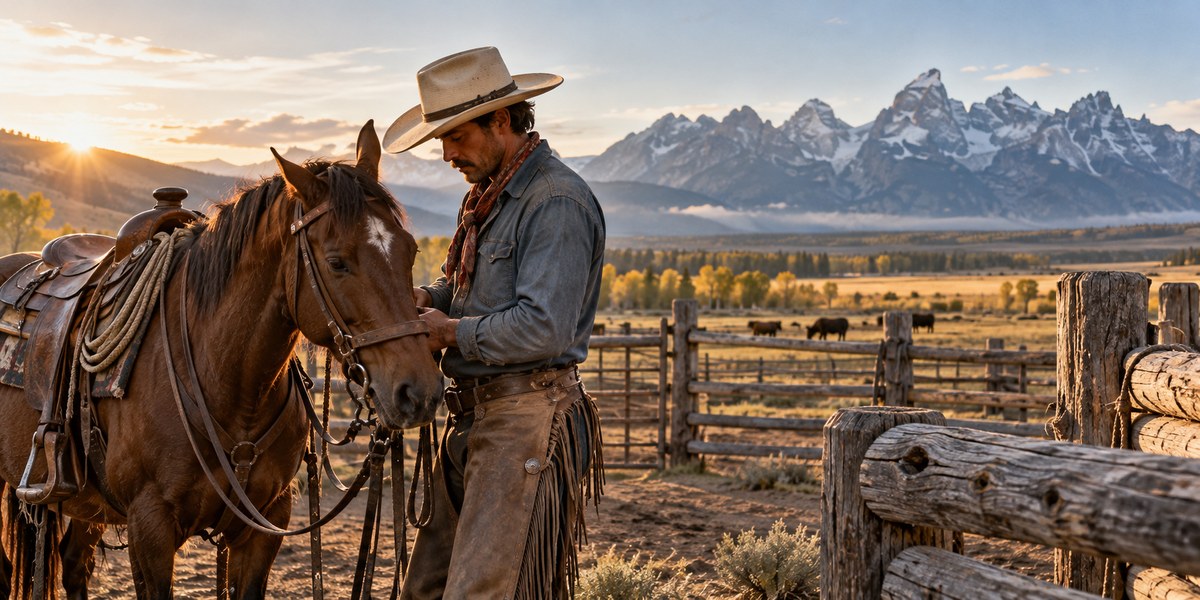
The first time I saw him work a cow out of a boggy draw on the far side of the Gros Ventre Valley, I understood what it means to inherit a landscape. He did not shout. He did not chase. He just sat his horse with a patience that seemed older than the Tetons themselves, and the cow came out. That kind of knowing cannot be taught in a book. It is passed down through hands and bones and long winter nights in a saddle shed.
A fourth-generation rancher in Jackson Hole is doing more than running cattle. He is keeping a vaquero tradition alive that stretches back to the Spanish colonial horsemen of the Southwest. Through rotational grazing, community education, and a stubborn refusal to sell out to developers, this family ranch shows how Western heritage can survive in a luxury mountain town. His story is a blueprint for preserving working landscapes in the Tetons.
The Vaquero Roots That Run Deep
Most people picture a cowboy as a white hat and a John Wayne drawl. The real story is more complex and more interesting. The vaquero tradition came north from Mexico in the 1500s, carried by horsemen who developed the low-stress stockmanship techniques that modern ranchers still use. When you watch a fourth-generation rancher in Jackson Hole move cattle, you are watching a line of knowledge that goes back nearly five centuries.
This rancher’s great-grandfather arrived in the valley in the early 1900s. He brought a string of horses and a set of brass spurs that had been forged in Santa Fe. Those spurs hang on a peg in the tack room today, worn smooth by four generations of thumbs. The family has run cattle through the same high pastures ever since, through droughts, market crashes, and the steady creep of luxury homes up the alluvial fans.
What Makes a Fourth-Generation Rancher Different
A fourth-generation rancher does not just own land. He holds a memory. He knows where the spring seeps run in August. He knows which two-track will wash out in a thunderstorm. He knows the bloodlines of his cows the way a historian knows the lines of a dynasty.
Here is what sets this kind of rancher apart from a newcomer running a hobby herd:
- He reads the ground, not the forecast. He can smell a weather change before the radar shows it.
- He uses low-stress handling. No yelling, no dogs, no hot shots. His horse does the talking.
- He keeps a closed herd. He has not bought a replacement cow in 15 years. His genetics are his own.
- He thinks in decades, not seasons. A fence repair this year might not pay off until his grandkids run cattle.
“My grandfather told me, ‘The land is not yours. You are just the one who walks on it for a while.’ I try to hand it off in better shape than I found it. That is the only rule that matters.”
The fourth-generation rancher, sitting on his porch at sunset
The Daily Work of Preserving Vaquero Heritage
Preserving a working ranch in Jackson Hole in 2026 takes more than grit. It takes a system. Here is how this rancher organizes his year:
- Late May: Turn out to high country. The cattle move on horseback up the Gros Ventre drainage. This is a three-day push that covers 12 miles of public and private land.
- June through August: Rotational grazing. Cattle are moved every 4 to 7 days. This mimics the way bison used to move across the valley. It keeps the grass healthy and the streams clean.
- September: Wean and sort. Calves are separated from mothers. Replacement heifers are chosen. The rest go to market.
- October: Fall gathering. The big push back down to the home place. This is the work that tourists stop to photograph.
- November through March: Rest. The high country rests. The rancher fixes fence, mends gear, and plans for spring.
Mistakes That New Ranchers Make (And How This Family Avoids Them)
I have watched a lot of people buy a piece of land and call themselves ranchers. Most of them fail within five years. Here is a table that shows the difference between a weekend operation and a generational one.
| Mistake | Typical Newcomer Approach | Fourth-Generation Approach |
|---|---|---|
| Overgrazing pastures | Turn cattle out and leave them until the grass is gone | Move cattle frequently; rest each pasture 30+ days |
| Poor bull selection | Buy a cheap bull at auction | Keep closed herd; select for hardiness, not size |
| Ignoring water sources | Rely on one creek | Develop multiple springs and solar pump systems |
| Selling to developers | Cash out when land values rise | Use conservation easements to keep the ranch intact |
| Losing stockmanship skills | Use dogs and four-wheelers | Handle everything from horseback with patience |
Why Jackson Hole Needs This Rancher
This valley is changing. You can see it in the construction cranes and the traffic on Highway 22. But every time a ranch sells, we lose a piece of the culture that made Jackson Hole famous. The fourth-generation rancher is not just a character in a story. He is a living archive. He knows how to read a horse. He knows how to pull a calf in a blizzard. He knows how to fix a ditch with a shovel and a length of wire.
When you spend time with him, you start to see the valley differently. That meadow you drove past? It is not just scenery. It is a working landscape. Those cattle are not a photo op. They are part of a cycle that has kept the grass healthy for a hundred years.
If you want to understand the real Jackson Hole, you need to understand the people who still work the land. Read about the last working cowboys of the Gros Ventre Valley and how they are keeping the tradition alive. You might also enjoy the story of the ranch hand who became Jackson Hole’s most unexpected artist. It shows how the skills of a working cowboy translate into something beautiful.
How You Can Support Working Ranches
You do not have to own a ranch to help preserve this way of life. Here are practical steps anyone can take:
- Buy beef directly from a local ranch. It costs more, but every dollar stays in the valley.
- Volunteer for a brand inspection or a gather. Most ranches welcome extra hands during fall work.
- Donate to a conservation easement fund. Groups like the Jackson Hole Land Trust help keep ranches intact.
- Tell the story. Share articles like this one. Bring your friends to a cattle drive. Make sure the next generation knows what a working ranch looks like.
The Future of Vaquero Heritage in the Tetons
The fourth-generation rancher I spent time with has a son who is 22 years old. That son works construction in the winter and rides on the ranch in the summer. He is not sure if he can afford to stay. The math is brutal. Land in Teton County is worth millions. A cow-calf operation barely breaks even.
But the son is still here. He is still learning. He is still showing up at 5:00 AM to feed hay when the temperature is 20 below. That is how heritage survives. Not through grand gestures. Through the small, stubborn choice to keep doing the work.
If you want to see what that looks like in practice, check out the story of how a group of locals saved Jackson Hole’s historic dance hall. It is the same kind of grit applied to a different piece of our culture. And if you want to understand the full picture of life here, read what it really costs to live in Jackson Hole in 2026. It puts the rancher’s choices in context.
Keeping the Legacy Alive
The next time you drive through the Gros Ventre Valley, slow down. Look for the cattle moving across the bench. Listen for the creak of saddle leather. That sound is not nostalgia. It is the sound of a fourth-generation rancher in Jackson Hole doing what his family has done for a hundred years. He is preserving a tradition that connects us to the land, to the horses, and to the vaquero culture that shaped the American West.
You can be part of that story. Buy local beef. Show up for a gather. Tell your kids where their food comes from. The heritage will survive as long as we keep showing up.