
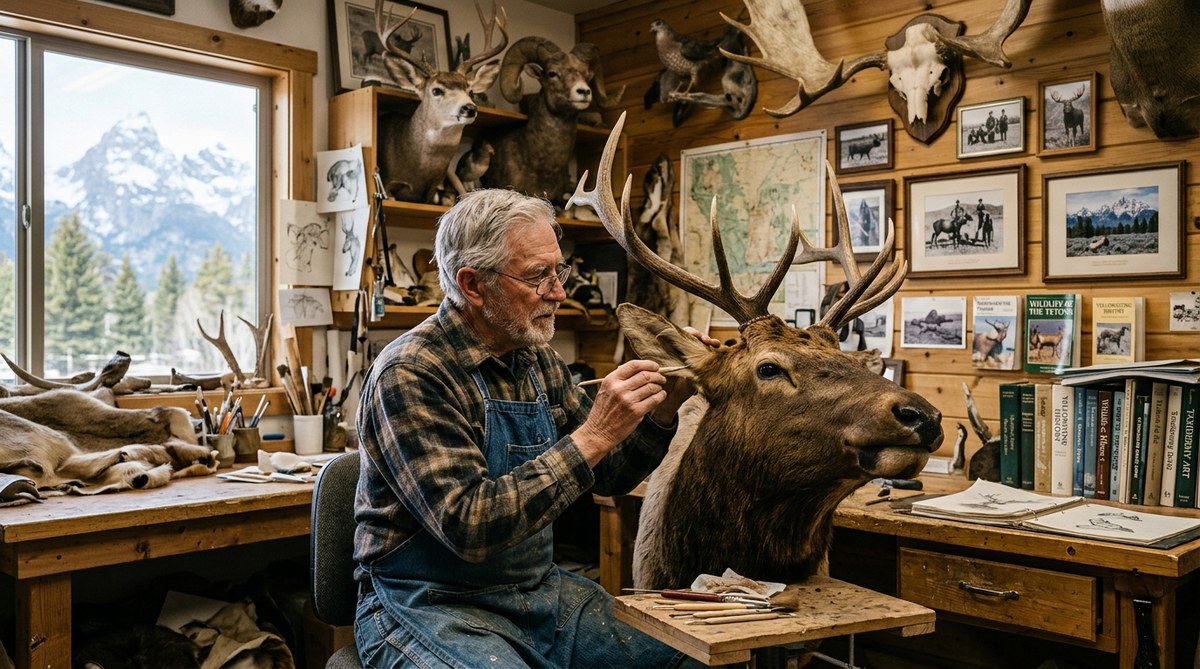
The scent of sawdust and borax hits you before the door swings open. Inside the modest workshop on the edge of Jackson, a man in a leather apron leans over a workbench, his hands steady as he stitches the hide of a young pronghorn. His name is Tom, and he has been doing this for forty years. But Tom does not just preserve animals for hunters. He preserves stories. Ask him about any mounted buck in the room, and he will tell you where it was born, what it ate that winter, and how the herd has changed since the 1980s. He has become the unofficial wildlife historian of Jackson Hole, a living archive of the valley’s changing ecosystem.
Tom’s workshop is more than a taxidermy studio. It is a record of wildlife patterns, migration shifts, and habitat loss. By examining his detailed notes and talking with him, you can learn how elk herds have moved, why certain species are disappearing, and what the future holds for Jackson Hole’s animals. His work connects past and present.
How a Local Craft Became a Historical Record
Most people think of taxidermy as a way to hang a trophy on the wall. In Jackson Hole, it has always meant something more. Ranchers brought in animals to remember a good season. Guides brought in specimens to study. Over time, Tom realized he was the only person in the valley who had seen every major ecological shift firsthand. He started keeping a log. Every animal that came through his door got a file. Species, date, location, weight, scars, stomach contents. After decades, that log became a map of the valley’s wildlife history.
Tom once showed me a file from 1987. It was a mule deer buck taken near the Gros Ventre River. The notes read: “Heavy winter coat, stomach full of bitterbrush, left ear torn from a fight.” He pulled out a file from 2022. Same area, same species. The stomach contained mostly sagebrush and cheatgrass. The bitterbrush was gone. That is the kind of detail you do not get from a government survey. You get it from a man who has held the animals in his hands.
The Three Steps to Becoming a Wildlife Historian
You do not need a degree in biology to start seeing the patterns Tom sees. You just need to pay attention. Here is how he built his knowledge, and how you can start noticing the changes in Jackson Hole’s wildlife yourself.
-
Keep a field journal. Tom writes down everything. Date, time, weather, animal behavior, what the animal ate, where it was found. Do the same on your hikes. Note which animals you see and where. Over a few years, you will see patterns emerge.
-
Talk to old timers. The people who have lived here for decades have memories no book can capture. Tom spends his lunch breaks talking to ranchers, guides, and biologists. They tell him about the years when the elk came down early, or when the wolves first returned. Every conversation adds a layer to the story.
-
Compare photographs and specimens. Tom keeps a collection of skulls, hides, and photographs dating back to the 1970s. He lines them up side by side to see how antler sizes have changed, how fur colors have shifted, and how body weights have fluctuated. You can do the same with your own photos. Compare a picture of the same meadow from 2016 and 2026. The difference might surprise you.
What Tom’s Files Reveal About Jackson Hole’s Wildlife
Tom’s logbooks contain more than forty years of data. They show clear trends that match what biologists are seeing across the Greater Yellowstone Ecosystem. Here is a snapshot of what he has recorded.
| Species | 1980s Observation | 2020s Observation | Likely Cause |
|---|---|---|---|
| Mule deer | Large herds wintering in valley bottoms | Smaller groups, higher elevation | Development and habitat fragmentation |
| Pronghorn | Consistent migration routes | Routes shifting eastward | Fencing and energy development |
| Moose | Common along willow creeks | Rare sightings | Willow loss and warmer winters |
| Elk | Heavy winter coats, deep fat reserves | Lighter coats, lower fat | Milder winters and less snowpack |
The table tells a story of adaptation. Animals are not disappearing. They are changing how they live. Tom says the biggest mistake people make is thinking wildlife is static. It is not. It is moving, adjusting, and sometimes struggling.
The Art of Reading a Mount
Tom can look at a taxidermy mount and tell you more than just the species. He can tell you the season it was taken, the health of the animal, and even the quality of the habitat that year. Here is what he looks for.
- Fur quality. A thick, glossy coat means the animal had good nutrition and a mild autumn. A thin, patchy coat signals stress or disease.
- Antler development. Wide, heavy antlers with many points suggest a mature buck with access to quality forage. Small, spindly antlers point to poor habitat or a young animal.
- Body fat. Tom checks the fat deposits around the kidneys and along the backbone. Fat is a sign of a good year. Lean animals tell him the winter was hard or the summer range was poor.
- Teeth wear. By looking at the molars, Tom can estimate the age of the animal. Old animals with worn teeth often struggled to chew tough forage in their final years.
These details are not just trivia. They are clues about the health of the entire ecosystem. When Tom sees a run of poor antler development over several years, he knows something is wrong with the habitat.
What the Experts Say
Tom does not claim to be a scientist. He is a craftsman who pays attention. But biologists have started to take notice. I asked a wildlife researcher from the University of Wyoming what she thought of Tom’s work. She said:
“People like Tom are invaluable. They have the long view that no grant-funded study can match. A three year study tells you what is happening now. A forty year logbook tells you what is changing. We need both.”
That is the heart of it. The Jackson Hole taxidermist historian is not competing with science. He is filling in the gaps. He sees the animals that die from causes no one reports. He talks to the hunters and ranchers who are on the land every day. His workshop is a museum of the valley’s hidden history.
How You Can See the Valley Through His Eyes
You do not need to become a taxidermist to understand the changes happening in Jackson Hole. You just need to slow down. Next time you see a deer crossing the road, do not just glance. Look at its coat. Look at its antlers. Ask yourself if it looks healthy. Compare it to the last deer you saw.
Tom suggests keeping a simple notebook. Write down the date, the location, and one observation about each animal you see. After a year, you will start to notice patterns. After five years, you will have a record that is uniquely yours. It is the same method he has used for decades, and it works.
If you want to see Tom’s work in person, you can visit his shop. He is happy to show you his files and explain what he has learned. He will tell you about the elk that came down from the mountains two weeks early in 1998, and the moose that wandered into town in 2015. Each story is a piece of the puzzle.
The Legacy of One Man’s Obsession
Tom is in his late sixties now. He does not know how many more years he will be able to work. But he has started training a younger taxidermist to keep the logbooks going. He is also working with a local historian to digitize his records. The hope is that the data will be available to researchers long after he is gone.
This is the kind of story that makes Jackson Hole special. It is not just about the mountains or the skiing. It is about the people who have paid attention for decades. People like Tom, who saw that a taxidermy shop could be more than a place to mount a head. It could be a library of the natural world.
The Hidden Value of Local Knowledge
We live in a time of satellites and drones and camera traps. But none of that replaces a person who has watched the same valley for forty years. Tom’s logbooks are a reminder that the best data often comes from the most unexpected places. A taxidermist. A rancher. A guide. The people who live with the animals every day.
Next time you visit Jackson Hole, take a moment to appreciate the wildlife. But also take a moment to appreciate the people who have been watching them all along. They are the ones who can tell you what has been lost, what has changed, and what might be coming next.
If you want to read more about the people who hold this valley together, check out our story on the last working cowboys of the Gros Ventre Valley. Or learn about what happens to Jackson Hole’s wildlife when 3 million tourists show up. These are the voices that keep the real story of Jackson Hole alive.
Tom will be in his workshop tomorrow morning, sharpening his knives and organizing his files. If you knock, he will probably let you in. Just be ready to listen. He has a lot to say.