
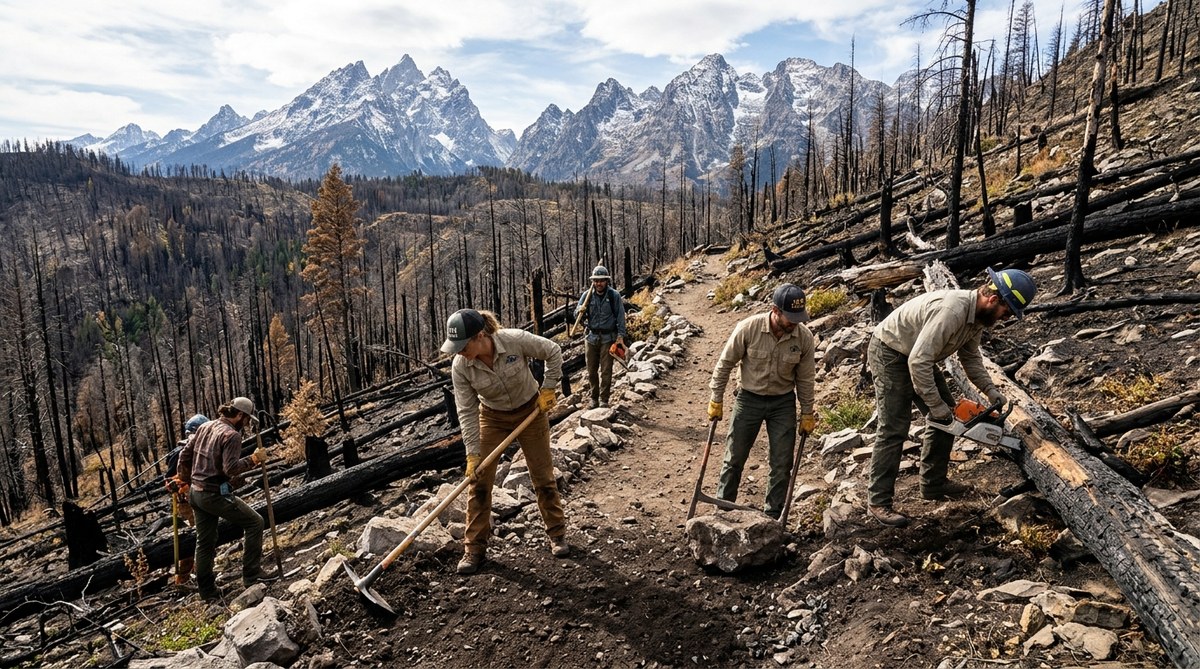
The first thing you notice after a big fire season in Jackson Hole is the quiet. Not the peaceful kind of quiet you come here for. It is the sound of a landscape holding its breath. The trails you hiked last summer might look different now. Some are gone entirely, buried under debris flows or marked by blackened snags. But here is the good news: the trail crews are already out there, working harder than you can imagine. They are not just fixing paths. They are reshaping how we move through the backcountry, and they are doing it with a level of care that will make you proud to call this place home.
Jackson Hole’s 2026 wildfire season burned over 40,000 acres of backcountry terrain, closing major trail networks in the Gros Ventre and Teton Wilderness. Trail crews are now using a mix of heavy machinery, hand tools, and bioengineering to restore access. This article covers exactly which trails are open, which are still closed, and how you can help with the recovery.
What the 2026 Wildfires Did to Our Trails
The 2026 fire season hit Jackson Hole hard. Two major fires, the Bull Creek Fire and the East Fork Complex, tore through drainages that hold some of our most beloved backcountry routes. The Bull Creek Fire alone burned more than 28,000 acres in the Gros Ventre range. That area includes the popular Red Hills trail system and several access points for the Bridger-Teton National Forest.
Hikers and backcountry skiers planning trips this fall and winter need to know what they are walking into. The fire did not just burn trees. It changed the soil structure, created new hazards like falling snags, and in some places, triggered mudslides that wiped out entire sections of trail. The team at the Jackson Hole Trail Crew has been documenting everything. They are using GPS mapping to track which sections are safe and which need major re-routing.
If you have been following the news, you know the smoke was bad. But the real work started after the flames died down. That is when the trail crews grabbed their tools and headed into the burn scars.
Who Is Doing the Work
This is not a government-only operation. The Jackson Hole backcountry trail restoration 2026 effort is a partnership between the Bridger-Teton National Forest, the Teton Conservation District, and local nonprofit groups like the Jackson Hole Trail Crew and the Friends of the Pathways. They have brought in professional trail builders from as far as Montana and Colorado, but the backbone of the work is local.
Volunteers are showing up in numbers we have not seen in years. On a single Saturday in September, over 80 people showed up to help clear the Teton Pass trailhead. They hauled out debris, rebuilt check dams, and planted native grass seed. It was a reminder that this community knows how to pull together.
One of the crew leaders, a woman named Rosa who has been building trails in the Tetons for 15 years, told me something that stuck. She said, “We are not just rebuilding trails. We are rebuilding trust. People need to know that the backcountry is safe again.”
A Step-by-Step Look at the Restoration Process
So what actually happens when a trail crew moves into a burn area? Here is the process they follow, broken down into clear steps.
- Assessment and mapping. Crews walk every mile of trail with GPS units. They mark fallen trees, erosion spots, and unstable slopes. This data goes into a shared map that the public can access.
- Hazard removal. This is the dangerous part. Crews cut down standing dead trees that could fall on hikers. They remove rocks and debris that could slide. They also flag areas where the trail needs to be rerouted entirely.
- Drainage restoration. Fire makes soil repel water. When rain falls, it runs off fast, carving gullies into the trail. Crews build water bars and check dams to slow the flow and prevent further erosion.
- Trail tread reconstruction. This means rebuilding the actual surface you walk on. They use hand tools to shape the dirt, add gravel where needed, and compact the tread so it does not wash away.
- Revegetation. Native seeds and plants are put in along the edges. This holds the soil and brings back the habitat for wildlife.
Each step takes time. A single mile of trail can take a full crew a week to restore properly. But they are moving fast. As of late October 2026, over 60 miles of trail have been cleared and reopened.
Which Trails Are Open and Which Are Still Closed
If you are planning a trip, this is the information you need most. The situation changes week by week, but here is the current status as of November 2026.
- Open trails:
- Teton Pass trail system (most routes, except the upper Red Hills loop)
- Cache Creek (fully open, some minor reroutes)
- Fish Creek (open with caution for falling snags)
- South Park Loop (open, great for beginners)
- Closed trails:
- Red Hills Trail (all access points closed until spring 2027)
- North Fork of the Gros Ventre (closed due to unstable slopes)
- Highline Trail segment near Bull Creek (closed for reconstruction)
- Several unnamed routes in the Teton Wilderness (check with the ranger station)
The Bridger-Teton National Forest updates their trail status page every Friday. You can also call the Jackson Ranger District directly. Do not rely on old maps. The landscape has changed.
Trail Restoration Techniques: What Works and What Doesn’t
Not all trail repair is created equal. The crews in Jackson Hole are using methods that have been tested in other fire-prone regions, but they are adapting them to our specific terrain. Here is a breakdown of the most common techniques.
| Technique | Best Use | Common Mistake |
|---|---|---|
| Water bars (drainage dips) | Steep slopes with high runoff | Building them too shallow, causing them to overflow |
| Check dams (log or rock) | Gullies and erosion channels | Using green wood that rots within a year |
| Recontouring the tread | Flat sections where soil is compacted | Not adding enough organic matter back to the soil |
| Seeding with native grasses | All areas near the trail | Using non-native seed mixes that do not survive winter |
| Snag removal (cutting dead trees) | Within 50 feet of the trail | Leaving stumps too tall, creating trip hazards |
The biggest mistake crews see is rushing the drainage work. If you do not get the water off the trail, the next rainstorm will undo everything. That is why the Jackson Hole crews spend so much time on the small details.
What Backcountry Users Need to Know
If you are heading out this winter or planning a spring trip, here are the key things to keep in mind.
“The biggest danger after a fire is not the burn itself. It is the debris flows that come with the next storm. If you hear thunder above a burn scar, get to high ground immediately.” — Rosa M., Jackson Hole Trail Crew
The fire changed the way snow melts in these areas. South-facing slopes that used to hold snow all winter are now bare because the tree canopy is gone. That means earlier runoff and more exposed rocks. For backcountry skiers, this changes the avalanche risk. The snowpack is thinner in some places and deeper in others. Always check the Bridger-Teton Avalanche Center forecast before you go.
For hikers, the main concern is trail stability. Some sections that look solid are actually undercut by erosion. Stay on the marked path. Do not cut switchbacks. The soil is fragile right now.
How You Can Help with the Restoration
This is not just a spectator sport. If you live here or visit regularly, you can be part of the recovery. Here are the most effective ways to contribute.
- Volunteer with the Jackson Hole Trail Crew. They run work parties every Saturday through the fall and into early winter. No experience needed. They provide tools and training.
- Donate to the Teton Conservation District. They are funding the seed and plant purchases for revegetation. Even a small donation buys a lot of native grass seed.
- Report trail damage. If you see a new washout or a fallen tree across a trail, snap a photo and send it to the Jackson Ranger District. They rely on citizen reports to prioritize repairs.
- Follow the rules. Stay off closed trails. The closures are there for your safety and for the health of the landscape. Walking on a closed trail can undo weeks of work.
There is also a growing movement among local businesses to adopt a trail. Several outfitters and guide services have already signed up to maintain specific sections. If you own a business in Jackson Hole, consider joining them.
The Bigger Picture: Why This Work Matters for the Future
The 2026 fires were not an anomaly. Scientists are predicting that fire seasons in the Greater Yellowstone Ecosystem will get longer and more intense. The work these crews are doing now is not just about fixing this year’s damage. It is about building a trail network that can survive the next fire.
That means designing trails that are more resilient. Wider treads that do not erode as fast. Better drainage that handles heavy rain. Reroutes that avoid steep, south-facing slopes where fire risk is highest. It is a long-term investment in the backcountry we all love.
The Jackson Hole backcountry trail restoration 2026 effort is setting a standard for the rest of the country. Other mountain towns are watching how we do this. If we get it right, we will have a model that works for decades.
What the Winter Season Looks Like on the Ground
Winter 2026 is going to be different. Some of the classic backcountry ski lines are going to be harder to reach because the trailheads are closed. The North Fork of the Gros Ventre, a favorite for intermediate skiers, will not be accessible until at least next summer. But there are still plenty of options.
The Teton Pass area is mostly open, and the skiing there is excellent when the snow is deep. Cache Creek is a good alternative for shorter days. And if you are willing to hike a little farther, the southern end of the Teton Wilderness has some untouched terrain that sees very few people.
Just be prepared for more exposed rocks and logs than usual. Bring a pair of ski straps and some extra wax. And always tell someone where you are going. The cell service in the burn areas is spotty at best.
A Final Look at the Community Effort
There is something about watching a community rebuild that reminds you why you live here. The trail crews are out there in the cold, swinging Pulaskis and hauling rock. The volunteers are showing up with their kids and their dogs. The local coffee shops are handing out free drinks to anyone with a dirty shovel.
This is not a story about loss. It is a story about resilience. The trails will come back. The trees will grow again. And in the meantime, we get to be part of something real.
If you want to see the full scope of the work, check out the story of how the local search and rescue team is adapting to the new terrain. Or read about what the 2026 snowpack means for your summer paddling plans. Both pieces give you a deeper look at how this season is shaping everything we do.
The Trail Ahead
The ground is still healing. But every time a trail crew member sets a stone in place, every time a volunteer plants a seed, the backcountry gets a little stronger. The Jackson Hole backcountry trail restoration 2026 is not finished. It will not be finished for years. But the progress is real, and it is visible.
Next time you lace up your boots or click into your bindings, remember that someone worked hard to make that path safe for you. And if you can, grab a tool and join them. The trail crew will be happy to see you. The mountains will be, too.